Strange steel pattern - W2

BKT

Joined
Feb 15, 2016
Messages
167
I have a strange streaking in this W2 blade. Is this alloy banding? At first I thought it was due to poor hand sanding or something but the streaks follow the profile of the knife like they were forged in. They also follow the outline of the hamon to some degree. They are annoying me because they are making my hamon look messy.

BoCNRad.jpg
 
I get this occasionally on my batch of 1095 although the striations are smaller and was curious as to what caused it as well. I tend to think David is correct. I mean, I think it's some kind of banding but too harsh of an etch is what makes it visible.
 
You think i got to go back to the grinder or just start back at 220 hand sanding?
 
I was able to get past them with hand sanding but like I said mine weren't so prominent. I guess I would try that first unless you're better than I am on the grinder, I avoid going back to it like the plague once I'm happy with what I got off it because there's a better chance I'll dick something up than fix it :redface:
 
That looks like alloy banding or carbide segregation. I have a knife on the bench that looks just like that right now, in mystery steel that I think is something like 1090. I etch in white vinegar and lemon juice, so a really deep etch is unlikely.

http://www.bladeforums.com/forums/showthread.php/1402268-Alloy-banding-Carbide-segregation

I've seen it in Aldo's 1/4" batch of 1084 from a few years ago, the stuff that needed to be normalized and thermal cycled to harden.
 
I just got something very similar on a 1075 chefs knife I just did, it only showed up behind the hamon though, there was a definite pattern to it as well, I had no idea what it was. I etched in a 5:1 water to ferric solution for 30 seconds swaying back and forth gently, I don't have a whole lot of experience with hamons so I was very confused as to what it was.
 
That looks like alloy banding or carbide segregation. I have a knife on the bench that looks just like that right now, in mystery steel that I think is something like 1090. I etch in white vinegar and lemon juice, so a really deep etch is unlikely.

http://www.bladeforums.com/forums/showthread.php/1402268-Alloy-banding-Carbide-segregation

I've seen it in Aldo's 1/4" batch of 1084 from a few years ago, the stuff that needed to be normalized and thermal cycled to harden.

This looks exactly like what I have going on. With W2 also.

I normalized this blade several times. 1450, 1430, 1430, 1400, 1400. I follow that same normalization process with a test piece and got good grain. Is this banding a problem? I figured large carbides would have been apparent when looking at the grain.
 
This looks exactly like what I have going on. With W2 also.

I normalized this blade several times. 1450, 1430, 1430, 1400, 1400. I follow that same normalization process with a test piece and got good grain. Is this banding a problem? I figured large carbides would have been apparent when looking at the grain.

The banding isn't caused by large grain. It's caused by either alloys segregating at certain temps or quench temps, or carbides migrating into bands. This is bad for bearings, but no worse than a Damascus blade in a knife, as long as the steel doesn't have massive carbon depleted zones. Quenching from bainite is one way to get it to show up, from the article, or the last part of the smelt to cool, the top center if the steel, based on the segregation as it cools. There are a few ways to get this. I wonder if this last part to cool is the steel that doesn't harden properly from Aldo's stock, and the pieces that do harden have some banding. I don't get it in my W2, but have seen it in 3 steels in my shop.
 
I normalized this blade several times. 1450, 1430, 1430, 1400, 1400. I follow that same normalization process with a test piece and got good grain. Is this banding a problem? I figured large carbides would have been apparent when looking at the grain.

It's pretty common to see newer knifemakers here using the terms Normalizing and Thermal Cycling interchangeably, but they are indeed different. The regimen you just typed, as Willie already pointed out, would be thermal cycling, which is what refines the grain.

Normalizing is what is done just before thermal cycling (grain refinement) when you take the blade up above critical to around ~1600-1650 F then air cool in order to break up all of the carbides and distribute them evenly. The high heat also causes all the grain to "blow up" (grow) which also causes them to become the same size.. or something like that at least. ;) I like to think of it as making everything in the steel ready and "normal" (uniform) before beginning to refining the grain.

Then, Thermal cycling is when you start reducing your temps, usually around 50 F degrees for each heat and air cool (or quench sometimes) until you get to a bit below critical, around 1400 or 1350 F which as you know refines the grain.

I'm not trying to pretend like I know a lot about ferrous metallurgy, because I really don't lol. But I do know a few basic terms and what they basically mean, and that's about it. :cool:

Anyway, I actually think the streaks give a pretty cool look to your hamon, but I understand not wanting them. I'm curious, did you forge any of that blade to shape, or as least the tip area?

~Paul

My YT Channel Lsubslimed
... (It's been a few years since my last upload)

 
It's pretty common to see newer knifemakers here using the terms Normalizing and Thermal Cycling interchangeably, but they are indeed different. The regimen you just typed, as Willie already pointed out, would be thermal cycling, which is what refines the grain.

Normalizing is what is done just before thermal cycling (grain refinement) when you take the blade up above critical to around ~1600-1650 F then air cool in order to break up all of the carbides and distribute them evenly. The high heat also causes all the grain to "blow up" (grow) which also causes them to become the same size.. or something like that at least. ;) I like to think of it as making everything in the steel ready and "normal" (uniform) before beginning to refining the grain.

Then, Thermal cycling is when you start reducing your temps, usually around 50 F degrees for each heat and air cool (or quench sometimes) until you get to a bit below critical, around 1400 or 1350 F which as you know refines the grain.

I'm not trying to pretend like I know a lot about ferrous metallurgy, because I really don't lol. But I do know a few basic terms and what they basically mean, and that's about it. :cool:

Anyway, I actually think the streaks give a pretty cool look to your hamon, but I understand not wanting them. I'm curious, did you forge any of that blade to shape, or as least the tip area?

~Paul

My YT Channel Lsubslimed
... (It's been a few years since my last upload)
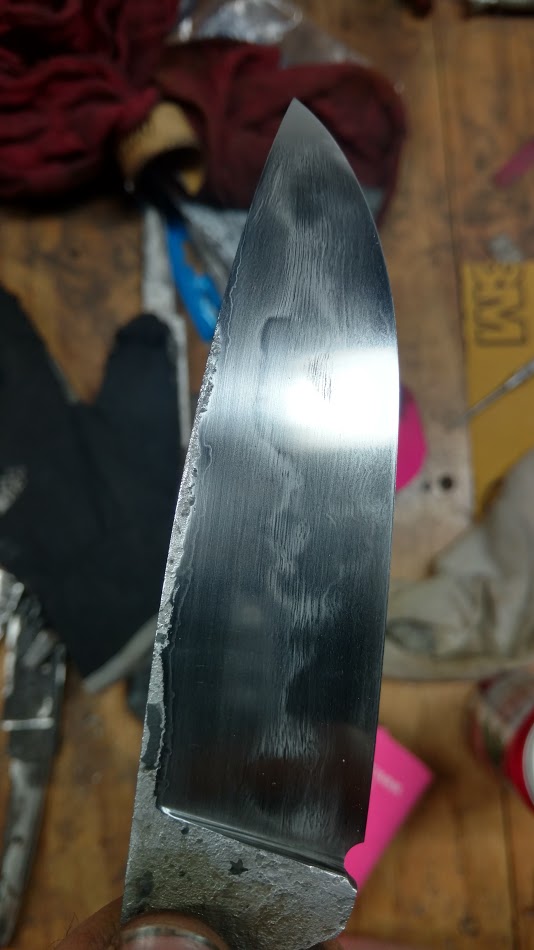
Yes the entire blade was forged.

If you are forging a blade, my last couple of heats are just to get everything straight, but are not necessarily moving any steel. I heat it up to critical and the blade naturally cools. Would this suffice for normalization?
 
You guys have accidentally discovered the deep, dark secrets of Techno-W***z. That Angel guy's platoon of lawyers will be contacting you shortly. :eek:;)
 
BKT, bringing the steel to critical and then air cooling is not normalizing, strictly speaking. Normalizing requires a heat around 100-200F above critical temp, and this will break up carbide networks. If you bring blade to critical temp, and then air cooled, that was a "thermal cycle", and will refine aus grain and stress relief, but will not "normalize" the steel, does not do much at all for carbide networks. And technically, any cycle involving heat would be a "thermal cycle", which "normalizing" is technically a "thermal cycle". But a "thermal cycle", for our use, is not "normalizing". If you forge a blade, it should always get a normalizing procedure around 1650F (to help even out the carbides/alloying at the expense of possible aus grain growth), followed by a few thermal cycles around critical temp (for aus grain refinement). 52100, W2, O1 usually 1650F is industry standard normalizing temps. 1095, 1084, 1600F is industry standard normalizing temps. More alloying requires a little more heat to normalize.
 
Well..... I'd pay for this kind of finis, whatever it is :) I'm curious whether you can get this on purpose?
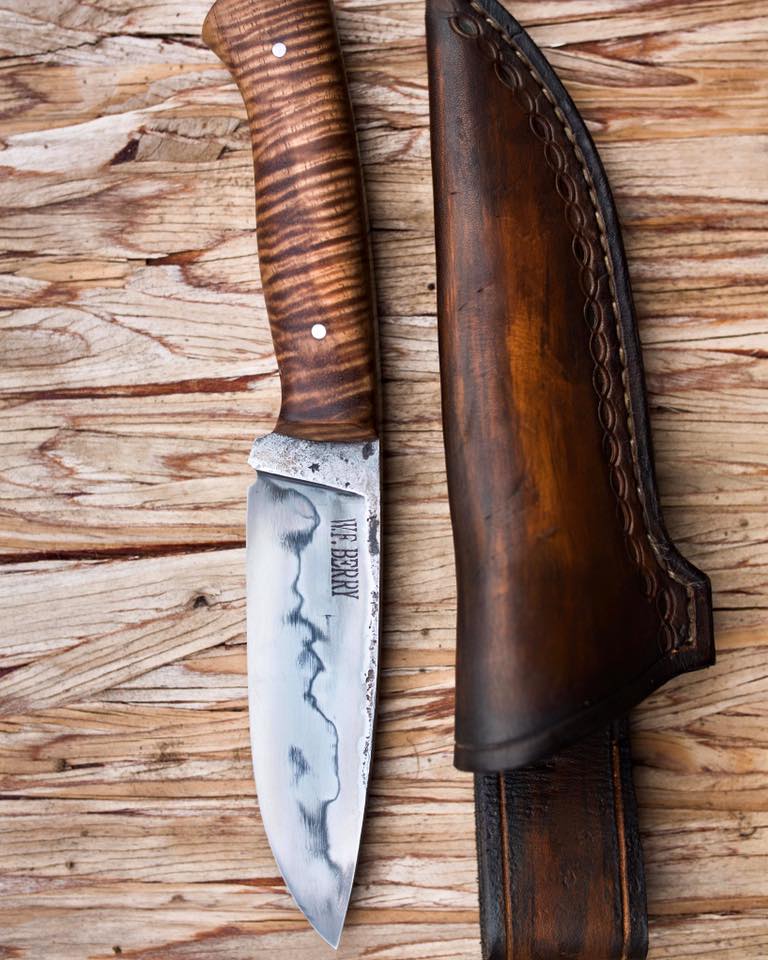
Quench from bainite, or buy steel that is segregated are the two easiest ways to do this. :D
 
Quench from bainite, or buy steel that is segregated are the two easiest ways to do this. :D

It's that easy :) Well , first I need to know how to get that bainite and what it is :thumbup: Just kidding but it looks beautiful .....
 
Otswald ripening it's what has happened, by low temperature cycling you promote carbides segregation, and it happens preferentially near the streaks of impurity (or alloy, like V) from drawing at the mill.
You have a very nice pattern there, the only thing i would do it is grinding/sanding a bit more since i think i'm seeing still some haze of decarburation in some spots.
 
Here is how it turned out. Still looks streaky and kind of dirty, but I am ok with it.

hZIFGTD.jpg
 
Back
Top