Strider doublespeak?

Joined
Feb 3, 2009
Messages
1,342
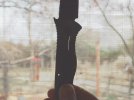
They say the contact point of tang and lockbar is intentionally not flush, making contact only at the very bottom of tang/lockbar so that crud can escape (and enter, by that rationale!). I have noticed this small point of contact on almost every production folder of theirs I've seen a picture of. But then I see on this exquisite piece of custom Strider goodness that the tang and lock are flush, making contact along the entire surface... like it logically should. I haven't looked at any other custom jobs to check on this. Can anybody explain?

And this ain't a Strider-bashing post. I very much like their knives and even own one.

Notes:
--I realize "doublespeak" is a bit of a misnomer, but I used it intentionally as doublespeak itself.;)
--many apologies if the use of someone else's (Vege-Taco) pic is frowned upon, but I didn't know how to link to just the pic and not the entire thread.


Image by Vege-Taco
 

Attachments

  • Strider.jpg
    Strider.jpg
    90.7 KB · Views: 274
How can you tell that the tang is flush with the lockbar? That picture certainly doesn't show that.

Of the four positions, it is clearly visible on the knife in open position, lock side up.

I just recently discovered that if you click on attached pics again once they've already been singled out, that it can be enlarged and made more clear. Sorry, crappy instructions/description, but you might have to do that--enlarge it--to be able to clearly see the lock-tang interface.
 
In a properly made liner lock, the full face of the lock face isn't supposed to make full contact with the blade tang.
 
I have only one liner lock, a military, and its contact area is flush. I can't imagine why you wouldn't want it to be flush. If the contact is basically a point or thin edge, it would be subject to faster wear.
 
according to Bob Terzuola in his book "the Tactical Folding Knife" the lockbar is supposed to contact the tang at the bottom.check out the explanation in the book
 
Of the four positions, it is clearly visible on the knife in open position, lock side up.

I just recently discovered that if you click on attached pics again once they've already been singled out, that it can be enlarged and made more clear. Sorry, crappy instructions/description, but you might have to do that--enlarge it--to be able to clearly see the lock-tang interface.

I did that before I posted, and still, it's not clear in the pictures.

To see what you're describing, you'd need to have the knife in-hand to visually inspect it. I'm guessing that it's not completely flush with the tang.

I even posited this question to Sal Glesser, who only confirmed that the front portion of the lock face should have contact with the blade tang, not the entire lock face. This was only in reference to the Military model [which, by the way, has the best engineered liner lock that I have ever used].
 
On a lot of Spydercos I have, about 1/8" is in contact. I think that is good.

Some OTHER knives I have had have just a speck contacting. They usually are VERY hard to unlock because they gaul.

I have two Striders, both had just that speck in contact. It was a real chore to unlock them. I "fixed" them to have approx 1/8" (-) and now are smooth.
 
They say the contact point of tang and lockbar is intentionally not flush, making contact only at the very bottom of tang/lockbar so that crud can escape (and enter, by that rationale!). I have noticed this small point of contact on almost every production folder of theirs I've seen a picture of. But then I see on this exquisite piece of custom Strider goodness that the tang and lock are flush, making contact along the entire surface... like it logically should. I haven't looked at any other custom jobs to check on this. Can anybody explain?

And this ain't a Strider-bashing post. I very much like their knives and even own one.

Notes:
--I realize "doublespeak" is a bit of a misnomer, but I used it intentionally as doublespeak itself.;)
--many apologies if the use of someone else's (Vege-Taco) pic is frowned upon, but I didn't know how to link to just the pic and not the entire thread.


Image by Vege-Taco


To be properly done the lock should contact far enough away from the midline of the pivot to allow a solid contact. What this means is that the lock contact should and can be anywhere past this minimum distance away from the mid line of the pivot so that only the bottom, or the bottom third of the lock comes into contact with the blade. In other words the lock should not contact the blade near the mid line of the pivot which means it can't connect fully to be correctly done.

The bottom of the lock is the correct part to make contact to the blade. The Striders are done correctly. The top of the lock down by where most detent balls are located should not contact the blade and this would be an improperly done contact. The difference between the custom and the production is simply tolerances and I assure you that the lock on the custom does not fully connect as you imagine. If it did you would notice 'blade roll' from an improper contact too close to the mid line of the pivot point.

Technically speaking the bottom third of the lock contact area from that minimum distance from the mid line of the pivot to the very bottom of the lock which is the area you are seeing connect on the Striders is the 'sweet spot' for optimum or best contact. Ideally I agree that to maximize wear and reduce the time it takes for the lock to work its way across the contact on the blade that the lock contact foot print should be maximized to cover as much of that bottom third of the lock to focus the contact over as large a surface as you can muster but if the lock connects more or all at the bottom of the lock its still technically correct. (see a Sebenza for ideal maximized surface area contact)

Usually the ones with just the very bottom of the lock contacting wear faster , and in my experience they stick more sometimes binding terribly but it doesn't mean its done wrong. Its just how production folders come out. Mick or Duane can't sit there and baby sit each one of the production pieces from start to finish but have delegated that to others. They are done about like the rest of the production folders being sold today and so long as they don't have blade roll from locks connecting too much on the top or middle areas getting too close to the pivot mid line they pass and can be sold.

It sounds to me like Mick simply hits a closer to ideal contact maximizing more foot print from his custom than the production which is exactly as it should be.

STR
 
A frame lock is a three point lockup and the spread between the back stop and lock bar /tang interface should be as far apart as the design allows.

Most, if not all decent made frame locks have full contact at the interface and don't stick or require 2H pencil treatments and don't suffer premature wear at the minimal contact point. I've owned Striders, Sebenzas and other custom frame locks and other than Strider, none required break in flicking.
 
To be properly done the lock should contact far enough away from the midline of the pivot to allow a solid contact. What this means is that the lock contact should and can be anywhere past this minimum distance away from the mid line of the pivot so that only the bottom, or the bottom third of the lock comes into contact with the blade. In other words the lock should not contact the blade near the mid line of the pivot which means it can't connect fully to be correctly done.

The bottom of the lock is the correct part to make contact to the blade. The Striders are done correctly. The top of the lock down by where most detent balls are located should not contact the blade and this would be an improperly done contact. The difference between the custom and the production is simply tolerances and I assure you that the lock on the custom does not fully connect as you imagine. If it did you would notice 'blade roll' from an improper contact too close to the mid line of the pivot point.

Technically speaking the bottom third of the lock contact area from that minimum distance from the mid line of the pivot to the very bottom of the lock which is the area you are seeing connect on the Striders is the 'sweet spot' for optimum or best contact. Ideally I agree that to maximize wear and reduce the time it takes for the lock to work its way across the contact on the blade that the lock contact foot print should be maximized to cover as much of that bottom third of the lock to focus the contact over as large a surface as you can muster but if the lock connects more or all at the bottom of the lock its still technically correct. (see a Sebenza for ideal maximized surface area contact)

Usually the ones with just the very bottom of the lock contacting wear faster , and in my experience they stick more sometimes binding terribly but it doesn't mean its done wrong. Its just how production folders come out. Mick or Duane can't sit there and baby sit each one of the production pieces from start to finish but have delegated that to others. They are done about like the rest of the production folders being sold today and so long as they don't have blade roll from locks connecting too much on the top or middle areas getting too close to the pivot mid line they pass and can be sold.

It sounds to me like Mick simply hits a closer to ideal contact maximizing more foot print from his custom than the production which is exactly as it should be.

STR

I'll buy that. :thumbup:

I did that before I posted, and still, it's not clear in the pictures.

To see what you're describing, you'd need to have the knife in-hand to visually inspect it. I'm guessing that it's not completely flush with the tang.

I even posited this question to Sal Glesser, who only confirmed that the front portion of the lock face should have contact with the blade tang, not the entire lock face. This was only in reference to the Military model [which, by the way, has the best engineered liner lock that I have ever used].

All I can say is that I clearly see it--the flush interface--on the knife positioned as I described in my last post. Maybe it's my screen resolution. But I know I'm not imagining it. Regardless, my SnG just arrived in the mail today and while the lock-tang interface is not flush, there certainly is more contact than on most other Striders I've seen. I guess they're all different, depending on mileage, who assembled it, position of the moon...:). All the best.
 
A frame lock is a three point lockup and the spread between the back stop and lock bar /tang interface should be as far apart as the design allows.

Most, if not all decent made frame locks have full contact at the interface and don't stick or require 2H pencil treatments and don't suffer premature wear at the minimal contact point. I've owned Striders, Sebenzas and other custom frame locks and other than Strider, none required break in flicking.

My Emerson CQC12 needed breaking in. Not as much as the Strider but it was really hard to release the lock for a few days. I definitely like my Sebenza more, it comes out of the box perfect, and it stays perfect.
 
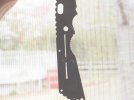
Most of the time you see this no matter which knife you chose. It may appear there is a full or nearly full contact at times but if you break them down looking from this perspective you'll see that its just illusion. Remember that the lock contact is angled on the blade. It will seal up blocking light due to this angle but when you take off the non lock side holding the folder such that its locked open with the sun shining through as I've done here regardless of if its a custom, or a production folder in a liner of frame lock this is what you will see with various amounts of bottom contact for a total foot print of contact from one to another.

Seen here is a typical Emerson and a typical Strider. Just what was handy to show but its the same for Kershaws, Spydercos or Bucks across the board. Test it yourself if you still believe your folders have a full contact. That is not to say that some designs do not allow for a full contact. There have been some. The old CRKT S2 was one such folder because of the wedge shaped lock cut out design. They don't typically contact fully though and can't and further they are not supposed to to be properly built. These contacts shown may not be as tight as they are when locked up after assembly but they are fully open showing what is going to be the same relationship of the lock to the blade in use. It makes for a sturdy three point contact and it is correctly done. Some of you guys need to read a book or three or just trust that the makers do know something about how to properly build a folding knife. There is no accounting for production errors as we all know that happens but the contact as mentioned in the OP is not one of those errors.

STR
 

Attachments

  • DSCF0002.jpg
    DSCF0002.jpg
    96.5 KB · Views: 242
  • DSCF0003.jpg
    DSCF0003.jpg
    99.4 KB · Views: 222
I'll buy that. :thumbup:


All I can say is that I clearly see it--the flush interface--on the knife positioned as I described in my last post. Maybe it's my screen resolution. But I know I'm not imagining it. Regardless, my SnG just arrived in the mail today and while the lock-tang interface is not flush, there certainly is more contact than on most other Striders I've seen. I guess they're all different, depending on mileage, who assembled it, position of the moon...:). All the best.

What model did you get? CC, stonewashed, or tigerstriped? I got bit by the Strider bug after I found a Buck/Strider 880 here on the forums... it's nowhere near the build quality and feel of a real Strider, but it'll do until I can get that SMF CC that I have my eye on. ;)
 
Most, if not all decent made frame locks have full contact at the interface and don't stick or require 2H pencil treatments and don't suffer premature wear at the minimal contact point. I've owned Striders, Sebenzas and other custom frame locks and other than Strider, none required break in flicking.

Yeah, Striders do have their problems, BUT...

I mean, I could sit here and easily pick apart my new SnG CC piece-by-part, joint-by-edge, and it would seem like I'm trashing the knife and its maker. But I'm not. Somehow this knife just transcends all its (very minor, mind you) flaws in isolation and emerges as a super-badass blade that I couldn't be happier with when considered as a whole. I guess the phrase I'm looking for here is that it is more than the sum of its parts. And this is where it gets strange in my opinion... Sebenzas are to me the opposite of this way of thinking about knives. They are flawless, with each and every perfect part held together with legendary tolerances. But when you step back from each of its pieces of perfection and take it as a whole, it just doesn't add up like I think it should or could. And here I go with the disclaimer again, but I do love my Seb and respect the hell out of CRK. It's just that it somehow ends up being a little less than the sum its parts.
 
Last edited:
Yeah, Striders do have their problems, BUT...

I mean, I could sit here and easily pick apart my new SnG CC piece-by-part, joint-by-edge, and it would seem like I'm trashing the knife and its maker. But I'm not. Somehow this knife just transcends all its (very minor, mind you) flaws in isolation and emerges as a super-badass blade that I couldn't be happier with when considered as a whole. I guess the phrase I'm looking for here is that it is more than the sum of its parts. And this is where it gets strange in my opinion... Sebenzas are to me the opposite of this way of thinking about knives. They are flawless, with each and every perfect part held together with legendary tolerances. But when you step back from each of its pieces of perfection and take it as a whole, it just doesn't add up like I think it should or could. And here I go with the disclaimer again, but I do love my Seb and respect the hell out of CRK. It's just that it somehow ends up being a little less than the sum its parts.


Funny... I feel the EXACT same... Sebs F&F are perfect... but I'll take an SnG over a Seb any day. They are not perfect, but the outcome is somehow better... I just love the design, and I love the outcome. I'm strongly considering a Krein regrind on my SnG to make it a better slicer... I don't necessarily need a knife to be a potential makeshift prybar... I just want a GREAT knife that fits my hand and needs and is a great cutter. The Sebenza's blade is better than the SnG, but I like everything else about the SnG more.
 
Yeah, Striders do have their problems, BUT...

I mean, I could sit here and easily pick apart my new SnG CC piece-by-part, joint-by-edge, and it would seem like I'm trashing the knife and its maker. But I'm not. Somehow this knife just transcends all its (very minor, mind you) flaws in isolation and emerges as a super-badass blade that I couldn't be happier with when considered as a whole. I guess the phrase I'm looking for here is that it is more than the sum of its parts. And this is where it gets strange in my opinion... Sebenzas are to me the opposite of this way of thinking about knives. They are flawless, with each and every perfect part held together with legendary tolerances. But when you step back from each of its pieces of perfection and take it as a whole, it just doesn't add up like I think it should or could. And here I go with the disclaimer again, but I do love my Seb and respect the hell out of CRK. It's just that it somehow ends up being a little less than the sum its parts.

Good observation. I still prefer the Sebenza as a personal knife, but I do agree with you in terms of the value of transcending one's limitations. It's nice to live in a country where vision still bats last.
 
To be properly done the lock should contact far enough away from the midline of the pivot to allow a solid contact. What this means is that the lock contact should and can be anywhere past this minimum distance away from the mid line of the pivot so that only the bottom, or the bottom third of the lock comes into contact with the blade. In other words the lock should not contact the blade near the mid line of the pivot which means it can't connect fully to be correctly done. STR

I remember this point has been discussed some years ago in a thread opened by STR himself. I yet owned a Strider PT and wondered, reading the thread, if the finish was in relation with the price i paid for. Four years later the PT is still in my rotation list, it shows numerous marks of wear but a thing has never changed: the blade is perfectly locked, no blade play, the lockbar has never been sticked on the tang despite the fact that with an average cutting ability i have to use more strength than with a thinner blade.
I have to use a magnifying glass but i can see the knife is exactly made as described by STR.

KarlMaldensNose, congrats for your purchase, enjoy it. I bet you will still like it in four years as i do.

dantzk.
 
Back
Top