Striving for straight..........

Joined
Apr 8, 2003
Messages
2,092
Or...How much tweak is acceptable?
This is something I have struggled with since I started making. I try and get everything as straight as I can, but more times than not there is some kind of deviation. There are some things that just wont leave my shop, but with others there comes a point when enough is enough and it has to go out. If I don't think it will preform the way it should it won't leave the shop period.
Please tell me I'm not alone here(although I have seen enough knives to know I'm not)...Just wondered how you all deal with it.
Mace

P.S. They do get straighter every year.:D
 
Im the same way . if it does'nt look straight i give it to a deer hunter at church.
so far I'm about 70%- 30%. 30 going to hunters. vern
 
Same here, but I can usually straighten most. In fact all, to where they are straight enough to sell.
 
- If the blade itself is warped, it either gets a new HT or gets tossed in the bucket.
- If the grind isn't straight to the point where you don't have to look really carefully to see it, it goes in the bucket.
- If the plunges don't match up to the point that I can't fix it up with a light use of a chainsaw file or rotary tool, and you don't have to look closely to see it, it goes in the bucket.
- If the guard isn't straight, I re-do it.
- If the handle isn't straight to the point that you don't need to inspect it very closely to see it, it goes in the bucket, or the handle gets ground off and redone.

I refuse to give work that I wouldn't sell to ANYBODY. It all has my name on it, and only the best I can do will leave my shop. Is every piece perfect? Hardly. Is every piece done to the best of my ability at the time? Absolutely, or it goes in the bucket.

Just my $.02.

-d
 
If ya find the secret will ya let me know? I'v been chasing the same problem here and wasting a lot of time trying to see what's wrong. I check for squareness after every 3-4 passes on the belt.

Doing all my work on basic tools, I run into the same thing w/ guards, keeping them square & symetrical.

That's the charm of "home made", right?? :confused:

Kinda interested in others opinions on this. How perfact are your knives?
 
So happens I was heat treating some test blades today and came across a 7" 5160 blade that had been warped bad, mebbe 2 yrs ago. I thought , what the heck, and normalized it 3 times , straightening in between. Did the HT on it and she stayed straight!! Into the toaster oven. We'll see ina coupla hours......
Ya never know what might turn up on the forge table. bruce/birdog
 
i am praying for stregenth!!! i am sharing a room with mace at the blade show and i dont want to watch my back all night....
matt !!!!help me out here
 
Mace,
Youre forging which I think adds a lot more difficulty than stock removal as you are starting your grinding with something thats been heaten and beaten.

Do you put the flats on a disc grinder or the platen first to get everything trued up?

I personally try to get everything to a point where my human eye either can't distinguish any non-straightness, knowing most non-knifemakers don't even have an eye for that stuff or the OCD we have. Then I give it to my fiancee and ask her to search for anything at all she can find wrong. If she finds nothing and I find nothing, I feel good...women are good at pointing out things wrong :P

I've kept blades that had little things wrong with them that probably could have been sold, but have tried to never sell anything with even minute defects that I could fix with some time and effort. For me, the hardest part is heavily sculpted handles. With tons of complex curves, theres just so much to get symmetrical that you could eat up the whole handle correcting things. I think thats why i do the majority of my sculting work by hand with files. It may take a bit longer, but it always comes out right and it takes more effort to screw things up.

Are you talking straight as in straight blades, or straight as in grind lines, plunges, bolsters meeting, etc etc?
 
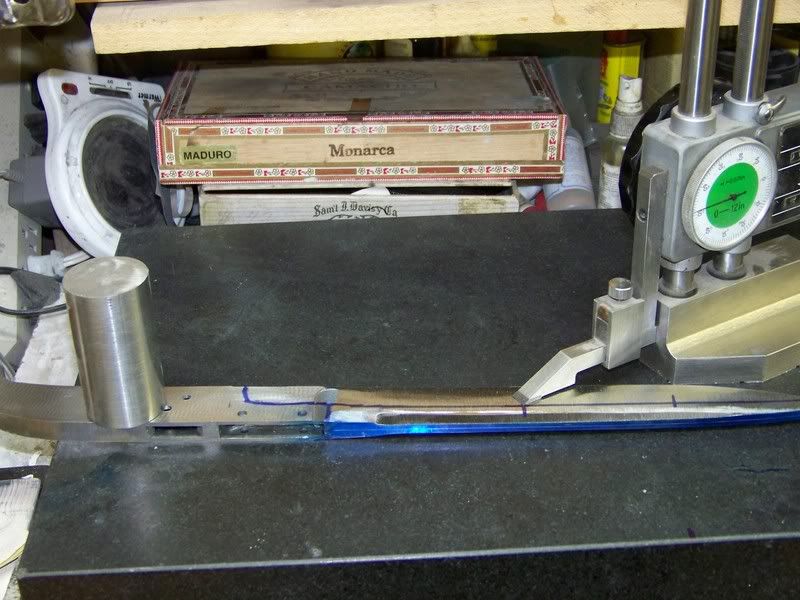
I think that I will wade in here with something that has helped me in keeping my forged blades straight. I use a flat surface and a tool that I made that works similar to the tool you use to scribe the edge of a knife prior to grinding. The difference is the tool I use slides on the flat surface not on the side of the blade. I coat the edge of the blade with dykem and lay it on one side on the flat surface. I adjust the scribe on the tool to the approximate middle of the blade and scribe a line around it. With this, it doesn't really matter if it is flat or not since you will put a marked line all the way around the blade the same distance up from the top of the flat surface. What you are looking for is the difference between one side of the blade and the other. This will really show it to you in a hurry. It will give you a good idea if you need to head back to the forge "n" anvil or if it is close enough to take out when you clean up with the grinder. It takes all the guess work out and will show up a warped or twisted blade that is difficult to see just using your eyes.

I just read what I typed and I am not sure it is all that clear. If you have any questions or want more detailed info I'll be glad to give it another shot.

Another thing that I have found that helps is to look at the blade from the point end. When most people look down a blade they do it from the handle end and I do too. The difference in perspective helps me sometimes to see something that needs more work and maybe a trip to the flat surface mentioned above.
 
You need to have a flat ricasso to base the rest on the knife on. Here is my trick for laying out the entire blade. The height gauge is only about $75 and the granite plate is about $25.
100_0805.jpg
 
I see that Mr. Bump beat me to the picture, but I'll post mine anyway. It shows a scribe that was made from scrap steel found around the shop. It is resting on a marble slab cut from a counter top where the sink goes. It is heavy, flat, smooth and free. Total cost....about an hour to make the scribe. At the going hourly rate for a knifemaker that is nearly nothing :D but the time and frustration it will save you will be significant.

318100427.jpg
 
Thanks Harry! I had been wrestling with this too and what you said is right on target I believe. I was thinking about the same setup to do it and yours is really nice. Bill
 
mace....i applaud you on your quest for straightness.....i have bought blades for alot of money that i later found out were not straight......luckily i sold it for more than i paid.....but if i can tell it's not straight at a glance.....what the hell is the knifemaker see?......and it was a journeyman smith......ohh yeah and it wasn't even close to being sharp......that's another thread though......ryan
 
I wondered if our phone conversation would lead to this thread...

Earlier today Mace and I were discussing the difficulties of getting everything 'just right', and how much --or how little-- deviation was acceptable. Funny how getting the blade straight is the part you offered up for the topic, as there were so many other things that we mentioned (and so many others have touched upon in their responses!).

I think the gist of our discussion was less searching the literal answer, and more of the theoretical... at what point do you accept a knife as it is and move on, or when do you toss it?
 
at what point do you accept a knife as it is and move on, or when do you toss it?
__________________
Matt Gregory

This is a question every maker has to answer at some point for him self. Shortly after Charlie and I started making knives we realized that friends were asking for our rejects at a discounted price. We don't sell them, mark them or give them away. If we can't fix it, then it won't be usable when we get through. We don't want any knife going out the door that is not the best we can make it. Yesterday I broke a stag handle off of a knife I was working on because I screwed up a spacer. In addition to the cost of the materials I wasted the two hours it took to fit spacers and a really nice piece of stag. It wasn't right and never would be. Sometimes a lot of work has to be trashed. It's amazing how hard it is to get a sambar stag handle off of a blade.
 
I knew the title of this thread was going to make it very hard for some of you to keep your mouth shut... Mike and Kieth...:D Mike your OK. Kieth You know your gonna have to watch your back any way. ....Uh...Death squads..duh.;)


Enough fun and now back to the topic:

Harry, Great idea...and I understand what you wrote.
Bruce was right about flat ricasso being the base to start from.

Here are a couple of quotes that made me think a bit.
"charm of home made"
This could be a whole other thread.

"straight enough to sell"....hmmm...this is kind of what I'm talking about.

"the BEST of my ability at the time" ....This I think might be close to the answer of this question.
I try to make everything to the BEST of my ability at the time I'm making it.

Over the years my ability has gotten better(I hope) and I supose my quality control standards have raised at a similar rate.
I remember when I first started and I heard guys say they had a box of bad blades and I thought ...how could that be?... Well I have a better idea now and a swamp full of blades that will never cut a thing.;)

Ryan, Maybe that smith made that knife to the best of his ability at the time...and maybe not. Maybe you didn't see it when you bought it, but you did when your "ability" got better.
You are right about sharp being a whole other issue too. It is one of my pet peeves.
Enough rambling.
Thank you for the comments and ideas. Please add more if you like.

Ah well...my quest for straight will continue.:thumbup:
Mace
 
Mace, I used to wonder myself if the blades moved in heat treat or if was my grinding job, I will be the first to admit to not being the greatest with a grinder, but after I started using the trued ricasso on a surface plate as Bruce and others have described, I got a better handle on what was straight going in.

Switching to the most even heat source I could find helped immensely in keeping things straight, as well as taking things through Ms as evenly as possible. Since I mostly use marquenching any distortion I can see while the blade is hardening is easily straightened then, however if some gets by me it can be dealt with, easiest with single edged blades, later by heating the spine until you get a slight purple color going and then pulling it straight while it is hot.

This is a case where all my blah, blah, blahing about modulus of elasticity can have an actual practical use. While things like heat treat and alloying cannot affect elasticity, temperature can. Heating things just a little bit will allow you to straighten the blade without any concern of damaging it, except of course the loss of hardness in the spine area where you heated. Be certain to keep the heat off from the edge though. I use a wet piece of ceramic wool to hold against the edge to keep it cool while I heat the spine. Most often I have the tip wrapped in a piece of leather and clamped in a vice so I can heat, cool and straighten all in one shot.
 
Mace,
I knew the title of this thread was going to make it very hard for some of you to keep your mouth shut...
...and you was right...:D

Just a couple of thoughts to add my .02:yawn:;)
'Guess I am learning something afterall! :p
I am behind the "learning curve" from many here, ahead of a few. :cool:
My first thought when I saw the word "straight" was that a forged blade, as opposed to other starting points, would have it's own unique considerations.
Second, As much as I appreciate the form/function of any craft, it does take no small amount of effort to accomplish what one sets out to do.
Third, Making nice steel into sharp steel is lots of fun.
Fourth, I do tend to ramble a little. Did I meantion learning wuz fun? :D

Matt
 
Back
Top