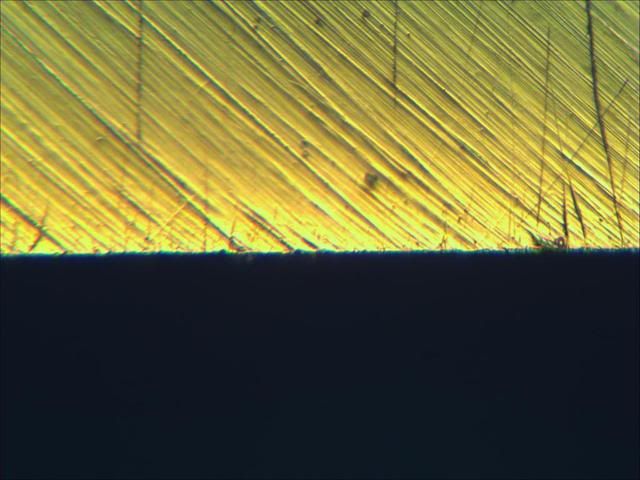
Stropped my edge to death again

Joined
Aug 12, 2011
Messages
24
I did it again. Every time I think, "I'll strop it at an angle just a little bit higher this time", I rub the edge off. I charge one side of my Bark River strop with the black abrasive that came with it, and I just treat the other side with Fromm Strop Dressing. The Fromm dressing protects the leather, and gives it just the right amount of "grab". Even the Fromm-treated side will quickly remove an edge if I strop it at too high an angle, even on D2 tool steel. Maybe one day I'll learn.

If anyone tells you that strops don't remove metal, they just straighten and polish it, they don't know what they're talking about.
 
I just use Chromium Oxide Wax on a thick leather strop, doesn't take much to polish up the edge and put the finishing touches. You shouldn't really need to strop more than a dozen passes on either side, if it takes that much work to get an edge you're starting with a poor edge in the start.
 
Yup, that compound can quite quickly take the edge right off again, just as easily as it puts it on. Light pressure, LIGHT pressure. As in, as close to no pressure as you can possibly manage.
 
As Komitadjie emphasized, LIGHT is always better. I'll add LOW (angle) to that, to always think "light & low, light & low, light & low" when stropping. Make this your mantra, and it'll help protect from overdoing it.

I used to over-strop a LOT, when I was trying to develop the feel & muscle memory for it. My goal then, was to at least protect an already good edge while 'practicing' stropping, so I really focused on the 'low' part. It's always better to be a little too low & maybe miss the edge entirely on a pass or two, than being too high in angle, and possibly erasing that good edge in the same two passes.
 
David,

I'm lost a bit here. Had same experience of blunting the edge by stropping too high. However, shouldn't it result in 'micro bevel' instead of dulling?

I don't use leather, but hard cardboard wih polishing compound, backed by flat hard surface (stone, glass, etc)
 
If it was a hard surface it would micro-bevel, but the leather is soft enough that it tends to wrap around the edge and round it off. That's why the lighter pressure helps, you don't want the leather rolling up the edge of the blade and grinding it off.
 
Chris "Anagarika";9927006 said:
David,

I'm lost a bit here. Had same experience of blunting the edge by stropping too high. However, shouldn't it result in 'micro bevel' instead of dulling?

I don't use leather, but hard cardboard wih polishing compound, backed by flat hard surface (stone, glass, etc)

It could 'micro bevel', in a sense. But the implication is, the lack of firm control over the angle would more likely result in rounding of the very edge itself, whether on a hard or soft surface. Even a micro bevel should still be a true 'bevel', with a relatively clean, FLAT face and a SHARP edge (when done deliberately and properly).
 
Last edited:
I don't believe stropping is as unforgiving as people make it sound. 10-20 passes per side on each strop is enough for me. I don't feel my angles are spot on, and I don't lift the blade when stropping. I never dulled an edge unless the edge had a small burr or it wasn't refined enough prior to stropping.
 
Chris "Anagarika";9927806 said:
Thanks for clarification ... yes, apparently stropping is not as unforgiving as what I thought ...

Your question made me think about my own changing perspective on it. I have sometimes made a couple of VERY, VERY light passes on the strop, at a slightly elevated angle. Mostly, I did this to break off any remaining, tiny burrs that might be left behind. I used to think it was more like 'polishing the micro bevel', but I don't look at it that way anymore. I don't ordinarily put micro bevels on my edges (not deliberately, anyway :p), and just a couple very light passes on a bare strop won't do much additional bevel polishing anyway. It always runs the risk of slightly rolling or rounding a thinly-ground edge, though, so I don't do this so much anymore, on the strop. I try to take care of most burrs prior to stropping, with a couple of slightly elevated and very light edge-leading strokes on a fine hone (ceramic, in particular). After that, whatever stropping I do, is as 'light & low' as possible.
 
Last edited:
If it was a hard surface it would micro-bevel, but the leather is soft enough that it tends to wrap around the edge and round it off. That's why the lighter pressure helps, you don't want the leather rolling up the edge of the blade and grinding it off.

That's the best explanation I've ever heard of what happens when you strop at too high an angle.
 
maybe you got your technique right. I too am better off with just sharpening. When I strop on leather, it seems to take the bite off the blade.
 
In my experience, stropping is not an art that is properly learned with a small handful of blades.

My stropping techniques required many, many hours of practice with lower end knives. I must say that once I found the proper technique, the effort was very worthwhile, but it didn't come easily.

If one thinks that buying a high quality strop, high quality pastes, and watching a video is going to teach him how to properly strop a blade quickly, then he is deluding himself.

Like most worthwhile pursuits in life, proper stropping techniques are acquired with concentration, patience and a great deal of practice. :thumbup:
 
I think it's worth mentioning that certain steels aren't physically capable of taking a sub-micron finish on a strop. And even some like Sandvik 12C27 will lose that sharpness within 5 cuts. I think Rc60+ is a must, and it would help to have very fine grain refinement. Carbon steels seem to be much better for it though. Must be the lack of carbides.
 
...Like most worthwhile pursuits in life, proper stropping techniques are acquired with concentration, patience and a great deal of practice. :thumbup:

:thumbup:
The upside is, that 'practice' time can be quite relaxing. I developed most of my feel for it while relaxing in front of the TV in the evening, after a good dinner, and with a glass of wine at my side. Great way to learn, so long as there's not TOO much wine involved. :p
 
OWE,

I quite agree.

After a trying day, sharpening in general, and fine stropping/polishing can be a relaxing activity. I prefer two fingers of "single malt" to the wine, but either works quite well! :p:thumbup::p
 
Hahaha ... Usually I have beer wih me, and my cigarettes (burn out rather than being smoked when sharpening / stropping) :D

Thanks for advices .. Will practice more ...
 
Was busy using the new microscope again, and finally took some more shots of different stropping compounds and how they might affect an edge. For a while now I've been jumping down a few grits on the strop to "refresh" an edge - nothing unheard of around here, but not many take it down as low as I do so I thought I'd throw this out there. Have a series of pics at 640x, the first is off of the fine side of a cheap AlumOx bench stone and stropped w/ Flexcut Gold, the second pic is after hitting the edge with 220Sic lapping compound, the third is after some black emery from Sears (my personal favorite for EDU), and finally back to the Flexcut to see how it would react. Used approx 20 passes/side for each change. The edge initially could just tree-top some leghair, though not consistently, and could easily crosscut newsprint. After hitting it with the 220SiC it could still shave some arm hair and cut paper with the grain but needed some draw to crosscut. Following the black emery it could crosscut newsprint with a push cut, shave armhair easily, and still had a lot of "tooth". After the second time around on the Flexcut it could no longer treetop leghair, but could dryshave facial stubble, crosscut newspaper etc. A bit more time with the black emery before going on to the Gold might have restored it entirely - you can see where its not quite as smooth or uniform as the first picture. Anyway, I'm adding this because I find that a relatively coarse strop comes in very handy for preventing trips back to a stone especially on "overstropped" edges- have even used it to sharpen softer kitchen knives that had been tossed about in a drawer and were quite dull. I used to use it only on my coarse-edged working knives to remove burrs and improve the edge off the stone, but its come into its own for a number of uses. On harder metals there's only so much you can do with a loose particle on a strop, but it never hurts to experiment. For keeping frequently used knives in good shape I can't recommend this strongly enough for saving time and steel.

Gold_640.jpg


220SiC_640.jpg


BlackE_640.jpg


Gold_2_640.jpg
 
I started stropping about a month ago, and I practices a LOT on a large range of blades. Am I the only one that notices a different feel to the pull of the blade when stropping properly? I use no compounds, but I got my old WWII machete to shave leg hair AFTER cutting through some treated wood right beforehand. I can testify there is a DEFINITE difference between a stropped and unstropped blade, no matter its use.
 
Back
Top