Stropped my edge to death again

You guys are probably aware there is a sticky thread at the top of this forum:

Thread Sticky: Stropping: angle plus pressure

I recently posted this there, I'll just paste it here:


I confess to being one of those people who managed to make a good edge dull by stropping -
of course that was years ago -

the BIGGEST hint - which I had diligently ignored - was how to flip the blade over to strop the other edge

I got so frustrated with stropping and getting duller edges that I was about to give up -
when I recalled the advice and lifted the blade off the leather the unintuitive way with edge first - flipping and rolling the blade over its spine stopping any contact with the edge -
and that was all there was to it, I had sharper/better edges after stropping.

Before I had done exactly as described - as if continuing the strop stroke/arc and lifting the spine first - to flip the blade over for the other side -
unbeknownst to me I was actually inadvertently raking the edge - hence the dulling -

Stopping and lifting edge first or rolling the blade over its spine to flip over the blade solved that.

Once practiced - rolling over on the blade's spine to flip the blade over then comes fairly naturally -
even if it does not seem as fluid as flipping over the knife over its edge........

Hope that helps someone.

--
Vincent

http://picasaweb.com/UnknownVincent?showall=true
http://UnknownVincent.Shutterfly.com
http://UnknownVT.Shutterfly.com
http://UnknownVT.multiply.com/photos
 
@HeavyHanded:

Wow! Those are terrific photos of knife edges! :)
What kind of microscope did you use? And how did you light the scene?

Also, would it be possible for you to include a length-scale for the images?
http://www.bladeforums.com/forums/s...f-Knife-Edges-how-about-Adding-a-Length-Scale

Sincerely,
--Lagrangian

I'd love to include a true calibrated scale to these pics but that would involve purchasing a micron-sized precision scale - management isn't going to give me any more money for this project without showing some results first using what I've got.

http://store.amscope.com/me300tz-5m.html

This is the one we have, a metallurgical microscope, it directs light through the the objective to the object and back up into the objective. For scale, at the size of the pics on the other page - 640x (and most of the ones I post in other threads) 1 micron = .5mm on the screen, 5 micron=2.5mm or about 1/10". That's mighty small - an average human hair at 100 microns equals about 2" of viewing area flat across the screen, and if laid across the top of the blade it obscures about half the image. Focal depth is less than the depth of an abrasive scratch. Keep in mind all those images are at exactly the same scale. It can go to 1600x but needs to be focused through a drop of cedar oil ( I have a few images at that scale - pretty neat - takes longer to set up and cannot always get clear images. Because focusing through oil, I have to overlap the apex with masking tape to give the oil something to sit on - this sometimes makes it tough to get an even oil film). At that scale one micron appears as 1.25mm. On my screen they appear 20% (approx) larger, but I shrink the images a bit for linking and emails etc. One of the real interesting things is how ordinary objects look at that scale - makes it very clear why different edge preparations (coarse, fine, everything in between) are needed for optimum cutting performance on any specific material.


I went back after taking those pics and put the knife to a Spyderco Fine ceramic. It took no more than 20 -30 light strokes followed by a dozen passes on the Flexcut Gold to restore the edge to its former treetopping level.
 
Last edited:
HH, Thanks for the photos. Great supporting evidence that coarse stropping plays a major role in ease of edge maintenance and saves wear on the knife. DM
 
@HeavyHanded:

I looked up some stage-micrometers (ie: micro-rulers) for microscopes, and ouch, they're expensive: around $200.
http://www.tedpella.com/histo_html/2280-10.htm

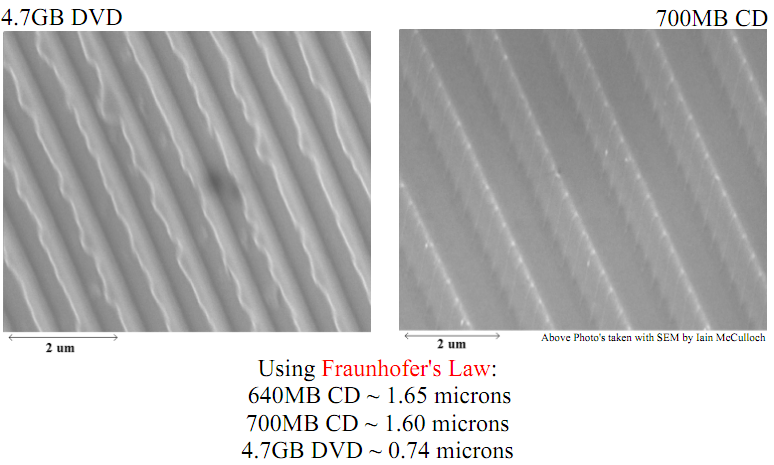
But, how about using a DVD disc or a CD disc as a calibration target?

4.7GB DVD has a track-pitch of 0.74 microns.
650MB CD has a track-pitch of 1.6 microns

For studying knife-edges, these should be good enough.

Image From:
http://mse.mcmaster.ca/undergraduate/courses/2H04/Tutorial1rev.pdf
xjsZC.png


Additional Reference:
http://en.wikipedia.org/wiki/Dvd#Technology

If you're able to try this out, then let us know if it works.
Hopefully it does, since it's a zillion times cheaper than a true stage-micrometer.

Sincerely,
--Lagrangian

---------------------------------------------------
"What grit sharpens the mind?"--Zen Sharpening Koan
 
That's good info, I hadn't considered calibrating against something like that. Now if I can find the manual around here...
 
I used to do that too. Finding the right start angle is important and in my case that meant a lot shallower angle than I was starting with. Pressure also plays a large part and in my case, the right strop for the type of edge. For me, hollow ground edges have to be done on a "barber" strop a flexible hanging strop or a wide belt. I just can't seem to strop a hollow ground on a rigid backed strop. On the other hand, flat ground or convex ground have to be done on a rigid strop. I can get away with light pressure on a hanging strop and loads of tension in the strap, but nowhere near the same results as a rigid backed strop. Sometimes stropping is counter productive. I have an Ackerman Serratta which is investment cast 440C. Stropping the edge makes it incredibly sharp, but it loses the edge quite quickly. Just sharpening it on a diamond hone, makes it act like a buzz saw, and the more you cut with it, the sharper it gets. The carbides seem to act as micro serrations and cutting seems to "unclog" the edge.
 
what has it to do with how the knife is ground ?

you strop your knife flat on the grind ? i and, unless i missed something huge, everybody strop on the bevel. a bevel is a bevel no matter what grind type you have above, it's the only part of the blade that should make contact with the strop. your knife is not a straight razor.
 
@HeavyHanded:

I looked up some stage-micrometers (ie: micro-rulers) for microscopes, and ouch, they're expensive: around $200.
http://www.tedpella.com/histo_html/2280-10.htm

But, how about using a DVD disc or a CD disc as a calibration target?

4.7GB DVD has a track-pitch of 0.74 microns.
650MB CD has a track-pitch of 1.6 microns

For studying knife-edges, these should be good enough.

Image From:
http://mse.mcmaster.ca/undergraduate/courses/2H04/Tutorial1rev.pdf
xjsZC.png


Additional Reference:
http://en.wikipedia.org/wiki/Dvd#Technology

If you're able to try this out, then let us know if it works.
Hopefully it does, since it's a zillion times cheaper than a true stage-micrometer.

Sincerely,
--Lagrangian

---------------------------------------------------
"What grit sharpens the mind?"--Zen Sharpening Koan


No go, my microscope can barely pick out the lines, and not clearly enough to use for a scale - the lighting washes it out or is not enough to see the lines at all. I'll keep at it till a suitable substitute finds me.
 
@HeavyHanded:

Oh darn, that's too bad.

Speculation:
Maybe the spacing is too close to the wavelength of visible light, which is 0.4 microns to 0.7 microns. For the DVD, the tracks are 0.74 microns, so may be too close. For the CD, the track pitch is 1.6 microns, so maybe more hope here. But the CD tracks are ridges with valleys between them, so the width is half, at around 0.8 microns which may be too close to visible light? On the other hand, some scale-micrometers have markings every 2 microns, which isn't so far away from the 1.6 microns. So, I don't know...

Thanks for trying!! :)

Sincerely,
--Lagrangian
 
The problem with using the CD is that the above pictures were taken with a SEM.

You might be able to see them with a scope that shines the light through the lens but any scope that uses surrounding light runs into major issues with depth and shadows.
 
The problem with using the CD is that the above pictures were taken with a SEM.

You might be able to see them with a scope that shines the light through the lens but any scope that uses surrounding light runs into major issues with depth and shadows.

@knifenut1013:

I think you're right... I was hoping that the CD tracks would be visible, just like scratches in a blade edge. Since a lot of scratches are easily visible in micrographs (like from HeavyHanded, or various USB microscope picts (such as from Clay Allison)), I thought CD tracks would be the same. Oh well.... :(

I'm going experiment with a CD-R later (blank and/or with recorded data), but my set-up probably does not have enough magnification to see them.

Sincerely,
--
 
Under magnification with a metallurgical microscope (directs light into the objective, no external light source needed. In fact when viewing opaque objects, no external light source can be directed onto the object - the lens is too close for light to get in at anything above 400x). i could just make out the lines in a CD as faint ghostlike wriggles - far too indistinct to use for calibrating, as they weren't even visible to the camera, though with the proper filters on my light source I'm sure its possible. My math-derived scale is probably pretty close though. I took a look at some unfused toner particles and at 5-7 micron range they showed up as between two and four mm on my screen at 640x.
 
@HeavyHanded:

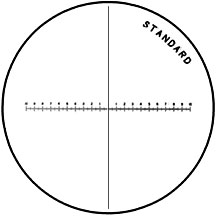
Ken Schwartz (Ken123 at knifeforums.com) pointed me to a link that shows you can buy a stage-micrometer for around $20. (You can buy the the stage-micrometer separately, without the magnifier.)

http://www.tedpella.com/magnify_html/magnifier.htm

It looks like they go down to 100 microns, which might not be fine enough unfortunately. But if your field-of-view is wider than 0.1mm, this should be good enough and pretty cheap! :D

"Standard Metric Scale ... 0 to ±10mm"
0umd8.jpg


Sincerely,
--Lagrangian

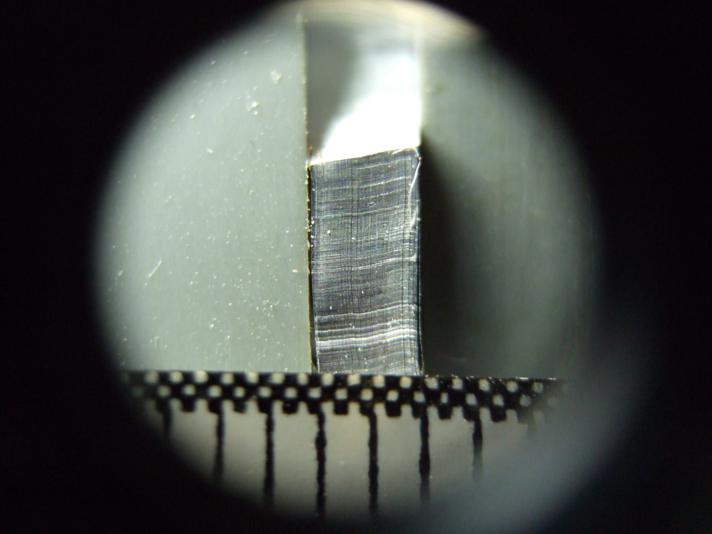
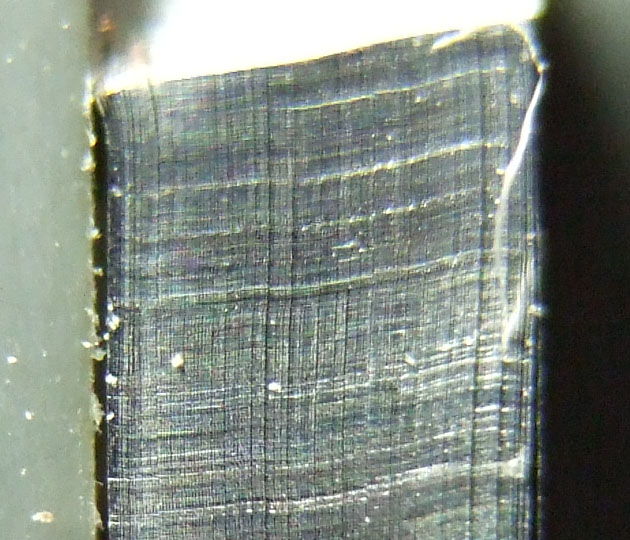
P.S. If you're a little crazy, you can also use household aluminum foil. The foil is about 16 microns wide, so that should be fine enough for 1600x magnification.
http://www.bladeforums.com/forums/s...t-Adding-a-Length-Scale?p=9992368#post9992368

128 layers of household aluminum foil. Fuji F30 camera with 20x loupe.
The ruler markers are in millimeters. The checkerboard squares are 0.25mm wide.
Image has been resized to 25% of original.
c2hq2.jpg


Close-up of the above:
S7j6s.jpg


--------------------------------------------------
"What grit sharpens the mind?"--Zen Sharpening Koan
 
Last edited:
Back
Top