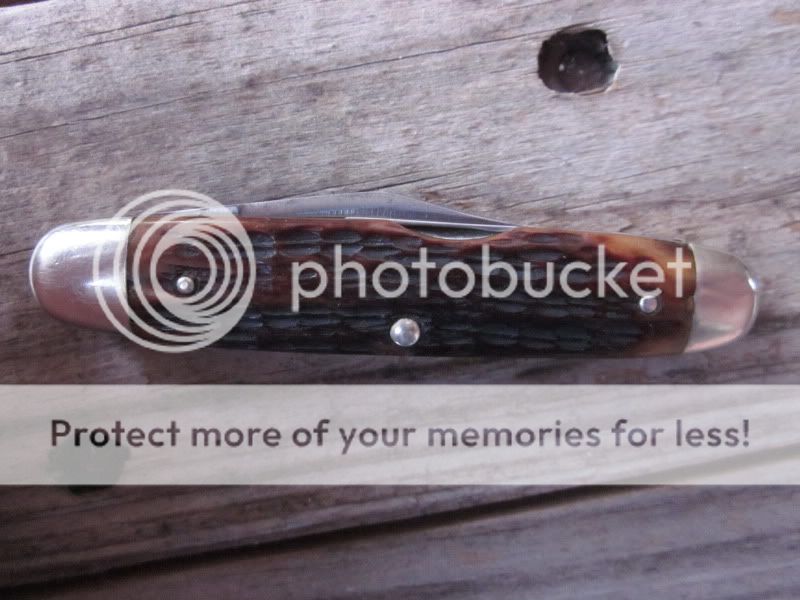
sunken joint question

Joined
Nov 12, 2011
Messages
658
I've got a question regarding sunken joints - I think that is the term - that is where the bolster covers the tang of the blade, so that there is no sharp square edge sticking out. This extra little touch was supposed to be a sign of very high quality in patterns where it was feasible e.g. the old Robeson knives. I have got hold of a few patterns now that are supposed to have this feature e.g. the queen canoe, the GEC congress style maverick, the Case SBJ, and whilst they are all superlative knives, there is always a little corner of the blades sticking out. So is the tang supposed to be literally hidden within the frame, or is it only meant to be almost hidden, or as discreet as technically possible?

Anyone who wants to clarify this with some nice pictures of vintage knives is more than welcome to do so. :)
 
I'm a bit confused. Are you talking about when the knife is closed and the spine of the blade comes to a square on the tang side?

I think I may have confused myself more...this is the issue that a copperhead fixes, yes?
 
yes I mean when the blade is in the closed position, the spine on the blade disappears into the frame, rather than leaving a square piece of the back of the blade sticking out.
 
I'm a bit confused. Are you talking about when the knife is closed and the spine of the blade comes to a square on the tang side?

I think I may have confused myself more...this is the issue that a copperhead fixes, yes?

Sounds to me like you're tracking with him just fine. Unfortunately, others will better able to answer the question than I.
 
8165277899_74ee4eb3b8_b.jpg


8057291359_68dda13887_b.jpg


Quick images of a sunken joint.....the tang of the knife is flush with the bolster or handle so as not to leave an edge...copperheads are great examples as well as the canoe pattern, though it can also be found other patterns were the handle (spine) isn't necessarily straight but with a slight contour or bow...
 
Last edited:
I've got a question regarding sunken joints - I think that is the term - that is where the bolster covers the tang of the blade, so that there is no sharp square edge sticking out. This extra little touch was supposed to be a sign of very high quality in patterns where it was feasible e.g. the old Robeson knives. I have got hold of a few patterns now that are supposed to have this feature e.g. the queen canoe, the GEC congress style maverick, the Case SBJ, and whilst they are all superlative knives, there is always a little corner of the blades sticking out. So is the tang supposed to be literally hidden within the frame, or is it only meant to be almost hidden, or as discreet as technically possible?

Anyone who wants to clarify this with some nice pictures of vintage knives is more than welcome to do so. :)

In my opinion, the tang must be completely buried, as in the photos that Boggs posted, to qualify as a sunken joint. If the tang sticks out even just a little bit, it is not a sunken joint.
 
Ok, I'm thinking it wouldn't technically be a sunken joint unless under that level.

On some you might be able to lower it a touch by filing down the kick? Choil?

You can press down on the spine and see if it will drop enough if you do, but obviously make sure the blade isn't going to touch the spring and the nail nick remains useable.

I've filed that down on a few knives where the tip broke and they needed to be reshaped leaving the new tip sticking up too far.

I just do it real slow on a sharpening stone, keeping in mind the old "It's a whole lot easier to take off metal than put it back on"

But yeah, if I got a knife that was designed to be sunken but still stuck up I might think of that as "defective" or at the least, improperly finished. And if there wasn't a fair amount of (I'm going to just call it the) kick where it could reasonably be lowered I might be sending it back.
 
The Case/Bose Norfolk is a good example of sunken joint construction.
DSC01916.jpg

DSC01910.jpg
 
Ok, I'm thinking it wouldn't technically be a sunken joint unless under that level.

On some you might be able to lower it a touch by filing down the kick? Choil?

You can press down on the spine and see if it will drop enough if you do, but obviously make sure the blade isn't going to touch the spring and the nail nick remains useable.

I've filed that down on a few knives where the tip broke and they needed to be reshaped leaving the new tip sticking up too far.

I just do it real slow on a sharpening stone, keeping in mind the old "It's a whole lot easier to take off metal than put it back on"

But yeah, if I got a knife that was designed to be sunken but still stuck up I might think of that as "defective" or at the least, improperly finished. And if there wasn't a fair amount of (I'm going to just call it the) kick where it could reasonably be lowered I might be sending it back.

Take this for what it's worth, but filing down the kick would drop the tip and raise the offending part of the tang. Other more experienced members might have better advice than mine, but you could always try softening the offending square edges of the tang a bit.
 
Or, you could buy original old 1910's to 1930's Robeson PocketEze knives that all have flush joints.

Just kidding.

Charlie Noyes
 
Take this for what it's worth, but filing down the kick would drop the tip and raise the offending part of the tang.

I respectfully disagree. While filing down the kick will change the angle of the part, and may make it catch more in a pocket, it will in every knife I've owned, still lower the part. On a knife designed to cover that part, that doesn't, filing it may be enough to do the trick.

If you take say a dual bladed jack knife and push down on the main blade you should be able to see this effect. Obviously, being at the end of the lever, so to speak, the tip will drop significantly further than the tang, but the tang will still drop.

There may be some odd knives where it does have the effect you describe, but I am hard pressed to think of any.
 
I respectfully disagree. While filing down the kick will change the angle of the part, and may make it catch more in a pocket, it will in every knife I've owned, still lower the part. On a knife designed to cover that part, that doesn't, filing it may be enough to do the trick.

If you take say a dual bladed jack knife and push down on the main blade you should be able to see this effect. Obviously, being at the end of the lever, so to speak, the tip will drop significantly further than the tang, but the tang will still drop.

There may be some odd knives where it does have the effect you describe, but I am hard pressed to think of any.

On this point you and I will have differing opinions, and that's okay. I certainly intended no disrespect, but in my limited experience, filing the kick both lowered the tip and raised the tang. Other than replacing the pivot pin, I don't see how this cannot be true, but will defer to others with better experience than myself.
 
Last edited:
On this point you and I will have differing opinions, and that's okay. I certainly intended no disrespect, but in my limited experience, filing the kick both lowered the tip and raised the tang. Other than replacing the pivot pin, I don't see how this cannot be true, but will defer to others with better experience than myself.

Depends where the corner of the tang is, in relation to the pivot. The kick is obviously forward of the pivot, and if the tang's corner is also forward of the pivot (and I think the vast majority are), the tang will lower. The only way the tang's corner could actually rise, in response to filing down the kick, is if it's to the rear of the pivot. If so, it would then rotate up as everything forward of the pivot rotates down. Compare this to the movement of spokes in a wheel, on opposing sides of the axis of rotation. If dividing the 'wheel' with a vertical line through the center (axis), everything to the 'left' of the axis will rotate 'down', while everything to the 'right' of the axis rotates 'up' (or vise-versa).

The angle of the tang's corner will change (usually towards more vertical), as the kick is lowered, which might make it appear that the tang is rising. But it's true height above the handle can't rise in actuality, if the tang corner is on the same side of the rotational axis as the lowered kick.
 
Filing the kick will lower the point of the blade, but may tip up the angle of the back square, pointing it upwards. If you have an exposed tang, there is no effective way of filing anything that will lower the tang without messing the knife's geometry.
A tang that is slightly exposed is called "semi-sunk".
 
thanks for the responses, that clarifies it. I wouldn't try to change anything so radical on my knives anyway, I do not have those sorts of skills.
 
Depends where the corner of the tang is, in relation to the pivot. The kick is obviously forward of the pivot, and if the tang's corner is also forward of the pivot (and I think the vast majority are), the tang will lower. The only way the tang's corner could actually rise, in response to filing down the kick, is if it's to the rear of the pivot. If so, it would then rotate up as everything forward of the pivot rotates down. Compare this to the movement of spokes in a wheel, on opposing sides of the axis of rotation. If dividing the 'wheel' with a vertical line through the center (axis), everything to the 'left' of the axis will rotate 'down', while everything to the 'right' of the axis rotates 'up' (or vise-versa).

The angle of the tang's corner will change (usually towards more vertical), as the kick is lowered, which might make it appear that the tang is rising. But it's true height above the handle can't rise in actuality, if the tang corner is on the same side of the rotational axis as the lowered kick.

Understood, and although you probably don't need or want validation from me, absolutely correct. I often have a poor way with words, but the angle of the kick rotating up more towards the vertical is the part to which I was referring.

There is a pretty good reason for my deferring to you fellows with more experience :)
 
Back
Top