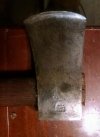
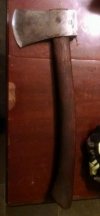
super banko hatchet identification.

Joined
Jun 20, 2009
Messages
364
Hello all.
I've recently purchased a super banko hatchet and was wondering the approximate age of this neat tool. I've done a tiny bit of google searching and haven't found any thing that could point me to the age of this hatchet. The stamp says"super banko Sweden" all on the one side. Other banko hatchets that I can seem to find are marked super banko on one side then Sweden on the other. If you need pics I will gladly get some.

Thanks,
Andrew
 
Entirely an experienced guess on my part but late 1950s and the 1960s were an era of expanding global trade. Europe was hurting for business and trying to find larger markets and the Swedes in particular elected to compete with the n. Americans at their own game. Lots of lower-priced but equal or better quality tools appeared over here during that time. Ice augers, Swede saws, fishing lures, axes and even Jonsered chainsaws.
 
Nice find. I had one once, it was finely shaped and unusual in that is was small, only 16oz. How much does yours weigh? Just curious.

I have another Super Banko head right now, a 2lb model.
 
Nice find. I had one once, it was finely shaped and unusual in that is was small, only 16oz. How much does yours weigh? Just curious.

I have another Super Banko head right now, a 2lb model.

Thanks,
I do believe it is a 16oz model. It is 5" by 3" head. It poorly hafted with what looks like the bottom of an Axe handle and am looking for a quality handle and was wondering where should be the best place to get it one.
 

Attachments

  • IMG_20150303_070732.jpg
    IMG_20150303_070732.jpg
    29.7 KB · Views: 33
  • IMG_20150303_070712.jpg
    IMG_20150303_070712.jpg
    14.7 KB · Views: 34
Last edited:
Axes marked Banko or Banco were evidently made by Säters, which reportedly existed from 1894 until 1966.

Säters Yxfabrik

...beyond Lerviken and Gessån outside Sater was built in 1894 a small factory plant for the manufacture of axes, right by the river's outlet from Björs Cab Sea. In Björs foundry can still see the mill stone foundation and the water pond that was built to produce electricity. It was Alderman Carl Rundqvist in Sater that with the assistance of itinerant workers took to the forging of the croft in Björs foundry.

The production was around 100 axes per day and workforce consisted of six workers. The operation went well and the factory became known for its excellent axes. Rundkvist decided in 1906 to expand the business and formed a limited liability company and a new factory building was built in Sater next to the highway and the railway. Now could yxtillverkningen operated more rationally with better access to electric power and communications. Säters yxfabrik eventually became a famous place of work and considerable industry. Yxfabrikens production of the so-called "Sater ax" eventually became widely known, and the factory received several awards for its quality manufacturing.

Besides the well-known "Sater ax" was made ​​even isbillar sledgehammers and kilsläggor. In the 1940s produced daily 800-900 axes in Sater factory. The workforce was about 50 men. Demand for the factory's products declined in the early 1960s and the factory was closed. Today is the factory premises including a cinema museum.

from http://www.geocaching.com/geocache/GC1J2DG_saters-yxfabrik-yxfabriken-2?guid=02e51ffa-d837-4c54-bb67-98bd7749faea
roughly translated by google


The Wetterlings History page says that Saters closed and was abandoned in 1966, leaving just 3 axe factories in Sweden (down from 20 factories in the early 1900s)
http://www.wetterlings.com/history/
 
Axes marked Banko or Banco were evidently made by Säters, which reportedly existed from 1894 until 1966.

Säters Yxfabrik

...beyond Lerviken and Gessån outside Sater was built in 1894 a small factory plant for the manufacture of axes, right by the river's outlet from Björs Cab Sea. In Björs foundry can still see the mill stone foundation and the water pond that was built to produce electricity. It was Alderman Carl Rundqvist in Sater that with the assistance of itinerant workers took to the forging of the croft in Björs foundry.

The production was around 100 axes per day and workforce consisted of six workers. The operation went well and the factory became known for its excellent axes. Rundkvist decided in 1906 to expand the business and formed a limited liability company and a new factory building was built in Sater next to the highway and the railway. Now could yxtillverkningen operated more rationally with better access to electric power and communications. Säters yxfabrik eventually became a famous place of work and considerable industry. Yxfabrikens production of the so-called "Sater ax" eventually became widely known, and the factory received several awards for its quality manufacturing.

Besides the well-known "Sater ax" was made ​​even isbillar sledgehammers and kilsläggor. In the 1940s produced daily 800-900 axes in Sater factory. The workforce was about 50 men. Demand for the factory's products declined in the early 1960s and the factory was closed. Today is the factory premises including a cinema museum.

from http://www.geocaching.com/geocache/GC1J2DG_saters-yxfabrik-yxfabriken-2?guid=02e51ffa-d837-4c54-bb67-98bd7749faea
roughly translated by google


The Wetterlings History page says that Saters closed and was abandoned in 1966, leaving just 3 axe factories in Sweden (down from 20 factories in the early 1900s)
http://www.wetterlings.com/history/


Awesome thanks for the info!
 
Back
Top