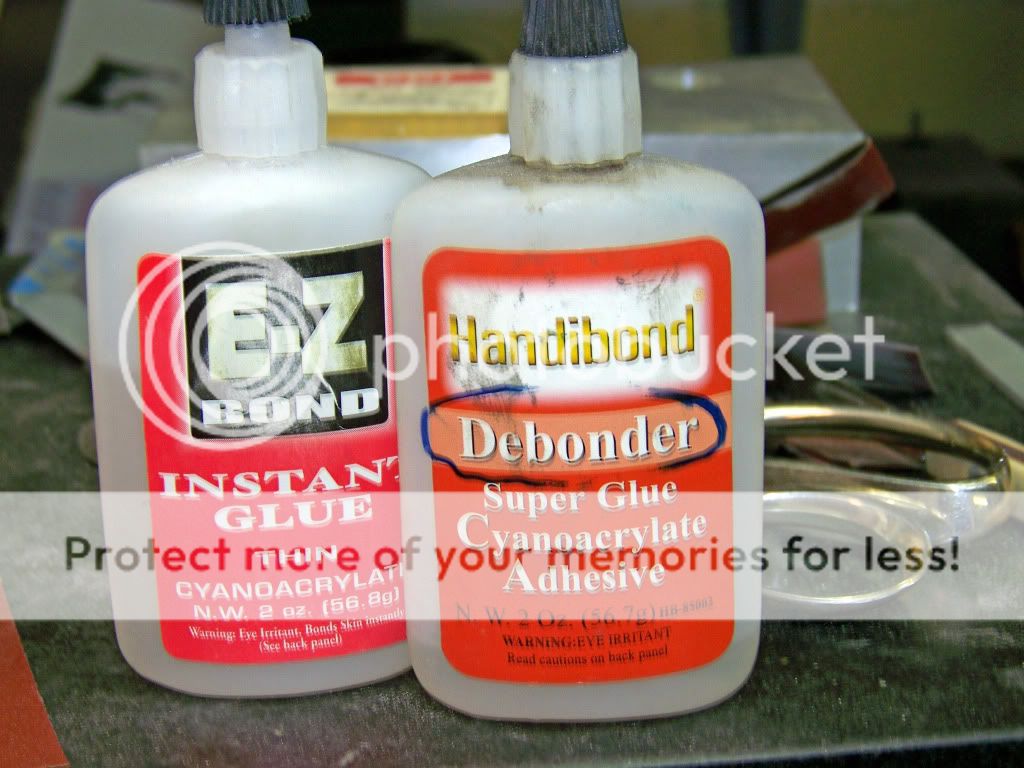
Super Glue Finish

Joined
Feb 10, 2010
Messages
106
I know this has been asked a lot of times but I can't find the answer I'm looking for in past threads. In this thread http://www.bladeforums.com/forums/showthread.php?t=659442&highlight=ca+debonder&page=2 by Bruce Bump he demonstrates the steps in how he does a Super Glue finish. After putting down a few coats of glue he smoothes out the glue by flooding with a debonder, rubs around with tip of his finger over a few applications and sets up to dry over night. Ok here's the question, on the debonder step after he smoothes up the glue with the tip of his finger would you wipe away the debonder with a rag or leave the debonder on to dry with the glue? I plan on practicing a little on a scrap piece first but to save a little product and time I thought I'd ask here first. Thanks ahead for any help.
 
Last edited:
Thanks guys for the advise. Well I've been finishing a handle all day. Didn't think it would take so long for the super glue to dry. I'm trying Mr. Bump's method and just got to the debonder step and once I applied it seemed like the glue softened up just enough to make it a thick liquid. I could not remove with a rag so I'm going to let it dry overnight and see what happens. If it turns out ok I'll post pics.
 
I don't understand the super glue finish. It is no more durable than many other finishes, looks no better, is difficult to apply consistently, and you breathe cyanide fumes!
 
The principle is to make a finish that penetrates the wood fibers without actually coating the wood. Bruce uses de-bonder ( others use plain acetone) to make the glue soluble again and increase penetration. Whatever method you use, the trick is to allow the glue to completely dry ,sand it away, and repeat the process. After from three to ten repetitions, the handle will be completely sealed and glass smooth. With patience, you could take a piece of 1" rope ( or cactus) and make a smooth handle from it using this method.
 
The principle is to make a finish that penetrates the wood fibers without actually coating the wood. Bruce uses de-bonder ( others use plain acetone) to make the glue soluble again and increase penetration. Whatever method you use, the trick is to allow the glue to completely dry ,sand it away, and repeat the process. After from three to ten repetitions, the handle will be completely sealed and glass smooth. With patience, you could take a piece of 1" rope ( or cactus) and make a smooth handle from it using this method.

Thanks Stacy.
yes, Its a good finish and really toughens the wood because of the penetration. They make odorless superglue too for those who dont like to run outside screaming from eye pain. :eek:
 
I see now. You aren't using it for a surface finish, but as a sub-surface treatment.
Bruce, you do world-class work, so I thought I might be missing something.
 
Well I'm all done with this one. I couldn't get the glue to dry after the debonder. It was still just as wet 8 hrs after. I removed all the glue with acetone and started over. I applied two coats then sanded up to 1500 grit to a semi-gloss finish. Turned out good. The reason I wanted to try the superglue is because I bought a big block of some great looking maple burl from ebay and it had a lot of small voids and cracks inside and wanted to fill them. I see this finish is great for that. Its very smooth and hard and you can't tell there was ever a crack or void. A little of work but worth it in my book.
 
Well I'm all done with this one. I couldn't get the glue to dry after the debonder. It was still just as wet 8 hrs after. I removed all the glue with acetone and started over. I applied two coats then sanded up to 1500 grit to a semi-gloss finish. Turned out good. The reason I wanted to try the superglue is because I bought a big block of some great looking maple burl from ebay and it had a lot of small voids and cracks inside and wanted to fill them. I see this finish is great for that. Its very smooth and hard and you can't tell there was ever a crack or void. A little of work but worth it in my book.

Did you follow my directions? Be sure to use the same glue and debonder. It works, believe me but just a couple coats and sanding like you finally did will work fine also.
 
The glue and debonder I'm using is Mercury brand. I left a little of the glue with debonder on a popsicle stick to see if it would dry and it still has not after a couple of days. I think what I did wrong is that I did not let it dry good enough and sand before I added the debonder. The glue was really thick and just turned into a sticky liquid. I'm experimenting on a scrap piece now and ill get it figured out. Thanks Mr. Bump.
 
The glue and debonder I'm using is Mercury brand. I left a little of the glue with debonder on a popsicle stick to see if it would dry and it still has not after a couple of days. I think what I did wrong is that I did not let it dry good enough and sand before I added the debonder. The glue was really thick and just turned into a sticky liquid. I'm experimenting on a scrap piece now and ill get it figured out. Thanks Mr. Bump.

The glue that is used in CA finish is usually the Ultra Thin type so it penetrates, not a gelled, or gap filling type. the thin stuff soaks in instantly.

the pic from bruces thread:
100_3418_edited.jpg
 
Last edited:
I'm sorry I wasn't too clear. The glue was really thick and sticky after the debonder was applied. The glue I used is the thin stuff. I have tried this method again and sanded with 220 before the application of the debonder. That made all the difference. I did the debonder step at lunch and its dry and hard now. I left the sanding job rough from the 220 to see if the debonder would smooth it all out and it done a great job. About 20 minutes ago I sanded with 1000 then 1500 and it looks great. However, I really can’t tell a difference in quality of the knife handle and the scrap piece and using the debonder took a little more time. Maybe it's because the wood was pretty light and it was harder to see any imperfections such as the cloudiness Mr. Bump was describing. I will try some redwood next maybe. All in all I think this is a great alternative to stabilizing for the reason of filling voids and checks in burl. This particular knife is going to be a user for an elk hunting guide and from what he describes it will be heavy use. We'll see after this year’s season how the wood is doing. My father has the knife showing it to a few guys he works with but after I get it back I'll post a picture. Thanks fellas for the help on this.
 
Ok here's the knife. I shouldn't even try to post these pics, I suck at taking pictures. The handle is from a block of ebay maple burl, brass guard with a few spacers and the blade is 1084 that I clay quenched in McMaster Carr 11 sec. The line is visable but I just finished with 800 grit for a good satin look.

dsc01588n.jpg


dsc01589.jpg


dsc01615eb.jpg


dsc01618k.jpg
 
Last edited:
Im in the process of doing this as well. I tested a scrap piece first. When I apply the debonder you only have a few seconds to smooth it out before it tightens and clumps the glue. Any suggestions?
 
Jason, thanks very much for this post. i have been needing to do this on a couple handles but didn't really even know it. and, i certainly wouldn't have known where to start. it looks like Bruce's thread remedies that. I had not seen it. in fact, it gives me a couple ideas for different projects that have been idling.

and, with all that said...congrats on the finished product. looks great. :thumbup:
 
Four and a half year old thread....but still good info.

Ha. i didn't even notice. i noticed that Bruce's thread was old. but, this one popped up in the new posts listing. i guess i didn't even think to look at the date. guilty as charged. :D

but yes...good info, and i'm glad someone else did post on it....or, i probably would have never seen it.

cheers.

P.S. you know the best part? i sent Bruce a message with a couple questions, and he answered them right away. i would never have done that if i noticed the thread was so old. Thanks Bruce!
 
Back
Top