- Joined
- Nov 18, 2007
- Messages
- 277
I had been considering buying a carbide filing guide for some time. The thing that always bothered me is that all of the guides I have seen are built so that the carbide is glued or epoxied into a milled slot. The first problem I could see about that is, most glues and epoxies will expand and contract both with heat/cold and with time. That could cause the carbide to shift and no longer be parallel. The second problem I could see was that if I dropped the fixture the carbide could pop loose and or chip. Then what do I do to try and fix the problem. I don't have diamond grinding equipment for surfacing carbide.
What I came up with is a way to eliminate the glues and epoxies. And also be able to fix the issue of chipped carbide surfaces.
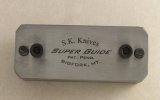
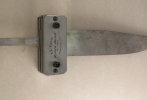
I designed and built the Super Guide.
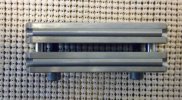
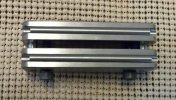
It looks much like any other filing guide you have seen in the past. With the exception of a pair of parallel horizontal guide holes machined along the top of the fixture. The guide holes accept a 1/4" X 3" round carbide rod that is press fit in. Hense, No glue!!
Another great thing about using the rods is that if the rod gets chipped, it can be pressed out with a small drift, rotated a few degrees and pressed back into place. That way when this happens to you, on a Saturday afternoon, like it always does to me, You're not out of business until you can figure out how to get the carbide repaired.
The third great thing about using carbide rods is that it greatly reduces the amount of carbide surface area that is eating the aluminum oxide off of your grinding belts.
I have been using the prototype Super Guide for a couple months now and have saved several hours squaring up shoulders on my knife blades. I used to spend about 15-20 minutes filing each blade. I now spend about 15-20 seconds grinding each blade on the flat platen of my KMG.
No more buying files so that I can ruin them in just 1 or 2 blades.
The Super Guide is built from 2 -1/2" x 1 3/8" x 3 1/2" pieces of cold rolled tool steel and is machined on a Haas cnc mill.
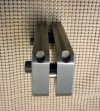
The guide will accept blades up to 2" wide and 1/2" thick.
I have just finished the first run and will have a few available at the Blade Show..
Please let me know what you think!!
Thanks for looking
What I came up with is a way to eliminate the glues and epoxies. And also be able to fix the issue of chipped carbide surfaces.
I designed and built the Super Guide.
It looks much like any other filing guide you have seen in the past. With the exception of a pair of parallel horizontal guide holes machined along the top of the fixture. The guide holes accept a 1/4" X 3" round carbide rod that is press fit in. Hense, No glue!!
Another great thing about using the rods is that if the rod gets chipped, it can be pressed out with a small drift, rotated a few degrees and pressed back into place. That way when this happens to you, on a Saturday afternoon, like it always does to me, You're not out of business until you can figure out how to get the carbide repaired.
The third great thing about using carbide rods is that it greatly reduces the amount of carbide surface area that is eating the aluminum oxide off of your grinding belts.
I have been using the prototype Super Guide for a couple months now and have saved several hours squaring up shoulders on my knife blades. I used to spend about 15-20 minutes filing each blade. I now spend about 15-20 seconds grinding each blade on the flat platen of my KMG.
No more buying files so that I can ruin them in just 1 or 2 blades.
The Super Guide is built from 2 -1/2" x 1 3/8" x 3 1/2" pieces of cold rolled tool steel and is machined on a Haas cnc mill.
The guide will accept blades up to 2" wide and 1/2" thick.
I have just finished the first run and will have a few available at the Blade Show..
Please let me know what you think!!
Thanks for looking