Survivor Skills Test

batosai117

Gold Member
Joined
Jun 5, 2007
Messages
5,463
This isn't really a 'test' just thought that would get your attention. I would like to know how you all would survive if put in the given scenerio:

1. You are lost on a backpacking trip in the colorado mountains, you have your sleeping bag, small tent, favorite knife, maybe a compass if you actually carry one, two liters of water, just about a days worth of food, and a fire starter (flint or matches whatever you prefer). Now, it is an hour before sundown and it begins to snow, you are 3 days into your trip, what do you do?

2. You are on a whitewater rafting trip and for some reason you are by yourself. The trip turns for the worst and you end up with a cut up leg and a bad headache. All you have is whatever it is that you had on you when you entered the raft, now remember everything else, including your pack, got washed away as you were being banged up and run ashore. Now you are 2 days into your trip but now you have a badly injured leg and only the items on your person, what would you do?

Now remember, no answer is a wrong one (unless you are just being stupid don't bother posting). I would just like to hear what you guys would do in these scenerios, maybe some of the same stuff will come up, and maybe some of you have a totally different way to do things. So, good luck on your 'trips' and let me know what you would do. In addition to this, I would like to know what knife it would be that you would have with you and why or how you intend to use it. Now I'm not talking about a 2 to 3 foot sword or monster axe, just something that you would realistically be carrying with you when these events happen.
 
It would depend on the length of the trip - If its the third day and Im ment to be home by sundown. I will ration for food for probably the next 2 or 3 days and just signal. If its a longer trip...
 
Good point, alright, for:

1. you are 3 days in on a week long trip, but nobody is expecting you for another 7 days because you left 2 days early eager to get on the trails.

2. you are 2 days in on a what would have been a 5 day trip going down stream on your raft since you already went 2 days down stream on the raft you are a good distance away from your initial destination.
 
1. doesent sound all that bad, I have a tent and sleeping bag and can ration my food, and hopefully suppliment with Wild game or plants along the way, water can be procured in many ways in these areas, so thats not that big an issue, just keep a cool head, bunk in for the night and start an about face march for home in the am.

2. could be more difficult. I will probably be wet and under dressed, a life vest, pants or shorts and shirt that are all probably wet. I keep a waterproof bag in my pocket on the water containig some basics, a small firstaid kit, Lighter, Magnezium bar, some chord, a flashlight some trash bags and a couple of ziplocks, my adventure medical Pocket pack is also on me with more gear. I generally have a spyderco Salt or endura in my hip pocket and a small Necker around my neck.

Depending on how cut up my leg is, I can probably bandage it up with what I have and start heading back the way I came. I will probably camp there for one day, light a fire to warm and dry myself and my gear, build a debris shelter and generally try to protect myself from the elements. Overall game plan would be, Stay near the water for the purpose of navigation and as a souce of water and food. (pocket pack has fishing gear)
 
1. Isnt to hard as i have been in a similar situation. I would probably set up camp and seeing andI would head in the direction I came in, in the morning. Keep walking till i find the track or civilisation. The food can be rationed and I pack plenty of fishing gear. I also pack snare wire and can add those to the meals.

2. This is harder but manageable. I always have my psk, small fixed blade, ferro rod and a torch on me. A fire will dry me out but I dont pack any bandages in my psk so my bandanna or a sleeve will be sacrificed to to it up. But i can clean it up with the alcohol wipes in the psk. Plenty of fishing gear in PSK so Ill do fine.
 
Situation 1): you can't really give a generic solution: depends on the size of the area, "how much" you're lost, if you have a compass, if there is a linear obstacle, you can aim for, if you have left clues about where you are to reliable people...
First food is not a real concern, you can leave quite a while without eating.
Water is another problem but snow would provide it.
If you can reasonably assume people will be looking for you in reasonable delay, assuming your gear is adequate enough to the weather, you should probably settle yourself a good shelter and wait for rescue in your sleeping bag.
If your sleeping bag and tent are good enough, you don't need a running fire, at least for thermal purposes .
I guess you should also prepare a signaling fire (3 fires as triangle if possible) topped by green branches (for smoke), so you can set it on fire quickly if you hear a plane or helicopter.

If you choose to walk your way out, first you have to be pretty confident about what you're doing because it can make the things even more complicated. If you choose that solution, leave clear clues down your way (inscriptions, marking on trees, notes stating date, who you are, what is your condition, what you plan to do...).
Of course because of stress, lack of food, possible sleep deprivation, you have higher chances to hurt yourself, so you have to be extra careful, because it could make things even more complicated.
Use compass try to aim for roads or rivers. Follow streams: they don't always lead to civilization, but in certain areas, coupled with some general knowledge of local geography, they do.

Situation 2: pretty much the same as situation 1 except you are wounded and have very little gear.
Priorities would be fixing your leg/getting dry (would modulate priority on how bad is the wound/how bad is the weather).
Depending on how complicated it is would probably make some attempts to recover some of my gear down the river (trying not to endanger myself).
From there it would be as 1) expect you have to replace tent+sleeping bag by debris shelter (which means you'll possibly need more fire for thermal purposes) and leg wound would probably increase pain, stress and reduce opportunity to walk out of trouble by yourself.
 
...jump off a clift into whitewater rapids and then squeeze poop to get the juice out. Oh and tumble down the side of a mountain because thats faster than just walking down.
 
The lost one presents a couple different strategies. You could find or build a shelter and wait for someone to find you if they know what area you are in. Trying to find your way out can get you more lost so much depends on how far you are removed from civilization.

If going down will improve your chances with the weather and being found then that would be my idea. Keep your wits about you and face the fact that you may be there for a spell. Survive for a better day.

Like others have said on the second situation with the raft. Same deal applies. How bad are your injuries? Can you make your way back up river or if not try to find shelter where you can be seen from the river or the air if search for you is inevitable.

In these kinds of situations, survival trumps all other concerns.
 
There are some interesting answers so far and I'm glad to get so many posts back so quickly. Now, seeing as how the leg keeps getting brought back up, let's say it was your shin which was banged up as that part of the body would be flailing around as you were tumbling in the water. Now as for the overall injury, let's say that you had a 3 inch gash (or 7-8 cm for some of you) on the outside part of your shin (the part of the leg facing outward).
 
all these views and no more responses? come on people, no wrong answers, just say what you think you would do.
 
Where is Colorado ?
:)
Yeah , Id be hellishly lost if I was there ... Im SPOSED to be in Aus ...

Whitewater rafting isnt a problem .. Id have to go a long way to find a river with enough water to go rafting now .

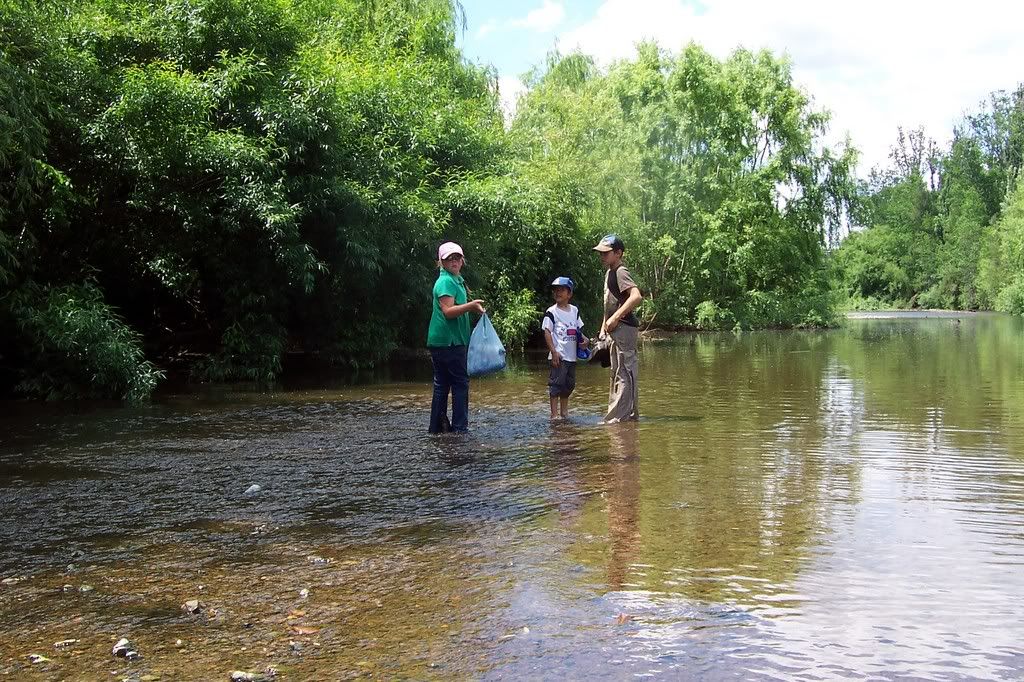
Still , even when we hiked the river bed last weekend a first aid kit , food and water came along with us we were on a 4 hour walk only , but we could have stretched the food we took out to last 2 days , and the food availiable there anyway is good , the fish are trapped in pools mostly , easy to spear , the bamboo grows along the bank , almost ready made spears , and with some poking around , the shoots are easily found and they are also edible , bullrushs grow long the shallows , their roots are edible , lift the rocks and grab the yabbies as they scoot hunt the turtles out from the willow roots , flick the eels out with a bamboo stick ( the water is really low , and this is not hard to do right now ) , even the thistles , nettles and "farmers friends" are edible , I have a billycan in my day pack , not big but enough to cook in , both myself and the eldest boy have a firesteel and at least one knife each

I feel very much like a city dweller at times when I bother to take a ready made snack when we go places like this .

FWIW , this is about as close as it gets to whitewater rapids
100_4399.jpg
 
Here's another from Field and Stream:

Question 1. If you are forced to spend the night outside, the first thing you should do is:

A. Start a fire
B. Build a shelter
C. Climb a tree

Question 2. Why is a wristwatch an important piece of cold-weather gear?

A. It can help you start a fire by focusing sunlight with the crystal
B. It can help you calculate the remaining hours of daylight
C. It can serve as a makeshift compass should your magnetic compass freeze up

Question 3. If you must spend the night in the mountains, where should you seek shelter?

A. On top of a mountain
B. In a valley
C. Somewhere in between

Question 4. If you feel cold, should you refrain from drinking cold water?

A. Yes
B. No

Question 5. In cold weather, how often should you stop to assess whether you need to put on more clothing?

A. Once a day
B. Twice a day
C. Never

Question 6. What’s the best food to eat to keep warm?

A. Red meat
B. Butter
C. Granola

Question 7. If you detect the telltale white spots of frostbite on your buddy’s cheeks, you should:

A. Rub them with snow
B. Ignore them until they become painful
C. Stop and build a fire

Question 8. The best way to prepare your clothes for winter wear is to:

A. Clean them
B. Sew in liners
C. Wear them to work to break them in

Question 9. If you break through the ice of a stream and get wet up to your hips, the first thing you should do is:

A. Suck it up and keep walking; you’ll be uncomfortable but fine
B. Dry out your socks and pants
C. Do jumping jacks

Question 10. If you’re spending the night in the winter woods and find yourself nodding off, you should

A. Go ahead and fall asleep
B. Stay awake—if you fall asleep, you may freeze to death
C. Close your eyes for 30-second intervals

ANSWERS

1. The answer is B. The first thing you need to do is create a shelter from the wind. If you are not wet and have adequate clothing, you can easily survive a night in cold weather as long as you stay out of the wind, which will suck the heat from you and induce hypothermia before you know it.

2. The answer is B, it can help you calculate the hours of daylight left. Winter daylight is a precious commodity. You should know at what time the sun sets and plan accordingly so that you won’t find yourself in an unfamiliar place when night falls, making it more difficult to find your way out. Dumb answer IMO. Compass is important too. Which one is more important will depend on the situation.

3. The answer is C, somewhere in between. Warm air rises and cold air sinks, so valleys are often 20 degrees colder than higher ground. But the tops of mountains are exposed to higher winds. It’s best to seek shelter somewhere in between, going low enough to avoid exposure to winds and staying high enough to keep out of pooling frigid air.

4. The answer is B, don't refrain from drinking, even if the water is cold. In cold weather, you can dehydrate quickly without knowing it. And when you are dehydrated, you are much more susceptible to the cold. You need to drink at least 2 quarts of water per day, and you must drink that water before you feel thirsty. When your mouth gets dry, you've waited too long. Carry water next to your body to keep it from getting too cold. If you have waited too long to drink, it's best to build a small fire and brew up a hot drink, which will rehydrate your body without draining body heat. If a fire is not an option, drink the water anyway.

5. The answer is C, Never. You don’t need to think about putting on more clothing; you’ll automatically do it when you get cold. What you do need to think about, however, is taking off layers as you warm up. It is all too easy to keep walking, and keep sweating, until your base layer is saturated and will sap the warmth from your body. It’s better to stop frequently and consciously judge whether or not you are starting to sweat. If you are, strip off a layer. Maintaining warmth without sweating is your goal.

6. The answer is B, butter. Food with lots of calories will see you through a cold day and a colder night. And fat packs twice the calories of protein or carbohydrates, which is why the Inuit eat whale blubber. Mash up a stick of butter with some brown sugar and carry the mixture in a sealed plastic bag. Eat it all.
Hmmm- didn't we have a debate about this recently?

7. The answer is C, stop and build a fire. Rubbing snow on frostbite is a ridiculous wilderness myth. Hmmmm- isn't this what Grylls recommended after he fell into the hole in the artic ice. Seek shelter, protect the affected body part, and get a fire going to warm the victim and the frostbitten area. Though of course it's far better to prevent frostbite with good clothing and roomy, warm boots than to have to treat it.

8. The answer is A, clean them. Clean clothing is warmer than dirty clothing (the latter does not trap air efficiently). Have woolens dry-cleaned and put synthetics through a second rinse cycle to remove all traces of soap, which absorbs moisture and renders clothing less effective at trapping insulating air.

9. The answer is B, dry your clothes. Being wet leads to being dead. Stop, build a fire, and dry out as fast as you can. Then head for home or camp.

10. The answer is A, go ahead and fall asleep. Don’t worry about freezing to death. When you start to get cold, your body will shiver involuntarily and you’ll wake up. Only in the later stages of hypothermia do you need to worry about drifting into unconsciousness and dying. IMO the answer should be in a survival situation, you'll often find that you either aren't warm enough to be comfortable and will shiver keeping you awake despite your attempts at sleeping OR will wake up every 20 minutes when the fire burns down to much.

YOUR SCORE: 10 of 100
Play again

How Did You Do?
100: Excellent. You know how to handle yourself in the winter woods.
80-90: Not bad. But don't get too excited. This test wasn't that hard.
60-70: Hmmm. Maybe you should stick to camping out in your back yard.
Less than 60: Go back to Starbucks, city boy. Should say, go to the hotel, pretend SAS boy.
 
I liked this one alot, learned a few things and backed up some other stuff that I would have done. Keep the replies coming, J.
 
I liked it also! Lots of good info to chew on. IIRC didn't Bear recommend rubbing the snow on yourself to absorb the excess water on your skin? If anyone remembers for certain, please chime in. Thanks. -Matt-
 
Yeah, that's what I remember. Still dumb. He should be building a fire immediately. In a few minutes he may not be able to use his hands. Then get the clothes off and get dry. Shelter if possible. Windbreak at least. Your really in trouble if you can't make fire in that situation. Better hope you have some warm buddies who will spoon naked...or furry friends. Rubbing freaking snow on yourself is a waste of time and certainly doesn't improve your chances of living.
 
Yeah, that's what I remember. Still dumb. He should be building a fire immediately. In a few minutes he may not be able to use his hands. Then get the clothes off and get dry. Shelter if possible. Windbreak at least. Your really in trouble if you can't make fire in that situation. Better hope you have some warm buddies who will spoon naked...or furry friends. Rubbing freaking snow on yourself is a waste of time and certainly doesn't improve your chances of living.

That's what I was thinking...forget the snow, put the energy into getting that fire as big as you can. The clothes, as wet as they would be, should provide more protection than being naked with snow on you, right?
 
Back
Top