
-
The BladeForums.com 2024 Traditional Knife is available! Price is $250 ea (shipped within CONUS).
Order here: https://www.bladeforums.com/help/2024-traditional/
You are using an out of date browser. It may not display this or other websites correctly.
You should upgrade or use an alternative browser.
You should upgrade or use an alternative browser.
Sweden Alert!!
- Thread starter waynorth
- Start date

- Joined
- Jan 17, 2013
- Messages
- 30
The stamp indicates that the knife was made between 1929 and 1939. Knivbolaget (the knife company) was the biggest knifemaker in Eskilstuna at the time, and was later to become EKA. The company goes back to 1882 ! All manner of pocket knives were made and many for export, especially to France. They are considered to be of high quality, and many models used etched scales, mother-of-pearl and other fancy materials. Yours seem to be the most basic of the basic knives.
  The company had almost 500 variations of 82 models of knives in 1929.
! All manner of pocket knives were made and many for export, especially to France. They are considered to be of high quality, and many models used etched scales, mother-of-pearl and other fancy materials. Yours seem to be the most basic of the basic knives. The company had almost 500 variations of 82 models of knives in 1929.
waynorth
Dealer / Materials Provider
- Joined
- Nov 19, 2005
- Messages
- 34,747
Thanks, Swedish_Steel.
There is an essay in "Blades Guide to Knives and Their Values", located by our emminent researcher, Jon_Slider, that suggests 1925 to 1944, so you and the Guide are pretty near agreement.
Thank you both!!
I am going to bring the knife to a couple of wood experts I know of, to help determine the species.
Thanks to all for your suggestions about the wood. It is not always easy to determine the type of wood from a small sample, on the internet.
I am also going to sharpen the knife and give that (presumed) Swedish steel a real world test!
There is an essay in "Blades Guide to Knives and Their Values", located by our emminent researcher, Jon_Slider, that suggests 1925 to 1944, so you and the Guide are pretty near agreement.
Thank you both!!
I am going to bring the knife to a couple of wood experts I know of, to help determine the species.
Thanks to all for your suggestions about the wood. It is not always easy to determine the type of wood from a small sample, on the internet.
I am also going to sharpen the knife and give that (presumed) Swedish steel a real world test!
- Joined
- Aug 24, 2010
- Messages
- 1,447
To my untrained eye, it looks like Swedish Oak — Quercus robur aka English Oak. And some great steel..

Last edited:
waynorth
Dealer / Materials Provider
- Joined
- Nov 19, 2005
- Messages
- 34,747
Well, I was just laying on the floor in my dining room, comparing this Swedish knife's handles with the oak flooring. I couldn't find an area of floor that looked definitively like the handles, but there were some similarities.
I am not convinced we have oak in our specimen.
Earlier I sharpened the knife. First I established a choil, as to me, that is critical to doing a good job. My favorite triangle needle file worked hard, suggesting a fairly high hardness, even at the tang.
But it didn't take long to effect a good edge - a tribute to the owner before me.
After a few stropping strokes on the back of my belt, the blade will cleanly slice the flimsy paper I get as deposit receipts. Pretty amazing!
Now we'll just have to see how the edge lasts.
It's an adventure and an honor to have custody of this Swedish knife!
I am not convinced we have oak in our specimen.
Earlier I sharpened the knife. First I established a choil, as to me, that is critical to doing a good job. My favorite triangle needle file worked hard, suggesting a fairly high hardness, even at the tang.
But it didn't take long to effect a good edge - a tribute to the owner before me.
After a few stropping strokes on the back of my belt, the blade will cleanly slice the flimsy paper I get as deposit receipts. Pretty amazing!
Now we'll just have to see how the edge lasts.
It's an adventure and an honor to have custody of this Swedish knife!


- Joined
- Dec 7, 2013
- Messages
- 914
I'm gonna through larch and sallow into the mix...just for the heck of it
The larch..... The larch......
- Joined
- Nov 29, 2000
- Messages
- 1,926
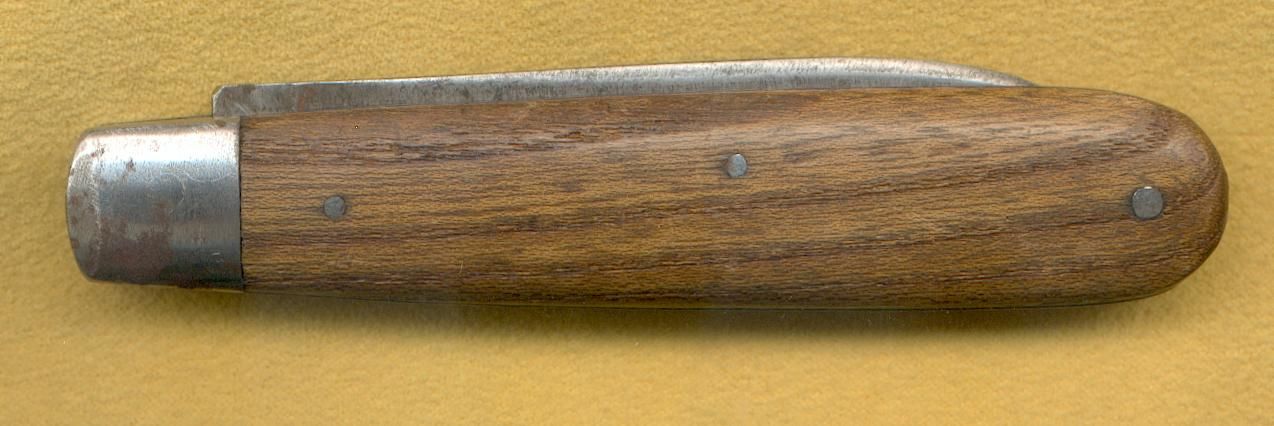
This side of the knife resembles oak, but it misses the typical and pronounced rays running across the growth rings, as well as the typical ray flecks which might show up in this section of the wood.
Beside birch, the wood also resembles English walnut, which has quite a range of looks and especially in lower grades, can have a coarse grain. Walnut was (and still is) a typical handle material in Europe, since it is also quite stable in service (moves very little with humidity changes).
http://www.museumfurniture.com/wood/walnutdir/walnut2.jpg
