
-
The BladeForums.com 2024 Traditional Knife is available! Price is $250 ea (shipped within CONUS).
Order here: https://www.bladeforums.com/help/2024-traditional/
You are using an out of date browser. It may not display this or other websites correctly.
You should upgrade or use an alternative browser.
You should upgrade or use an alternative browser.
Swedges
- Thread starter Lo/Rez
- Start date
- Joined
- Nov 8, 2009
- Messages
- 1,533
I read somewhere a long time ago that the purpose of a swedge was to make the tip thinner so it would slice better. I suspect that it's actually a cosmetic preference as often as not, but reading that actually made me rethink my idea of edge angles and grind types back then and leaned me towards full flat grinds, with no swedge

KnifeHead
Knifemaker / Craftsman / Service Provider
- Joined
- Apr 5, 2006
- Messages
- 5,576
Here's a post I wrote about swedges that you might find helpful. http://www.bladeforums.com/forums/showthread.php/503503-A-Brief-Study-On-Swedges

- Joined
- Dec 21, 2006
- Messages
- 3,158
Well, I am trying to wrap my head around how a swedge, by thinning out the spine, makes it cut better. Never really thought about it much at all, and these are my initial thoughts.... If the spine is thinned out, the bevel is still just as thick as it was to begin with, right at the bevel/swedge conjunction anyway. I think of a V cross section, then cut the swedge to make it a coffin shaped cross section. Does the thinning out of that little material near the spine really add to cutting ability? I can certainly see how a swedge would allow easier stabbing, but push cutting/slicing? To me, it is more form over function. But I am not so hard headed to where I can't learn from you guys!!


james terrio
Sharpest Knife in the Light Socket
- Joined
- Apr 15, 2010
- Messages
- 22,618
A crowned spine works just as well or better than a swedge when it comes to stabbing stuff or passing through deep slashing cuts. Other than that, it's mostly for looks... and they do look cool as heck, no question about that.
For fighters, there's no sense in putting a clip or swedge on a blade unless it's sharpened. It's almost frightening, how well a sharp clip digs in and cuts on a back cut.
For fighters, there's no sense in putting a clip or swedge on a blade unless it's sharpened. It's almost frightening, how well a sharp clip digs in and cuts on a back cut.
- Joined
- Feb 7, 2014
- Messages
- 1,161
I was under the impression that a swedge like on the Spyderco Native 1 was mainly for weight reduction.

Fred.Rowe
Knifemaker / Craftsman / Service Provider
- Joined
- May 2, 2004
- Messages
- 6,848
I use swedges to reduce weight forward if a blade dose not balance where its supposed to. As James pointed out, on a fighter they double the usefulness of the blade, in actual use. Any blade built for puncturing will benefit from one.
This fighter is blood letting sharp on both edges and I don't remember how many times I cut my self during the build.

This fighter is blood letting sharp on both edges and I don't remember how many times I cut my self during the build.
- Joined
- Jun 5, 2012
- Messages
- 1,071
I've found that they can help on certain blades with curving cuts through softer materials. They look cool, can aid in balance, as mentioned above.
I'm not saying that they cut better, but they most certainly don't cut worse with a swedge. If the swedge is integrated properly with the bevel and tip, I feel they can assist to some point there.
I'm not saying that they cut better, but they most certainly don't cut worse with a swedge. If the swedge is integrated properly with the bevel and tip, I feel they can assist to some point there.

- Joined
- Oct 20, 2008
- Messages
- 5,547
To me, like Fred said, it's about balance first and aesthetics second. You want a fighter to be fast, what better way than to reduce weight at the tip.
For swedges that have plunges, I grind like beveling a blade... for swedges that blend up to the spine, I grind vertical on the platen or wheel. Strong light at the grinder is your friend, and if you have a blade with time invested, mark it out first and grind to the line.
For swedges that have plunges, I grind like beveling a blade... for swedges that blend up to the spine, I grind vertical on the platen or wheel. Strong light at the grinder is your friend, and if you have a blade with time invested, mark it out first and grind to the line.

- Joined
- Dec 4, 2001
- Messages
- 3,824
They look cool, and if incorporated with the point can really help with stabbing cuts, and on small knives can make for a wicked precision point. As far as cutting, they do nothing to increase the initial cut, but once the material is flowing over the blade, like say slicing through meat or fruit or what ever, the swedge allows for a slightly thinner wedge and for the material being cut to flow around the wedge. Take a look at the Japanese sword cross section, the flats are not flat, they are tapered or swedged to the spine, i.e. narrower at the spine than the end of the bevel, which is convex, to reduce drag in slicing cuts.
Just my .02 cents on the subject. I don't normally do swedges on drop point hunters, but bowies and such I often do.
Just my .02 cents on the subject. I don't normally do swedges on drop point hunters, but bowies and such I often do.
- Joined
- Dec 21, 2006
- Messages
- 3,158
Ah...that's right. The top of japanese blades (swords/tantos and the like) do indeed have a couple swedges on the spine, one each side. They spent quite a bit of time studying how to slice thru someone.....so......there ya go! Good info.

- Joined
- Dec 26, 2013
- Messages
- 301
On long swords that will swing fast you would think aero dynamics would have a say it how straight it swings, much like a heleicoptor blade. Put a foil in it basically. As far as small shear trusting ability would be my two pennies.

- Joined
- Mar 19, 2012
- Messages
- 7,863
much like a heleicoptor blade. Put a foil in it basically.
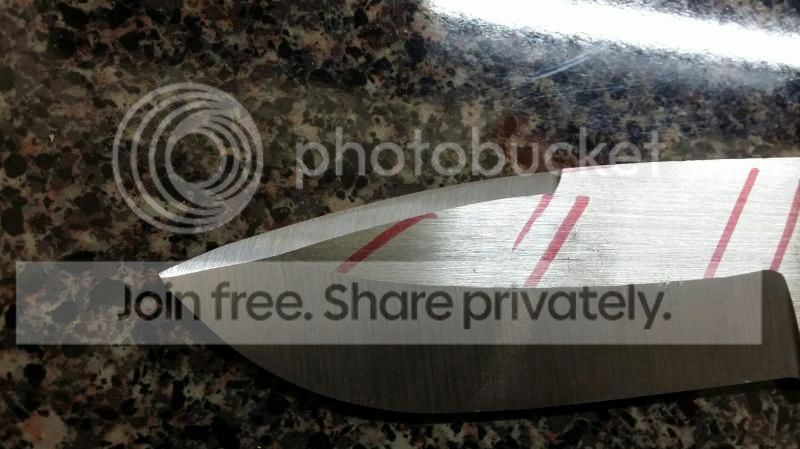
Swedges come in two flavors, single and double, a sword would have a double swedge

- Joined
- Mar 5, 2014
- Messages
- 202
I have considered using a sharpened swedge on an outdoor knife as a chopping blade to keep a more fine main edge from being abused. It would only work ergonomically with a very straight handle.
John, can you elaborate on a double swedge? I don't know what that would look like.
Swedges come in two flavors, single and double, a sword would have a double swedge
John, can you elaborate on a double swedge? I don't know what that would look like.

james terrio
Sharpest Knife in the Light Socket
- Joined
- Apr 15, 2010
- Messages
- 22,618
I was under the impression that a swedge like on the Spyderco Native 1 was mainly for weight reduction.
If you think taking off a gram of steel right at the tip on a knife that size makes a serious difference in overall weight or balance...

On a fighter or bowie or camp knife that's 8+ inches long and plenty more than an inch wide and more than 3/16" thick... heck yeah, swedges can dramatically affect weight and balance. Of course, so can a full-distal taper. And a tapered tang. And whether the handle is made of G10 or unstabilized maple...
It's all about percentages.
- Joined
- Dec 26, 2013
- Messages
- 301
This is what I was thinking about, I had to re-find it. I'm not sure this is totally true but it was something I had read which lead me to my answer. I am no expert by any means on swords or properties of any particular sword but dynamics are dynamics and they will always be around. http://blogs.scientificamerican.com...ence-of-swords-the-sound-of-approaching-doom/