Sword Heat Treat forge question

Joined
Jan 10, 2010
Messages
1,818
I'm setting up a sword heat treat forge in a 55 gallon drum. I intend to have it sitting vertically and with a steel muffle located centrally and refractory lining the inside of the drum. The blade will be lowered into the muffle and hang during the soak. I now have a burner port located on the bottom of the drum and situated to deliver flame tangentially for a nice swirling heat around the muffle. I intend to have PID/SSR/Solenoid control of the burner. What are folks' opinion of using a venturi versus forced air for optimal heat .. i.e. even heat? I have a side arm type venturi from Zoeller that is currently not being used. I understand that it's nicer to control the blown type due to the issue of the burner turning on and off etc... but I don't mind dealing with that for the sake of a simpler control set up and if it delivers nice even heat.

Also.. I read somewhere a while ago... and now I can't find it.. that somebody was using a gate valve to control the blower fan output rather than the motor controllers. Can anybody shed any light on this option???
 
Scott... one enemy of the venturi burner is back pressure. That will greatly effect the performance. I am not totally familiar with the barrel oven but have used a muffle rig with my horizontal propane tank forge. Any attempt to close the cavity cause the Z-Burners to spudder out. It was worse when the forge was at heat because it caused multiple mini-explosions as the superheated gas would back-up and ignite in the burner tube. Perhaps, the larger barrel oven doesn't do that, but it is something to consider.
 
If you want to use a venturi burner and are worried about pressure, just lessen the pressure going in. I have an NC knifemaker, I block off 3 of the 4 holes on the burners which lessens the amount of pressure going in, the dragon's breath coming is a slow, long and lazy blue flame and the temperature inside is incredibly even.
 
You won't get a venturi burner to work well on a forge that size. You will need a large burner tube and and flare, and a good blower. I would use 2" pipe from the blower and gas inlet, with a 3" mixing chamber, and drop to 1.25" or 1.5" at the flare. The drum lining will need two inches of kaowool, 3/8"-1/2" satanite, and ITC-100. You will need to let the forge soak for 20 minutes to 1/2 hour before doing a HT. Be sure there is enough gas exit room to allow proper chamber pressure ( no back pressure). I use the rule of ten times the exit port as the gas line inlet.
 
I have seen a Ron Reil burner work incredibly on more then one occasion in drum forges.
 
Last edited:
okay thanks guys.... I already have the 2" pipe from the blower on my forced air burner that I use for my general use forge.... but no mixing chamber. Are you talking about something like a 3" diameter pipe section with the inlet coming into that and then stepping down to the flare?

I'm preparing for long pre-heats just to get the muffle up to temperature. Which brings up another issue..... Am I going to want a second thermocouple inside the muffle somehow???

I'm going to have a nice thick layer of 3000 castable refractory over the wool and plistix over that. But I was thinking that was over-kill. Jesus Hernandez's water tank heat treat forge for his katanas has only 1" of wool and not much else..and he uses a venturi. But... I built my first one like that and I haven't been happy with it at all. Although I never tried it with a muffle.
 
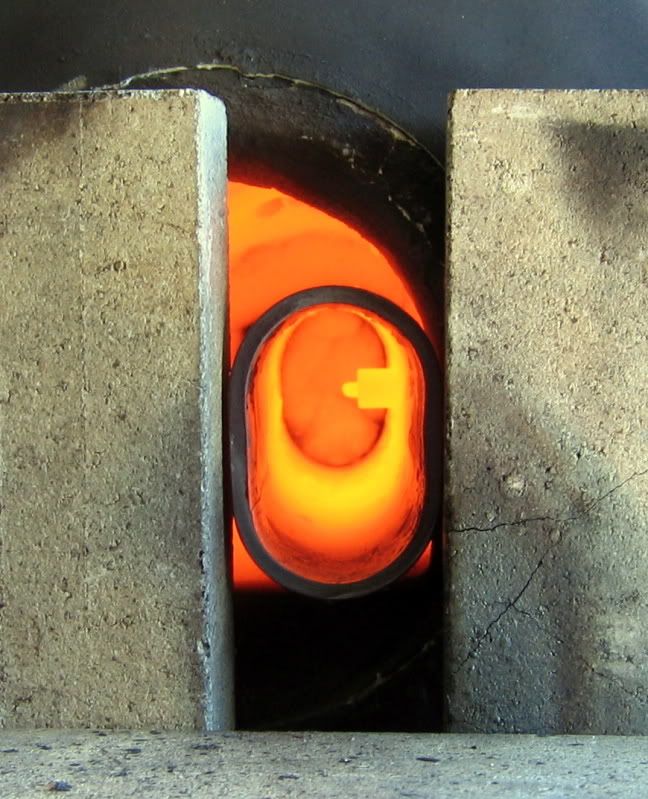
Scott... I had a thermocouple passing through the wall of my forge and into the muffle pipe. I wrapped(kaowool) the length that was exposed in the forge cavity to help keep it from getting a false reading.

IMG_0104-2.jpg
 
Thanks Rick... Yeah I figured I would probably end up doing something like that. Seems like I should have one in the main chamber and one in the muffle.

Brian.. I wish I would've seen that thread before lining mine.. good idea he had with that.

Man... I'm starting to get overwhelmed with this project. Between figuring out the forge and wiring all of this PID/SSR stuff .. my head is about to explode.
 
Nothing against blown burners, but some of you guys must not have stuck with venturi long enough to get one to run just right. Not bragging or anything, just saying I find it pretty simple to get a venturi burner to run in anything from an almost totally closed up forge to wide open air. Sidearm, Reil, mongo, what have you. Concentricity and a correct orifice size/placement will do a lot. A flare helps but I've not found it essential. I'm sure though that blown will help with even heat in this vertical iteration of the drum forge...

More in line with this thread, I'm watching this build and wishing you luck, Scott. When I got into this it was in large part with swords as a long term goal. Lucky I have guys like Don Fogg, Phillip Patton, and you to iron out some of the details in equipment before I end up building it.
 
Salem,
Thanks for bringing that Patton thread to the top. It seemed like a good build.

I am a venturi man, too.... but how were you able to run one in a closed cavity? The only thing I can think of is that the cavity was large enough, not to cause a problem. I had 2 burners in a propane tank forge with a closed muffle system. I guess it was too much for such a limited space?
 
There are many folks performing foundry work with venturi burners (and they are also used in many HUGE industrial ovens/kilns), so the potential BTU output is there. Like Salem and Rick said, if the design of the burner and forge is correct it will work.

From an engineering perspective the nice thing about the blown option (with a high pressure blower) is that back pressure is not an issue, and sizing the burner is much less criticial.

Scott, if you are not performing any work outside the muffle, I don't think that you would gain anything from having a TC anywhere besides inside the muffle (other than satisfying curiosity).
 
Scott, if you are not performing any work outside the muffle, I don't think that you would gain anything from having a TC anywhere besides inside the muffle (other than satisfying curiosity).

I think he would. TC improves the refractory to keep more heat in the cavity. A "tighter thermal seal" (for lack of a proper term) means the unit will run more efficiently. I would suggest no refractory on the muffle pipe, itself but instead make it so the pipe can be removed and replaced. The muffle should be thick-walled pipe to diffuse the heat and add thermal mass for temperature stability.
 
Last edited:
Rick? You're absolutely right if you're speaking of "top coat". I was answering his question on using another "thermocouple" (TC for short in industry) in the forge interior, outside of the muffle. Sorry for not being clear.
 
Oops... derp... my fault.... don't know why I was thinking refractory coating.

ETA: Now, I know why I thought coating.... ITC-100 ceramic coating is used a lot by forge builders. I'm glad to know I wasn't THAT far off... lol.
 
Last edited:
I'm still curious to hear how Phillip's worked, as I don't recall anything about a muffle in his build. Not that I think it's a bad thing, I use one myself in my horizontal forge for HT, but it does seems to complicate a couple aspects of the build.

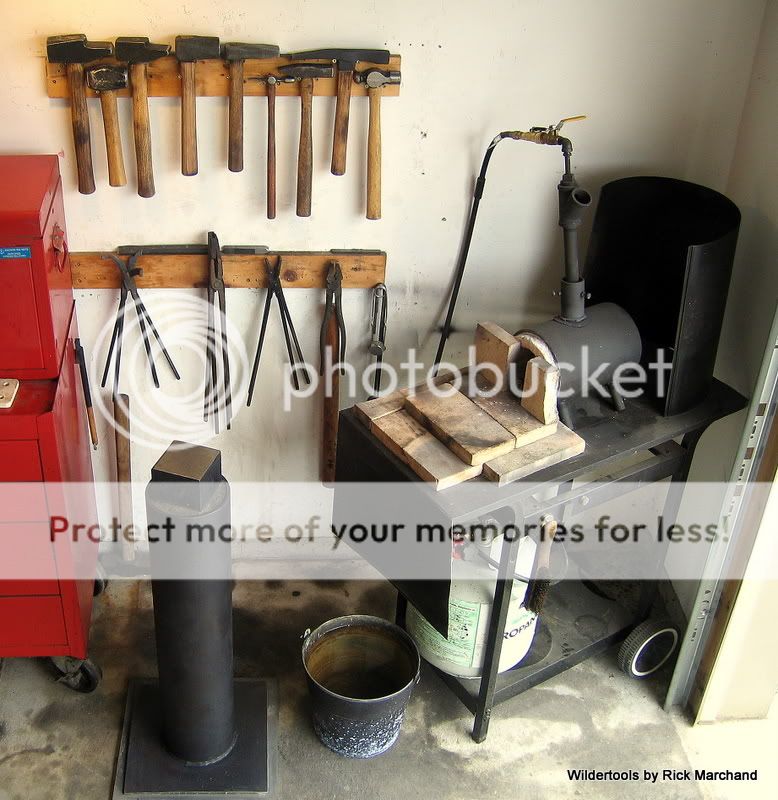
Rick, as for the venturi thing, an example is my current small forging forge- it's 8" pipe, 12" long, with a 3/4" Reil burner in the middle. IIRC, it's a #60 jet or so. I can turn it down to 1 psi or less, in which case I can have the back door closed (bricks) and the front door open an inch square or less no problem. It's just a small burner turned down low. Also, some exhaust no doubt leaks past the bricks...

It's great on gas, why use anything bigger if I don't have to.
 
... my current small forging forge- it's 8" pipe, 12" long, with a 3/4" Reil burner in the middle. IIRC, it's a #60 jet or so. I can turn it down to 1 psi or less, in which case I can have the back door closed (bricks) and the front door open an inch square or less no problem. It's just a small burner turned down low. Also, some exhaust no doubt leaks past the bricks...

It's great on gas, why use anything bigger if I don't have to.

That's basically my set up too, bud...

IMG_0046-4.jpg
 
Scott, I haven't been online for awhile and just saw your post, so it's probably too late for you to change course, even if you wanted to; but I want to call your attention to a post by Dee on the Fogg forum. She has a detailed wip on making a thermostatically controlled electric oven for swords. I don't have it bookmarked, but I'm sure it would be easy to find. The thing is, it's very easy to do and gives you perfect temp control. It's definitely the way I'm going to go. By the way, I will be posting pictures of my first sword in a few weeks, as well as my second (a broadsword) and my third (a saber), still have to Ht these two. I have to say making swords has renewed my interest in the whole making process.
 
Last edited:
Back
Top