Table for DeWalt Portaband (dumb question!)

Joined
Sep 16, 2002
Messages
1,577
Hey guys,

I have the DeWalt Portaband saw and a piece of aluminum sheet that I want to make into a work table for the saw (like the ones pictured here http://www.bladeforums.com/forums/s...-Mounting-Pictures-Needed?highlight=portaband ). The only problem is that I can't seem to wrap my brain around the problem of how to cut the slot for the blade and drill the mounting holes so that everything lines up? :confused:

I'm sure the solution is quite simple, but I just can't seem to figure it out. Please go easy on me...and thanks for any guidance! :o
 
The easiest way I've found to do things like this is to make templates out of heavy cardboard. MUCH cheaper than wasting aluminum or steel.

Charlie
 
you might study the SWAG Offroad design. I have one of their tables and am supremely pleased with it!

I was having difficulty figuring out the mounting of my milwuakee saw in it, until i realized the guide nuts on the saw are loose in a T channel!
 
Paul, I used alu at first too but with time it pitted and scratched. I now made a bigger one out of 0.250 steel plate and I am much happier with it.
Now to the problem at hand. The need for precision is there but not to the extreme. The 2 retaining nuts move up and down the channel so all you need really is for the holes to be lined up correctly and space about right. Drill and chamfer the holes. When that's done, fix the table and mark where your blade channel would be. Use a square to get a straight line, put your factory table back on and cut it all to way until it hits the back of the saw. Voila! I think I made this one 10"x10". First one was too small.
 
Patrice Lemée;9559770 said:
Paul, I used alu at first too but with time it pitted and scratched. I now made a bigger one out of 0.250 steel plate and I am much happier with it.
Now to the problem at hand. The need for precision is there but not to the extreme. The 2 retaining nuts move up and down the channel so all you need really is for the holes to be lined up correctly and space about right. Drill and chamfer the holes. When that's done, fix the table and mark where your blade channel would be. Use a square to get a straight line, put your factory table back on and cut it all to way until it hits the back of the saw. Voila! I think I made this one 10"x10". First one was too small.

So where are the pix dude?! :)
 
Thanks guys. I haven't actually removed the factory 'table' yet to see exactly how its mounted, so I guess I'll start there. But I'm still perplexed about how to get the blade slot and mounting holes in the right places so everything lines up. I.E., if I take the blade out to locate the mounting holes, then how do I know exactly where the blade goes? Alternatively, if I leave the blade in and cut the slot, how do I locate the mounting holes?

If I wasn't broke, I'd just buy the Swag offroad table, but I am so I won't ;)
 
Remove the mounting screws, take the sized table top and cut the blade slot.
When satisfied with the placement of the slot, turn off the saw. Take a marker
and locate the holes from UNDER the table through the bracket. Drill and
countersink as needed.

Hope this helps.

Bill
 
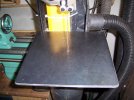
I made a pattern out of carbord to get everything where I needed it, and when statisfied I transfered it to 1/4" steel plate! This is the final product. I have seen it where the slot is cut from both directions but doing it this way allows for changing of the blade without removing the table.


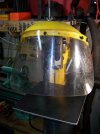
Now I can't remember if I did the holes first or the slot. But either way it's about the same. I would cut the slot first, then mark for two holes. They are bolts in the channel below as you surely know so they don't need that much precision from front to back, just in a straight line. Here are the pics with the automatic face shield included for good measure. Sorry I can't explain it any better with my limited grasp of Shakespeare's tongue.

100_3748.jpg
100_3749.jpg
100_3750.jpg
 
Bill, Dixie, and Patrice, thank you guys for your help, descriptions, and pictures! Bill, when I said in my first post that I was sure the solution was simple, it seems I was right (ie, mark the holes from UNDERNEATH!!)

I haven't had time today to take the factory 'table' off to get a better look at things, but I hope from the suggestions and pictures you guys have posted that it will now be straightforward job. If I come up with any other questions, I'll post again.
 
why cant you lay the old rest on the new chunk of steel and mark the holes? and the position of the blade channel?
 
OK I had these pics yesterday but due to an upgrade of my PC made by my son-in-law and my poor PC skills I could not figure out how to make them upload.

This is pic of the table on my Dewalt Porta Band Saw. I made the table from cardboard originally and used short pointed studs screwed into the original nut that holds the small rest that comes with the machine, to locate the position need to drill and countersink the screws to attach the table.
Once I had it established I used a square to orientate the blade squarely to the machine. I then cut the new one out 1/4" steel and I painted it with Ospo to stop any rust and buffed with steel wool and two more coats of Ospho. The lines were painted on the table to help me keep a piece square when running it through the saw.
CLICK THUMBNAIL FOR LARGER VIEW:


Using a heavy piece of carboard.
Cut your cardboard square and cut the slot into it square from what will be the front side, (remember you can change the stop point of the slot on the real table).
Using a small square across the front of the cardbaord table and establish you are square with the blade. Push the carboard down onto the pins screwed into the nuts from the orgional table, (this establishes the screw holes for the top).
Once you establish the table mount the cardbaord and make sure it is all square to the blade.
You will need to cut the back left hand corner of the table at a 45* to allow for the blade to have clearance as seen in the last pic.

I hope this makes it easier.

Their only two things I would have done differently about this build is the table that supports the Porta Band would need to be more to the back of the steel plate, since the marjority of the weight is in the front. Without being mounted the saw will not stand on its own. It misses its own balance point slightly!
Also I and this one I may do yet is like Patrices rig I need a vacum hookup, you do not realize how much steel dust you create till you begin to see it pile up on the bench!
 
Last edited:
why cant you lay the old rest on the new chunk of steel and mark the holes? and the position of the blade channel?

Thanks 724...I had that same thought, but when looking at it the other day I wasn't sure that was going to work (although now I can't recall why I thought that.)

OK I had these pics yesterday but due to an upgrade of my PC made by my son-in-law and my poor PC skills I could not figure out how to make them upload.

This is pic of the table on my Dewalt Porta Band Saw. I made the table from cardboard originally and used short pointed studs screwed into the original nut that holds the small rest that comes with the machine, to locate the position need to drill and countersink the screws to attach the table.
Once I had it established I used a square to orientate the blade squarely to the machine. I then cut the new one out 1/4" steel and I painted it with Ospo to stop any rust and buffed with steel wool and two more coats of Ospho. The lines were painted on the table to help me keep a piece square when running it through the saw.
CLICK THUMBNAIL FOR LARGER VIEW:


Using a heavy piece of carboard.
Cut your cardboard square and cut the slot into it square from what will be the front side, (remember you can change the stop point of the slot on the real table).
Using a small square across the front of the cardbaord table and establish you are square with the blade. Push the carboard down onto the pins screwed into the nuts from the orgional table, (this establishes the screw holes for the top).
Once you establish the table mount the cardbaord and make sure it is all square to the blade.
You will need to cut the back left hand corner of the table at a 45* to allow for the blade to have clearance as seen in the last pic.

I hope this makes it easier.

Their only two things I would have done differently about this build is the table that supports the Porta Band would need to be more to the back of the steel plate, since the marjority of the weight is in the front. Without being mounted the saw will not stand on its own. It misses its own balance point slightly!
Also I and this one I may do yet is like Patrices rig I need a vacum hookup, you do not realize how much steel dust you create till you begin to see it pile up on the bench!

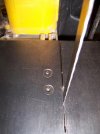
Thanks for the extra pics and tips, Dixie! In your third pic, the blade appears to be offset from the slot you cut in the steel plate and I can't quite tell what you did there. It almost looks like you drilled a hole(s) there???
 
You got it. The slot for the blade is cut with a metal cutting blade on a right angle grinder and is about 1/8” wide all total. It was nearly tight against the blade when all was assembled and done!
So I went back and drilled holes in front of and behind the blade itself with a 3/16” bit, thus allowing for extra clearance on the blade. The hole only allows for about 1/16”+or- on each side of the blade, and yes it ended up being slightly offset, (good eye).:eek: Which is only a problem if you OCD!:D
However I have discovered that the extra clearance is a good thing, because you will get small pieces of steel sucked down the holes and with out the extra clearance to allow them to kick out the bottom they will jam and possibly detrack the blade. That is why after first use I opened the hole slightly around the blade!:thumbup:
 
OCD, huh? I might resemble that remark! ;)

I wouldn't have thought about making the slot extra wide to allow for pieces getting trapped and jammed, although I've had that happen with the factory rest. I was just thinking that I would cut the slot with the bandsaw blade itself, but now it seems that won't work too well.
 
The slot itself doesn't necessarily need to be wider.

After all it is just the blade that needs to go through slot for installation, but the thickness of a metal blade on a right angle grinder ( will give you approx a 1/8” slot) that does allow for a enough clearance to make it not a fight to install the blade.

However right at the point where the blade itself runs it is best to have a little extra clearance because invariably you will end up with a little sliver of metal getting sucked into the blade and this will cause a jamb, burnt blades and other problems if there is not clearance for it to kick through. Now on the other hand too much clearance might create a problem also!

Now I will go on to say you have got to have one of these a foot switch to operate the unit. Once you go this way you will love it.


I tied back the switch on the unit and the unit now functions off of the foot switch a $22.00 investment off of Ebay.


Most of the time it sets under my bench ready to go just walk up and put a toe on it!


One word of caution unplug the machine when working on installing a blade or clearing a jamb. The fine teeth on a Band sawblade love human flesh and the it is easy to get on the switch when distracted and amazing how fast you will get off of it too (but not fast enough) !!!!!!:eek::mad:
Don't ask how I know!!!!!!!!!:D:D:D
 
Patrice Lemée;9571412 said:
Yep, footswitch is the cat's meow. :thumbup:

+1... I have cheap HF foot switches on several machines in my shop... almost a necessity with the DeWalt portaband.
 
I think having a slot the thickness of the bandsaw blade was contributing to my bewilderment about how to align everything (ie, zero margin for error)

I've been using a switched power strip as a poor man's foot switch. Not as elegant, but at the same time not too much concern of accidentally stepping on it at the wrong time!
 
Back
Top