Talk about lines-force, tip relation to index finger, etc.-design considerations

Brian.Evans

Registered Member
Joined
Aug 20, 2011
Messages
3,267
Can we talk about some in depth design considerations? I'd really like to take my designs up a notch in usability and feel. Can we talk about line of force in a knife, the line that goes from butt to tip and how deviation from the line could make a knife feel clunky? Maybe about proper balance, where to balance a knife and how to accomplish it. Tip height related to index finger and how it makes a knife feel different. Stuff like that. We talk all day about "my first knife" and other specific things, but I'd like some people who really know what they are talking about to school the rest of us on in depth knife making knowledge. I want to learn! I want to be a bladesmith, not just a guy that kind of makes knives. I want to pursue mastery of the craft as a means to its own end. Forgive me if I'm going a little "out there," but you should all be used to it by now. :)
 
I'm 100% unqualified to contribute to the conversation, but I do wonder along the same lines. Like edge profiles... what does a little more belly do for me, or moving the belly a little forward or back, tilting the handle down a little bit, etc. And all that in the context of different uses/types of knives.

I picked up Murray Carter's 101 knives book hoping to find some discourse on this. It had a little but it was mainly on cosmetic aspects of edge profiles. I wish there was some more analytical diatribe on these design aspects somewhere. As it is, the beginners like me are left copying existing blade shapes from the pros and tweaking on them until we find something we like (which isn't a bad way to go).
 
A long time ago, somebody told me that whenever possible, try to have the point of a "fighting" bowie as close to being inline with the center of the handle as possible. Mind you that is easier with say a coffin handle or a gently curved one made from some materials you can grind to your hearts content compared to say something like a stag carver where you are essentially building the knife around the handle, but there it is. The good news is that a very large number of talented people have already done the grunt work for us in the last 60-70 years or so. :thumbup: If you want to look at a long history of one of those very talented makers and how his concept of handle design evolved over the decades, look at Bill Moran's work. The first time that I made an ST 24 style knife with his style of handle, I discovered that I could tell if I needed to sand even just a tiny bit more in one spot or another just by grabbing the handle. You see evolutions of that dropped butt pam swell design a lot and some guys have it down to a science where they know exactly which big contact wheels and small wheels to nail the the handle shape every time for any size knife they make. Same with Bob Loveless, although you could argue that he hit his mark relatively early on and stuck with it cuz it were GOOD.. I would also take a look at the Randall 14/15/16, but NOT the standard figure groove handle, which I don't really like. Look at the optional "border patrol" and "single finger groove" handles and you will see some designs that look very familiar. Look at the Arkansas guys and their work over the last 30 years or so. Back in the natural handle materials likestag, walrus, etc where you can't grind away much. Look at how guys choose their piece of handle material and "work around" the shape. It is still hard to comprehend sometimes how much more information we have today than what some of these pioneers had. As far as being out there, that sounds like good way to GET out there where you want to be, but what do I know?. ;)
 
Last edited:
Draw a line from the center of the butt to the tip. If a major portion of the mass of the knife is above or below that line, it will divert some of the force toward moving the knife up or down, not forward in a thrust. In a downward cut, if the mass is below the line it will be Ok, but above will make the knife want to rotate in a hard cut.

In a perfectly balanced knife, the amount of mass above and below the butt/tip line should be nearly even. A line that divides the mass in half is called the center of mass. This line is what determines how well the knife's inertia is used and other things like deflection vectors. The simplest way to say it is, "Direction of the cut/blade follows the direction of the mass.

These are the reasons for having a fighter built on a fairly straight along the center of mass line and a cutting/slicing blade built with the edge rising to the tip, and the tip at or above the center of mass line. Except on specific function or design blades, having the tip below the center of mass is usually to be avoided.

Obviously, there are many other issues in knife design. Ones like distribution of mass are as important, or more important, that center of mass. A knife with a 10oz. blade and a 3oz. handle would not work well and would feel like a bar of lead, the opposite would also be poor, and would feel clunky with weak cutting power .... but a knife with a 5oz. blade and a 5oz. handle may feel weightless in the hand.

There are exceptions to all rules, and knifemaking is a big place for those exceptions. Most know that I am not a Kukri fan, because they break most all the rules of balance and design. How they compensate for that is a large and heavy blade to create more inertia than the handle does.
 
"A line that divides the mass in half is called the center of mass."

Actually that is not correct. "Center of mass" has a definition...

"The center of mass is the point where all of the mass of the object is concentrated. When an object is supported at its center of mass there is no net torque acting on the body and it will remain in static equilibrium."

http://dev.physicslab.org/Document.aspx?doctype=3&filename=RotaryMotion_CenterMass.xml

de7438cb-bbeb-43c1-9240-79e1e64a6ad0.gif
 

Attachments

  • de7438cb-bbeb-43c1-9240-79e1e64a6ad0.gif
    de7438cb-bbeb-43c1-9240-79e1e64a6ad0.gif
    2 KB · Views: 16
These are the reasons for having a fighter built on a fairly straight along the center of mass line and a cutting/slicing blade built with the edge rising to the tip, and the tip at or above the center of mass line. Except on specific function or design blades, having the tip below the center of mass is usually to be avoided.

Specifically, what would those functions be?

Obviously, a dagger that is designed to be thrust would need to concentrate the force along the center line. A dedicated skinner, like a trailing point skinner (Schrade Sharpfinger maybe?) would be better with the point above the center. How about sheepsfoot and wharncliffe knives? Draw cuts? And why would a straight edge with the tip below the center work better for them? What's the physics behind it?

How does all this relate to kitchen knife design? Stacey, Bill Burke, Butch Harner, all you other guys I've forgotten because I haven't slept in 40 hours care to weigh in?
 
For larger kitchen knives you are looking for finger clearance and the shape of the edge as related to how straight or curved it is. A kitchen knife nut's definition of balance may be a bit different that someone say buying a Bagel style fighting bowie. In the kitchen knife, they may want what little mass there is to be a bit forward as opposed to as close to the guard as possible. Like Stacy explained, on a bit fighting or chopping knife, a straigter handle means speed and a downward curved one means power. As for skinners, the objective with them may not be pure physics, but avoiding puncturing internal organs.
Specifically, what would those functions be?

Obviously, a dagger that is designed to be thrust would need to concentrate the force along the center line. A dedicated skinner, like a trailing point skinner (Schrade Sharpfinger maybe?) would be better with the point above the center. How about sheepsfoot and wharncliffe knives? Draw cuts? And why would a straight edge with the tip below the center work better for them? What's the physics behind it?

How does all this relate to kitchen knife design? Stacey, Bill Burke, Butch Harner, all you other guys I've forgotten because I haven't slept in 40 hours care to weigh in?
 
Correct, Some knives diverge in distribution of the mass to allow specific requirements to take precedence.

Also, on a wharncliffe or sheepsfoot, the actual tip maybe the termination of the blade, but the centerline of the blade is higher. Drawing a line down the center of the straight blade to the butt will show that these shapes are actually very close to perfectly balanced for transferring the cutting energy to the edge.This is what I would call a "difference in design" more than an "exception to balance rules".
 
I second Zhyla's comments. I need to see it in a book with drawings and force diagrams. Any one know of such a book? Stacy, why don't you write one or get several makers to collaborate on one. I'll pay $40 for a spiral wound copy.

Tim
 
"A line that divides the mass in half is called the center of mass."

Actually that is not correct. "Center of mass" has a definition...

"The center of mass is the point where all of the mass of the object is concentrated. When an object is supported at its center of mass there is no net torque acting on the body and it will remain in static equilibrium."http://dev.physicslab.org/Document.aspx?doctype=3&filename=RotaryMotion_CenterMass.xml

de7438cb-bbeb-43c1-9240-79e1e64a6ad0.gif

That is why I use my term "Center of Mass Line"...there is a difference.
We all know how the energy of a hammer blow can transfer to the wrist if the blow is off center or the handle strikes the object instead of the head. In a big hammer or axe, the transferred energy can be enough to break your wrist bones. In swords, it can be nearly as dramatic. On a knife it is more subtle.

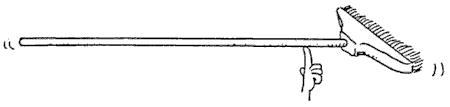
It is pretty easy to visualize how moving the center of mass affects how a knife cuts. If you replaced the broom with a knife in AVigil's drawing, it would shows that at the center of mass, the knife is "balanced". We often say, "The knife/sword has a balance point just at the ricasso", etc. This means that there will be no torque applied to the knife if you place your finger at the ricasso on one side...the knife will balance. If you apply force to either end ( handle or blade) an opposite movement would happen at the other. Moving the mass forward or backward by making the blade and handle lighter or heavier moves the balance point. That is pretty basic and merely a teeter-totter view. However, this is sort of a 2 plane balance...up and down. or left and right. X and Y as it is called in engineering.

OK, this is fine as long as the piece being balanced is basically a straight line. We all see how a bowie or a rapier feels better or worse if the center of mass is moved.

But, if you look at the blade in profile, and imagine the balance point in true 3D as not just a fulcrum point, but add a line dividing the mass of both X and Y along a Z axis, we add a big change to the term "balance". Now the blade can rotate along the tip to butt line ( rotate on the Z axis) in response to changes along the X/Y planes.If the blade edge is far below the centerline, as force is applied to the edge it will apply a torque to the center of mass point. Your grip on the handle prevents the tip from moving along the X and Y planes, so the blade will try and rotate on the Z axis. In the 2D view, it just deflected up/down or left/right. In the 3D view, it can rotate on the centerline ( twist in the hand). If it was a frictionless situation, it would rotate until the edge was pointing up and the spine was trying to cut. Since there is an edge biting into the cutting object and your hand gripping the handle, the blade does not rotate....but the energy applied to the edge tries to rotate. Thus the edge that is much too low will try and rotate against your grip, which overpowers the rotation in most cases. That transfers part of the energy of the cut back into your hand. If the edge was near the centerline, or above it, all the energy would be transferred to the edge and the cut would have more "power". How a knife "cuts" and "handles" is a factor of these things. Moving the edge and tip along these planes can make a knife function differently. The ways to change this situation are to either apply much more mass below the line ( kukri); or reduce the total mass to a point where the hand easily overpowers the applied torque ( light weight knives); or apply the force along a longer plane on one axis only ( 2" tall blade on a chef's knife); or raise the tip above the line and make it have much more control ( fillet and skinner).

A well planned slicing knife, like a yanagi-ba, can be held almost with just two fingers and slice like a laser. It's handle is thin and often just a round stick. Since the blade centerline is on the same line as the handle, it reacts to every move of the hand with almost no resistance. The lower the mass of the blade, the higher degree of response to the handle movements.
A big chopper or kukri with a dropped edge for transfer of energy will have a big grip and finger grooves to assure the force applied by the moving hand and arm are transferred as straight as possible to the edge to drive it deep into the target object. The higher the mass of the blade, the more the impact drives the edge in.


This was sort of fast and not heavily proof read, but I hope it explains it a bit better.

 
"That is why I use my term "Center of Mass Line"....there is a difference."

I just would not want a new maker to get confused when they try to look up the definition of "center of mass line" and it can not be found anywhere ....except in your post.;)
 
Try a few blade styles... for example upswept or trailing point, drop point and a wharncliffe.

It depends on what the knife is made for but try some tests - drill holes, fillet a fish, skin some game, cut some rope, dice some veggies... chop some wood or pierce some materials and see what the tips do.

I find that a tip in line with the axis* will drill well, a tip below this point will have lots of control/leverage at the tip, an upswept blade will work well for filleting a fish or getting int o a tight spot while boning a chicken.

* I'm making this terminology up as I go! :D
 
Try a few blade styles... for example upswept or trailing point, drop point and a wharncliffe.

It depends on what the knife is made for but try some tests - drill holes, fillet a fish, skin some game, cut some rope, dice some veggies... chop some wood or pierce some materials and see what the tips do.

I find that a tip in line with the axis* will drill well, a tip below this point will have lots of control/leverage at the tip, an upswept blade will work well for filleting a fish or getting int o a tight spot while boning a chicken.

* I'm making this terminology up as I go! :D

Dan....You forgot to include your Cartisian Orthogonal Coorodinate system so I have no idea what you are referring to:D (sorry couldn't resist)
 
"That is why I use my term "Center of Mass Line"....there is a difference."

I just would not want a new maker to get confused when they try to look up the definition of "center of mass line" and it can not be found anywhere ....except in your post.;)

Point taken.
It was hard to describe the line from tip to butt in a simple verbal way. More exactly - It is the rotational axis of the plane that passes through the center of mass along a line drawn from butt to tip.
 
Perhaps a good way to look at the physic of knifey things might to look at the extreme examples. For example, the current competition cutting knives have cleaver style blades and a pretty severe drop to their handle to get that power you need. At the extreme other end of the spectrum, a modern sport fencing epee or foil is likely to have a "pistol grip" handle. Both are strictly one trick ponies, but you can see what is currently considered the optimum way to attain to those very specific and narrow performance goals.
 
Last edited:
Dan....You forgot to include your Cartisian Orthogonal Coorodinate system so I have no idea what you are referring to:D (sorry couldn't resist)

:D I look at it like a line drawn down the center of the handle to end of the blade... on a Loveless drop point it would be a near rainbow shaped arc. Is the tip above or below this point?
 
Back
Top