Talk to me about ti framelocks...

Joined
Jun 10, 2015
Messages
1,144
Alrighty. My newest knife is a Spyderco Slysz bowie, which is a titanium framelock (or RIL, if you prefer) without a lockbar insert.

1st question: I know that the lock bar is treated somehow, but I'm not sure how. There's visual evidence that something has been done to it. I've heard "carbidized" some places and "carburized" other places. Can anyone confirm which it is, and explain what exactly that means to me? I've heard, from some people, that whatever process is used creates a hardened surface, but that this surface can chip off. Is that true? Or does it harden deeper than that?

2nd question: Percentage of lock up refers to what? The percentage of the lockbar that is engaging the tang? OR, the amount of the tang covered by the lockbar? I've heard both versions used and I'm trying to figure out what the preferred method for communicating lockup is.

Any thoughts are much appreciated!
 
I think there are two treatments to the lockbar where it touches the tang; carbidizing and heat treating. I have a Sage 2 that a gracious member here carbidized the lock face for me and it looks a little bit like silver paint. The guy who did it for me warned me it will wear off. The heat treated lock face discolors the titanium, you can see this on the Chris Reeve knives, it's very obvious. As to lockup percentages, always assumed it was related to how far the ti lock face has traveled over the tang. In my experience it doesn't mean a whole lot. I have a Boker frame lock that is flush with the tang and it's dead solid.
 
carborized is just heating the lock bar kinda like heat treating steel. which im pretty sure is whats done to the slyz its also done on chris reeve knives, and there is nothing to chip off. Carbidizing is putting a layer of stuff(I believe tungsten carbide) on the lock bar and it can chip off over time.
 
Carburized - NO
Carbonized - NO

Carbidized - Yes.

;):D

I built a home-brew carbidizer using an old PC power supply; it sort of worked...

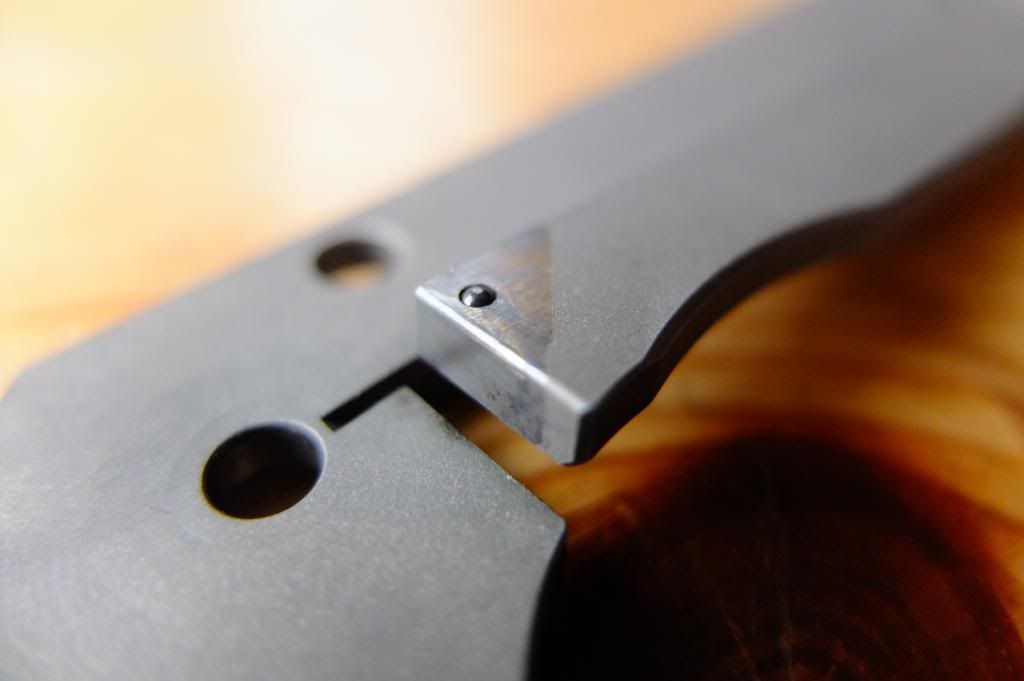
The carbide eletrode "welds" a thin layer onto the surface it touches; it can be ground off but I'd imagine it would take a long time to wear away on it's own due to the high hardness...

Here's a pic of one:

tung-carb.jpg
 
Here's something Kristi (part of Spyderco's staff) posted on Spyderco's forum about titanium locks (the thread was about the Nirvana). I'm not sure whether she's talking about all current production Spyderco framelocks or not.

"We have no plans at this time for a steel interface. We also do not carburize or carbidize.

What we do have though is lots of experience, data from extensive testing and several thousand knives (some with a steel interface and some without). We also have our practice of CQI (Constant Quality Improvement). Just as we do with every model (new and old), we'll be watching and listening to all of you.

I hope this helps.

Kristi"

About your second question, I understand lock up percentage as how far down the blade tang has the lock face travelled. So, close to 100% would mean that the locking bar is almost touching the oposite liner.
 
Thanks for the help so far! The consensus seems to be that the percentage of lock bar engaged is the general method for communicating lockup. For example, if all of the lock bar is touching the tang (even if some tang is not touching the lock face) that is considered 100 percent lock up.


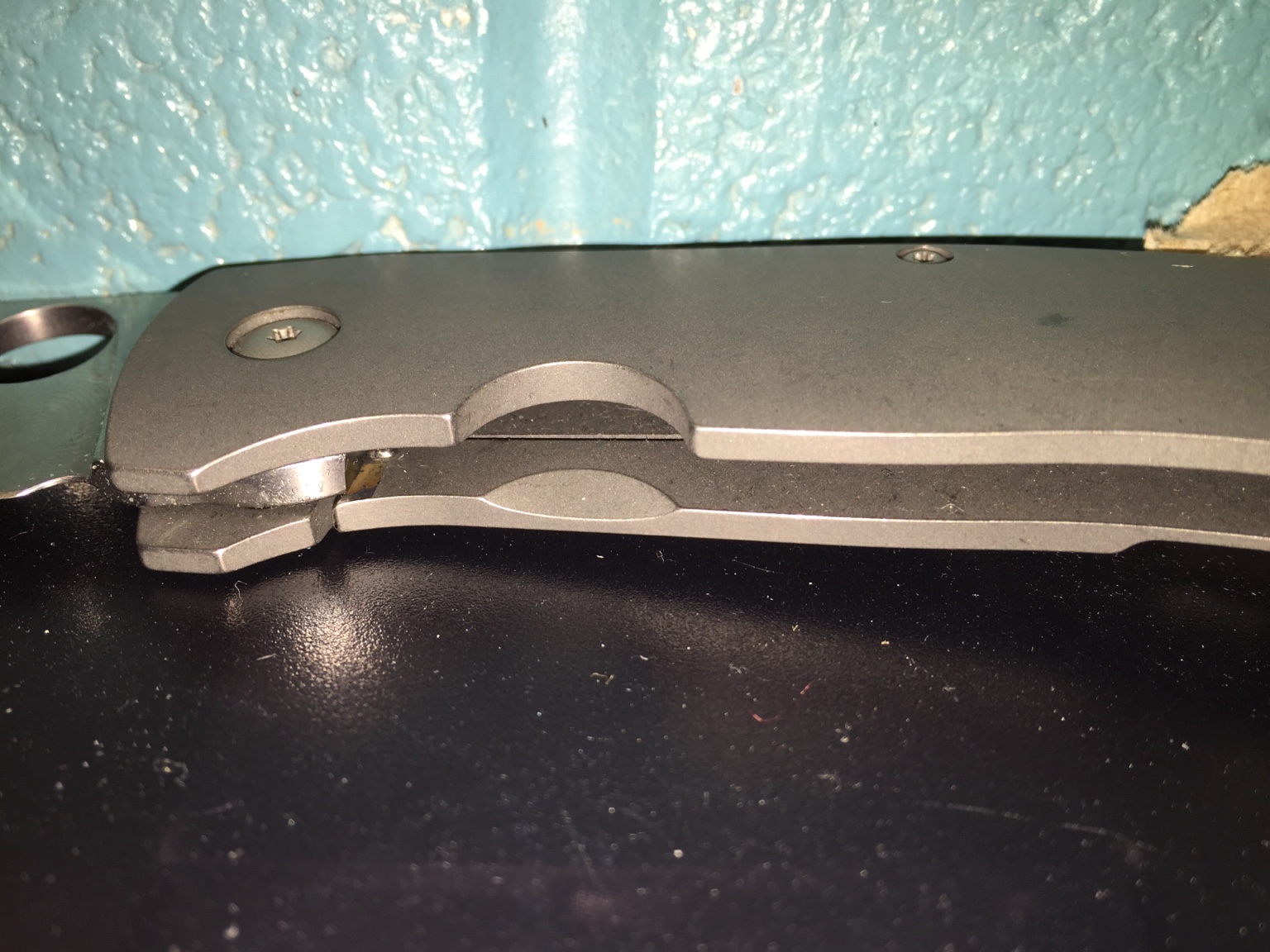
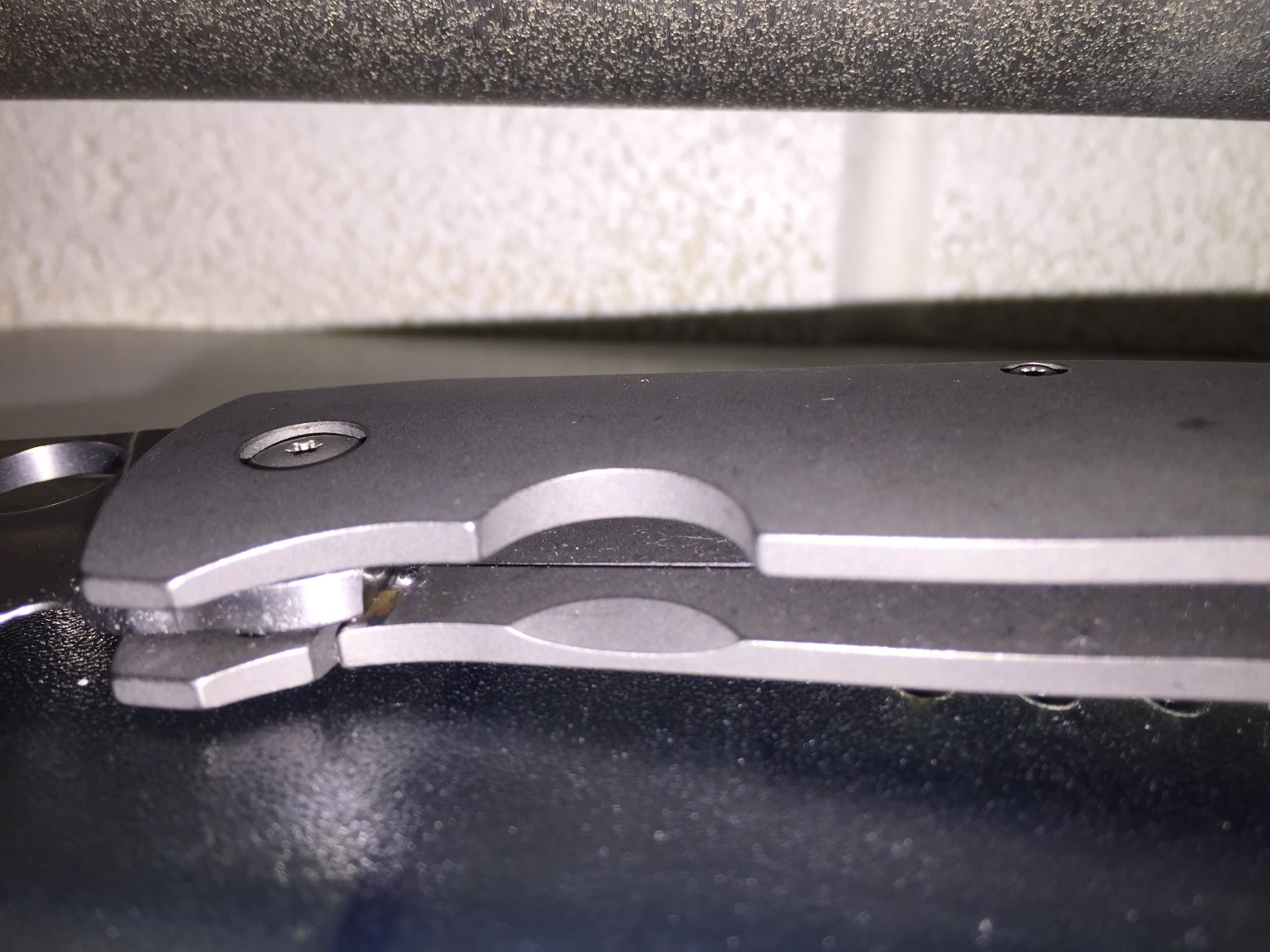
Secondly, I snapped some pictures of my lock bar (in the bathroom at work. Shhhhhhh). There is definitely some kind of treatment here, I just don't know what it is!

Also, I really want to note that the question about the lock treatment is strictly out of curiosity. I'm not concerned about the quality or longevity, nor am I trying to start any heated debates or anything. I just really want to understand the different methods for treating titanium locks and really want to know which was used in this case!

Here are the pics:

03f1002a09fef24f7529bea4fd857867.jpg

33fe46a54db1f577874748a8c8933678.jpg
 
Last edited:
FWIW, the carbidizing (if it's there) would be on the end of the lock bar that contacts the blade's tang; not on the side with the detente ball...

random internet pic of the end of a carbidized lockbar:
maxresdefault.jpg


As for lockup percentages; here's my poor interpretation; the middle vertical red line would represent approximately 50% lockup...

22367415743_83ccbdf4d7.jpg
 
Last edited:
You are seeing the lockbar slightly polished when the detent ball loses contact with the blade tang, right before it locks up. Mine looks the same.
 
I wouldn't worry about it. As an experiment I went out of my way to flip one of my Spyderco Southards 25+ times a day, every day, for a long time. I stopped tracking how many times I'd roughly flipped it at around 5k flips.

From analyzing photos I took of the lockup before and after the experiment, it would appear that the lockup moved ever so slightly deeper, almost imperceptibly so.

That same knife is one of the knives I carry most frequently, and years have passed since the 5k flips and I still haven't seen any noticeable change in it.

At this point it's just not something I worry about. If anything, I've come to prefer knives to not have a lockbar insert; I've seen more issues with lock rock and wobble on knives with inserts than knives without, though that could just be bad luck.
 
I carry my Slysz Bowie almost every day. I flip it all the time and use it all the time. My lock up moved a tiny bit at first then settled at about 80%, basically the entire LOCKBAR is engaged to the tang. It has not changed for a long time. I have used it for hard cutting and can even try to push the lock bar in deeper with no change to lock up and absolutely no stick what so ever on disengagement. I see these as signs of a well made lock. I believe the Slysz collabs are indeed heat treated (carburized).
 
FWIW, the carbidizing (if it's there) would be on the end of the lock bar that contacts the blade's tang; not on the side with the detente ball...

Not quite, CRK puts a layer of WC near the detent ball. Being that Sal and Chris are buddy's, I'd imagine Spyderco is following in CRK's footsteps.

DSCF7495_zps5dd97987.jpg
 
Carburizing is (from my understanding) introducing carbon into the matrix of the metal in question, in this case 6AL4V Titanium alloy, through the application of heat in the presence of a source of carbon.

It is used to make the metal harder, and in the case of frame-locks, make the titanium much less likely to gall onto the steel and slowly wear away.

I don't know when that quote from Spyderco was from, but they have ALREADY used a steel insert in more than 1 of their knives that have framelocks, and I know for a fact that they did use something (and I believe it was carburization) on the Slyzz Bowie.

If you combine a carburized lockbar with good lock geometry, you get a very good framelock overall that should show virtually no wear in the lock at all over it's life of use once it has been properly seated against the blade tang.

And yes, the % of lockup is based on how far the lock-face has progressed along the blade tang, at least in general, so if it covers 10% of the tang, that is a 10% lockup. The % of the lockbar that is engaged with the tang is generally considered to be the engagement of the lock-face, and not the % of the lockup itself.
That way, if you have a knife with 25% lockup, and full engagement, that means that the lock face fully engages the blade, but only reaches 25% of the way across the tang (which would usually have to be a liner lock, frankly).
 
Carburizing is (from my understanding) introducing carbon into the matrix of the metal in question, in this case 6AL4V Titanium alloy, through the application of heat in the presence of a source of carbon.

It is used to make the metal harder, and in the case of frame-locks, make the titanium much less likely to gall onto the steel and slowly wear away.

I don't know when that quote from Spyderco was from, but they have ALREADY used a steel insert in more than 1 of their knives that have framelocks, and I know for a fact that they did use something (and I believe it was carburization) on the Slyzz Bowie.

If you combine a carburized lockbar with good lock geometry, you get a very good framelock overall that should show virtually no wear in the lock at all over it's life of use once it has been properly seated against the blade tang.

And yes, the % of lockup is based on how far the lock-face has progressed along the blade tang, at least in general, so if it covers 10% of the tang, that is a 10% lockup. The % of the lockbar that is engaged with the tang is generally considered to be the engagement of the lock-face, and not the % of the lockup itself.
That way, if you have a knife with 25% lockup, and full engagement, that means that the lock face fully engages the blade, but only reaches 25% of the way across the tang (which would usually have to be a liner lock, frankly).


⬆️ This guy! Excellent, accurate response. I'm not sure what to make of the Spyderco response either, as Brad Southard has stated that his first design DOES have the lock bar carburized. There's been several discussions about this on the Spyderco Forums, but the consensus was that yes, the lock is treated, which again, is why Kristi's response is confusing to me.
 
[emoji651]️ This guy! Excellent, accurate response. I'm not sure what to make of the Spyderco response either, as Brad Southard has stated that his first design DOES have the lock bar carburized. There's been several discussions about this on the Spyderco Forums, but the consensus was that yes, the lock is treated, which again, is why Kristi's response is confusing to me.

Thanks for the compliment!!
 
Great Illustrative pics from Charr and Czechmate!
 
Back
Top