Talking about Spanish, Basque and Latin American patterns

Ugaldie

Gold Member
Joined
Feb 27, 2013
Messages
391
I'm opening this thread due to a conversation we started in a thread dedicated specifically to other topics.

We were talking about the names South American axes used to have in catalogs made by non Spanish manufacturers. I commented that they used to have some names that were originally not exactly related to the pattern. Here is my response to FortyTwoBlades FortyTwoBlades .

You are right FortyTwoBlades FortyTwoBlades , they may have become patterns but they refer to the purpose of the axe.

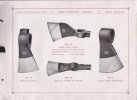
To understand this correctly you have to know that South American Spanish derives mainly from Southern Spanish and Canary Islands dialects, where, among other major changes, they tend not to pronounce the ‘r’ at the end of verbs. In this context, hacha de tumba (standard Spanish hacha de (or para) tumbar) simply refers to a felling axe. In the catalogs they used to be the biggest axes and the ones most prone to having cheeks. Like this one you can find in the Douglas Axe Manufacturing Co catalog.

De tumba.jpg

Hacha de labor or labor entera means a working axe, an axe without a specialized task.

Labor entera.jpg

Media labor refers to a light working axe without a specialized task, similar to a half axe or a boy’s axe.

Media Labor.jpg

There used to be variations but the axes in the labor family were just Biscayne pattern axes. Let’s take a look at how Spanish manufacturers themselves named these axes. This catalog was made by Ramón Onraita, a prominent and highly respected Basque axemaker, in the 1930s.

Here you can see which axe was the most prominent and best selling in its context, the first one and the only axe that occupies a full page the traditional Biscayne axe. The one we know here as the axe with the tear shaped eye.

IMG_20170904_0002.jpg

Some more models.

IMG_20170904_0003.jpg

This gets interesting. I love the Olive pattern (I find it similar to the Oberharzer pattern) but look at the axe in the middle. We know it as the Basque axe, but it was originally developed by Basque charcoal makers. By Basque I mean the Basque people, those who live in the Basque Country (Biscay is part of it), Navarre, and southern Aquitaine. The design was so good that it was adopted on a large scale in just a few years, and its name changed accordingly.

IMG_20170904_0004.jpg

I know it can be confusing for foreigners, but the Vascongadas pattern in the next image refers to the Basque Country axe. As I mentioned before, the Basque Country is only part of the area where Basque people live, so the concept is more localized than the pure Basque .

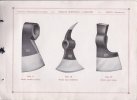
IMG_20170904_0005.jpg
IMG_20170904_0006.jpg
IMG_20170904_0007.jpg
IMG_20170904_0008.jpg

I hope you find this interesting.
 
Lovely catalog pages--thanks for posting them! For examples of some common Latin American patterns and names, Imacasa has a bunch here that are sold to various markets throughout Latin America. Note that to see the whole results you need to click the "show more" button at the end of the results.
 
Thank you FortyTwoBlades FortyTwoBlades .

I find the way Imacasa uses these terms interesting. It seems they use media to refer to narrower bit axes regardless of weight. The same applies to de tumba, I don't undestand the logic they are using. I wish I knew the path these names took to reach the meanings Imacasa currently uses.

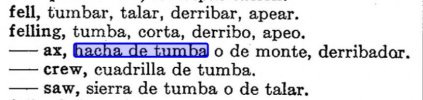
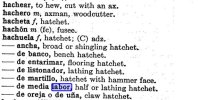
Let's take a look to this Dictionary for Engineers, Mexican Edition


De tumba is the easiest one to discriminate, it refers to a felling axe

De tumba.jpg

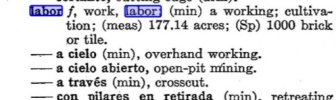
If we look at the meaning of labor we can see it has a very broad usage but esentially it means work

Labor.jpg


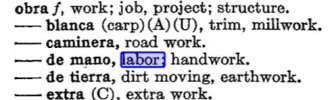
An example of use

Labor de mano.jpg

Labor usage with hatchet

Hachuela.jpg

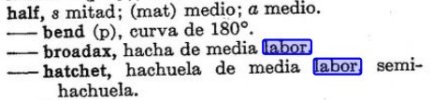
Media labor

Media Labor.jpg


Note that the term broadaxe refers to wide bit axes in Spanish context, not to the broad axes known in central and northem Europe.

I hope this helps clarify any possible confusion on the subject. Have a great weekend.
 
Last edited:
Thank you FortyTwoBlades FortyTwoBlades .

I find the way Imacasa uses these terms interesting. It seems they use media to refer to narrower bit axes regardless of weight. The same applies to de tumba, I don't undestand the logic they are using. I wish I knew the path these names took to reach the meanings Imacasa currently uses.

Let's take a look to this Dictionary for Engineers, Mexican Edition


De tumba is the easiest one to discriminate, it refers to a felling axe

View attachment 3098620

If we look at the meaning of labor we can see it has a very broad usage but esentially it means work

View attachment 3098621


An example of use

View attachment 3098622

Labor usage with hatchet

View attachment 3098624

Media labor

View attachment 3098627


Note that the term broadaxe refers to wide bit axes in Spanish context, not to the broad axes known in central and northem Europe.

I hope this helps clarify any possible confusion on the subject. Have a great weekend.
Yeah I believe "media" is is basically being used just to indicate "a full-width version of this pattern exists somewhere even if we don't necessarily make it ourselves."
 
Yes FortyTwoBlades FortyTwoBlades it could make sense, but media refers to the weight. It's like producing a 4.5lbs boys axe.

Perhaps, but the mental framing may have been more like "it is as if the final axe were a cut down larger one" -- it may be that the original versions of those patterns were cut down from the full size axe heads much like is done in Russia--they produce pretty broad axes there which are commonly cut down and modified to suit the needs of the end user. The naming convention may refer to something similar having originally been done, or at least the concept of it. For instance, if I wanted to make an axe to suit my needs by cutting down a larger one, if I wanted to end up with a 3.5lb head I would likely need to start with a 4lb or even 5lb head depending on what I was trying to make. If such a variation became popular enough that they just started making them that way, some people might want that shape but in a larger or smaller model overall, and for a manufacturer it makes more sense to just start off making the thing at a given size originally, but referring to that model by the "reduced weight" nomenclature still makes sense given the origin.
 
Last edited:
It’s the first time I have read about cut down factory axes, FortyTwoBlades FortyTwoBlades . It might be a thing today, since we have very cheap and high quality abrasives compared to older times, but I doubt it can be a commercially optimal production method even now.

If we look at the original sources we have to go very, very far back, half a millennium, to be exact. Biscayne axes were the first iron/steel axes to reach America; they are the earliest tomahawks and trade axes. Even the author of the next link confuses some terminology (which is quite common and understandable when English speaking people talk about Basques, ask if you want to know more about this), but most of the information is very good. Take a look if you want to read about the first metal North American axes.


Let's take a look to the excelent August/September 2012 issue of the Journal of the Early Americas: Axes in New France: Part I. The Biscayan Axe by Kevin Gladysz and Ken Hamilton. In that period, each axe size was marked according to its specific size and weight.

Aizkoren neurriak.jpg

Note even five centuries ago the basical sizes were the same as today. There are four sizes that match exactly with the terms we are talking here, from the smallest to the biggest media hachuela, hachuela, media labor and labor entera.

It may have happened somewhere at some point during that half millennium, but from those days to the present I have never read about, nor spoken to anyone who has any indication that axes were ever industrially cut down. In my opinion, the use of the terms we see today most probably has its roots in commercial reasons.

Regards
 
It’s the first time I have read about cut down factory axes, FortyTwoBlades FortyTwoBlades . It might be a thing today, since we have very cheap and high quality abrasives compared to older times, but I doubt it can be a commercially optimal production method even now.

If we look at the original sources we have to go very, very far back, half a millennium, to be exact. Biscayne axes were the first iron/steel axes to reach America; they are the earliest tomahawks and trade axes. Even the author of the next link confuses some terminology (which is quite common and understandable when English speaking people talk about Basques, ask if you want to know more about this), but most of the information is very good. Take a look if you want to read about the first metal North American axes.


Let's take a look to the excelent August/September 2012 issue of the Journal of the Early Americas: Axes in New France: Part I. The Biscayan Axe by Kevin Gladysz and Ken Hamilton. In that period, each axe size was marked according to its specific size and weight.

View attachment 3100053

Note even five centuries ago the basical sizes were the same as today. There are four sizes that match exactly with the terms we are talking here, from the smallest to the biggest media hachuela, hachuela, media labor and labor entera.

It may have happened somewhere at some point during that half millennium, but from those days to the present I have never read about, nor spoken to anyone who has any indication that axes were ever industrially cut down. In my opinion, the use of the terms we see today most probably has its roots in commercial reasons.

Regards
What I'm saying is that it was common in places like Russia for factories to make lots and lots of one pattern with a broad bit to it, and the end user would modify it to suit their needs. They were not cut down by the factory. However, some styles of cut-down axes became particularly popular, and factories then began producing such patterns from scratch because demand was sufficient. It's very common in Latin America for rural agricultural workers to only be able to afford one steel cutting tool. A machete costing about $4 USD locally may represent a week's wages to them. So economies of scale were quite commonly used for exporting models whether from Europe or (in time) regionally produced. Making lots and lots of one thing costs much less per unit than making a bunch of different versions and selling smaller quantities of each. As such there are relatively few patterns seen in Latin America and it makes sense that many of the "media" models would be based on user-modified examples of the "full sized" patterns as manufacturing, industry, and wages have continued to improve over time.
 
It also may be possible that they simply offer the different patterns in different sizes now in spite of the patterns having historically been limited to certain sizes simply because the proportions and aesthetics are more preferred in some areas. For instance, if one region was receiving "media labor" pattern axes from a seller in that locale that was ONLY importing and selling the one size due to cost reasons, locals may have said "can you make this, just bigger" and the seller communicated that upstream and the factory built to meet that preference, therefore leading to multiple sizes of what were once more size-specific naming conventions.
 
I understand FortyTwoBlades FortyTwoBlades . Yes, it could be, and as you say, it has indeed happened. Basque axes had a similar origin, but instead of users modifying the axes themselves, charcoal makers requested gradual custom changes from blacksmiths until a new pattern became established.

I think you nailed here,

It also may be possible that they simply offer the different patterns in different sizes now in spite of the patterns having historically been limited to certain sizes simply because the proportions and aesthetics are more preferred in some areas. For instance, if one region was receiving "media labor" pattern axes from a seller in that locale that was ONLY importing and selling the one size due to cost reasons, locals may have said "can you make this, just bigger" and the seller communicated that upstream and the factory built to meet that preference, therefore leading to multiple sizes of what were once more size-specific naming conventions.

It's a bit sad to see this centuries-long cultural heritage begin to disappear due to commercial pressures.

Regards
 
At the same time, it's just part of the tool's evolution! The different styles do offer different edge curvatures, bit widths, and eye shapes for their respective weights, so it was probably a very easy way to diversify the functional combinations of properties for folks in those markets without needing to produce patterns that were unfamiliar-looking to them. The practice does seem to be widespread. Truper of Mexico does the same thing.
 
I understand what you say FortyTwoBlades FortyTwoBlades , but I don't agree. Evolution consists in two phases that occur repeatedly, first an increase in variability, followed by a bottleneck. That has been the reality throughout history, new patterns appeared, foreign ones arrived, and from their mixture only a few moved forward.

But what we are living through today is a very different step. The use of the axe as a tool has almost vanished, except in a few niches. Knowledge of the axe was once common, but it has practically disappeared for most of humanity, except among a few romantic and/or specialized practitioners. The knowledge of the average axe user today is far, very far from that of the common axe user half a century ago or earlier.

In general terms, there has not been any bottleneck comparable to those of earlier times in the past half century, yet during the same period there have been changes in the axe world. This can be seen as a form of evolution, it has its changes and bottlenecks, but these have been driven mostly by factory and commercial reasons not by real user experience. What may look like a Cambrian explosion to some people is in reality closer to the kind of lab engineering we see in the Jurassic Park saga. Each step in almost all axes that a typical person can readily access is increasingly far from being viable specimens in a natural environment.

And that's just how I see the examples we are seeing here. This world has perverted in a such way some makers are producing boys axes even heavier than full sized axes. Even worse, if they really think they are talking about patterns, is that they have such a lack of knowledge about axe patterns and even their own heritage that they fail to realize they are hiding their own national pattern behind a misused term.

Mexican Pattern.jpg
Source

Don’t get me wrong, I really appreciated your work years ago and now that I have returned to the public axe world I find your continued effort to share axe knowledge with the world truly laudable. I know the Basque way of expressing things may come across differently to others (I’ve especially noticed this with Anglo-Saxon culture) but whether we agree or not, I write and share my thoughts with all my respect.

Regards
 
It's something that happened quite a long time ago, to my understanding, and was more likely the result of market conditions in Latin America more than anything else. I wouldn't call it a perversion at all, so much as "just the way they do things there." People evidently were satisfied with the FORM of the axes available to them but wanted more variety in WEIGHTS.

I'd be cautious about calling a pattern made by a foreign producer definitive, as Mexican in this case really just means "we make these for sale to the Mexican market", and just as there was maker-to-maker variation in named patterns across time, so too is there variation in what foreign producers sent to export markets. In the UK, Sweden, Austria, and Germany, all of which produced axes for export to the USA, they developed the "Yankee" pattern axe and hatchet which is basically an amalgamation of several patterns into something "vaguely average American-shaped", or sort of a "Michigan-Maine-Dayton" hybrid (MichiMaiTon?), or...basically a Boy's Axe pattern in a bunch of different sizes. Ultimately it was a development that occurred during the general range of what could be called the "golden age of axes", and is not a recent dumbing-down of things so much as consolidation of patterns into a genericized single pattern for all-purpose use and sold as a cheap import model. A similar but slightly different dynamic seems to have happened in the Latin American markets.

Latin America started importing tools from the USA and Europe in large volume during the Industrial Revolution but the companies shipping finished goods eventually decided "let's just set up factories closer to where we're selling all this stuff" where labor was cheaper. As an example, Imacasa and Invermec/Incolma were originally local divisions of Gebr. Weyersberg of Solingen, Germany, and all of their equipment was made in Germany, with German managers overseeing locally-sourced staff. Weyersberg (like many other companies at the time) decided to sell off their international holdings in the 1960's and employees bought the company. Truper of Mexico was a branch of True Temper (Tru-per being literally a concatenation of the first and last syllables of their name that was easier for Latin American markets to pronounce, like Weyersberg's Corneta branding) so this is all a reflection of how the markets in Latin America started, developed, grew, and matured, arriving at the place we're at now with naming conventions that don't really align with their originating approach. That last part is conjecture on my part based on what I know of tool development in other parts of the New World, but it's clear to me that the approach of making that handful of patterns in a variety of sizes is commonplace and considered as normal/traditional in Latin America, and that's the most sensible way I can envision it coming to pass.
 
I agree. This has truly been the result of market conditions in Latin America, but it’s not “just the way they do things there.” As you say it has developed over the past few decades as a consequence of foreign companies leaving the market in favor of new local factories.

It doesn’t look like people had much of a role in it. When axes were still produced by foreign companies there was a plethora of patterns, some universal and others local. This started to change when production shifted to local factories, roughly at the same time as the decline in the use of axes. We don’t have exact information about what actually happened, but as you say it appears that these factories simplified their offerings so people had to adapt to it.

The USA and the case we are talking about are mostly the opposite. The Latin American market was absolutely dominated by foreign companies. Hults Bruk was a major player there and outside of Spain (where some of those patterns originated) there is no significant variation in pattern names, especially in locally named patterns. In addition Hults Bruk used and uses to be a reliable source of information, I haven’t been able to find that exact pattern in any other pre-1960s sources, the only place name I’ve found associated with this axe is the Mexican one and Labor Entera has been used for other patterns. This leads me to believe that the Mexican pattern name is most likely the original.
 
I agree. This has truly been the result of market conditions in Latin America, but it’s not “just the way they do things there.” As you say it has developed over the past few decades as a consequence of foreign companies leaving the market in favor of new local factories.

It doesn’t look like people had much of a role in it. When axes were still produced by foreign companies there was a plethora of patterns, some universal and others local. This started to change when production shifted to local factories, roughly at the same time as the decline in the use of axes. We don’t have exact information about what actually happened, but as you say it appears that these factories simplified their offerings so people had to adapt to it.

The USA and the case we are talking about are mostly the opposite. The Latin American market was absolutely dominated by foreign companies. Hults Bruk was a major player there and outside of Spain (where some of those patterns originated) there is no significant variation in pattern names, especially in locally named patterns. In addition Hults Bruk used and uses to be a reliable source of information, I haven’t been able to find that exact pattern in any other pre-1960s sources, the only place name I’ve found associated with this axe is the Mexican one and Labor Entera has been used for other patterns. This leads me to believe that the Mexican pattern name is most likely the original.

The offering of multiple sizes of the same patterns is, to the best of my knowledge, not something that only started happening when European companies pulled out of the market. Rather, it appears to be a legacy convention. Most machete manufacturers in Latin America, for instance, use the exact same model numbers that Collins did. The 127 machete from any machete company corresponds to a particular pattern regardless of who made it, and while different manufacturers make them all a little different from one another, they all trace their origins to the Collins model 127, and are fundamentally of the same style. There is a known dynamic in the tool world where it was historically very difficult to get people in a given region to adopt tools that were of a form that they were unfamiliar with, and in many areas that dynamic persists in the market at large. That is to say, a better tool may exist for their use case, but because it isn't a familiar shape, they do not buy it, and go with what they know instead. I suspect that this is what led to offering limited patterns in multiple sizes rather than offering different patterns than the ones already known to the region. They likely wanted the same familiar shapes, just bigger or smaller. So that's what they got.
 
A little background on Collins' exports from their self-published miniature history, "One Hundred Years 1826-1926: The Collins Company"

BookReaderImages.php

BookReaderImages.php

BookReaderImages.php
 
Great contribution FortyTwoBlades FortyTwoBlades 👍 Do you have any access to Collins catalogs from that era?

Herragro of Colombia also lists axes this way. It is seemingly a consistent standard amongst Latin American markets.

Correct, I have done my own research, reached the same conclusion and have already referred to Latin America.

But no, I’m not arguing that there were fixed weights for each specific pattern. I’m sure there were variations, even in the first Biscayne batches. What I’m arguing is that the way axes were originally produced in and for Latin America is not the same as today. Conditions can change, and people can adapt to a wide variety of situations, but when the size and/or weight of a half-size "given tool" exceeds that of a full-size "given tool", something must have happened. And as we can see, historical catalogs appear to support this point.

There is a contradiction in one of your recent messages that supports my point. I don’t fully agree with the following quote, but it may generally hold true at least for the initial period following first contact.

... There is a known dynamic in the tool world where it was historically very difficult to get people in a given region to adopt tools that were of a form that they were unfamiliar with, and in many areas that dynamic persists in the market at large. That is to say, a better tool may exist for their use case, but because it isn't a familiar shape, they do not buy it, and go with what they know instead ...

If that were the case, then the following would not be possible.

... I suspect that this is what led to offering limited patterns in multiple sizes rather than offering different patterns than the ones already known to the region. They likely wanted the same familiar shapes, just bigger or smaller. So that's what they got.

From the perspective of the other side of the ocean, some patterns are repeated. From the perspective of Latin America, during the era when axe use was common, they had a wide variety of them. Not all of them are visible in every catalog, but in the one where the Mexican pattern axe appears, there are up to fifteen different patterns. The availability of several patterns remains consistent up to the period we have already discussed. If the changes in pattern availability and size variation were due to people, they would have occurred in the ancient era, not in the modern era.

Regards
 
Great contribution FortyTwoBlades FortyTwoBlades 👍 Do you have any access to Collins catalogs from that era?


Correct, I have done my own research, reached the same conclusion and have already referred to Latin America.

But no, I’m not arguing that there were fixed weights for each specific pattern. I’m sure there were variations, even in the first Biscayne batches. What I’m arguing is that the way axes were originally produced in and for Latin America is not the same as today. Conditions can change, and people can adapt to a wide variety of situations, but when the size and/or weight of a half-size "given tool" exceeds that of a full-size "given tool", something must have happened. And as we can see, historical catalogs appear to support this point.

There is a contradiction in one of your recent messages that supports my point. I don’t fully agree with the following quote, but it may generally hold true at least for the initial period following first contact.


If that were the case, then the following would not be possible.


From the perspective of the other side of the ocean, some patterns are repeated. From the perspective of Latin America, during the era when axe use was common, they had a wide variety of them. Not all of them are visible in every catalog, but in the one where the Mexican pattern axe appears, there are up to fifteen different patterns. The availability of several patterns remains consistent up to the period we have already discussed. If the changes in pattern availability and size variation were due to people, they would have occurred in the ancient era, not in the modern era.

Regards

The variety of models that they are producing in that catalog is possibly the result of them having been sent a local example from a different producer, and HB retaining it as a template and producing to suit rather than saying "take your pick from these models." It's a change in the production model that eventually came to pass, mostly post-WW2 as the science of marketing and mass production became more commonplace. Legacy manufacturers using the job shop method had an easier time offering a wide range of patterns via open die forging. Some of those old companies still do such work today. The newer factories, however, were operating more on the mass manufacturing model. There are few significant functional differences between the models HB shows, but the fundamental bones of them remain in Latin American axes today. Largely the difference comes down to "is it a round or oval eye, poll-less or 'flat backed', wide or narrow?" without significant differences in the overall bit geometry. But all in all, there was likely a greater variety initially mostly due to what specific makers were supplying which specific regions, and the forms sent to those regions becoming their preferred type, being supplied by other makers in time, and then the same consolidation of patterns that other parts of the world experienced as production methods were modernized. But the fundamental shapes are still present in those consolidated models, and still offered today. The naming convention is likely simply legacy rather than literally descriptive anymore. I don't see anything about that as contradictory.
 
As far as Collins catalogs go, unfortunately I don't have access to any, nor have I seen any surviving! It was common practice of many manufacturers in the past to instruct clients to DESTROY their old catalogs when a new one was issued! As a result, few examples remain from many of those companies. If any Collins catalogs survive from Latin America themselves, they are likely in Spanish or Portuguese and I haven't come across them due to my limited ability to refine my searches for such things, but for certain there are seemingly none available in English. With the Collins machete and axe model numbers they can be matched from surviving tools, as they were marked. I do have a book on Collins machetes ("Collins Machetes and Bowies, 1845-1965" by D.E. Henry) but while it has some excepts from a 1928 catalog stated to be in the ownership of Rober M. Soares that catalog has seemingly not been digitized and made available publicly.
 
Back
Top