Tanto blades... chisel grinds?

Joined
Nov 18, 2001
Messages
43
I've noticed this quite a few times. Why do tanto blades come with chisel grinds? Not saying they do all the time but i have never seen a spearpoint or droppoint with a chisel gind?

DB
 
DB, don't know the original reasons behind the chisel grind and tanto,but it does work.I have been doing some non-tanto chisel grinds for a couple of years,mostly on smaller utility types.My EDC has a chisel grind and has performed very well,certainly well enough to keep experimenting.Dave

fe56c21e.jpg
 
Yo DB,

The chisel grind looks cooler on a tanto! In addition to this, it has advantages:

1) is is easier to manufacture
2) typically, a chisel ground blade has a total edge angle of 30 degrees, while typically a double ground blade has an edge angle of 40 degrees. This, of course, can be altered easily sharpening.
3) If you are a right hander, having the flat side on the left side of the blade allows very precise cuts. THis is great in things like precision cutting in the kitchen.
4) as a fighter, it is great if the blade is ground on the left side for a right hander. A common technique is an inward slash so grinding on the left side is best for this attack. Also, the wound channel caused by a stab is boxy and less likely to close in on itself and stop the bleeding. A dagger thrust into a target leaves an oval wond channel that can close in on itself and stop the bleeding.
 
Also, the wound channel caused by a stab is boxy and less likely to close in on itself and stop the bleeding. A dagger thrust into a target leaves an oval wond channel that can close in on itself and stop the bleeding.

Crayola, this is something I've heard before, and I'm curious if your comment is based on your own experimentation, or if you're repeating what you've heard. I find it unlikely that the shape of a stab wound is going to make much difference in the body's ability to close it off. A more likely explanation of this (I think) is that tantos tend to be beefier (thicker, wider) blades than daggers, resulting in, simply, a bigger hole. FWIW, bowies have also been claimed (I'm remembering an article by James Keating), to deliver more devastating stabs because the upward curve of the tip cuts into the target, rather than piercing (if that makes sense). I'm not trying to attack your statement, just curious on what it is based.

DB, regarding why tantos=chisel ground, I think a large portion of that is due to the tactical market, when first beginning, being hugely influenced by Ernest Emerson, who is well-known for his chisel ground tantos.
 
The whole purpose of the chisel grind is to provide a reinfored tip for penetration thru tougher materials
attachment.php
 
Burke,

You are a good man for asking the questions you did. My statements about the wound channel are based on Wayne Goddard and personal experience. In Goddard's book (the wonder of knife making, or something liek that) he shows that a drop point creates a nice oval hole and a chisel tanto does not. He recommended stabing card board and looking at the hole created. I did what he said to do and I found that indeed, the hole created ising knives with more odd grinds created odder holes. The idea is to create an irregular hole such that the wound can't totally close in on itself. Michael Janich teaches to us a comma cut when pulling a knife out of a bad guy you stabbed. The comma lookign wound channel will be less likely to completely close in on itself, as a closing action on one area tends to open up the wound in another area. I would like to experiment more, but I am convinced at least that a chisel tanto does create an irregular hole which tends less to close in on itself. How much this anti-closing factor works I am not sure of. And, whatever knife I used, I would comma cut my away out of possible anyways.
 
Originally posted by Crayola
You are a good man for asking the questions you did.[/B]

Well shucks, you're definitely too kind. :) Seriously, I agree with you about "comma cutting", and I see the logic behind it, but skin isn't like cardboard, being much more elastic. We should probably avoid getting too gory for the general forum; suffice to say I appreciate your explanation of your source, though I'm not sure of its accuracy. Thanks.

edited to add:
If you wanna see a vicious looking comma cut, try some ripping cuts on cardboard with an Emerson/Perrin Griffe. The short blade provides great leverage, the hawksbill drags the blade through the material, and the chisel saber grind lets the blade do all sorts of weird ripping stuff.
 
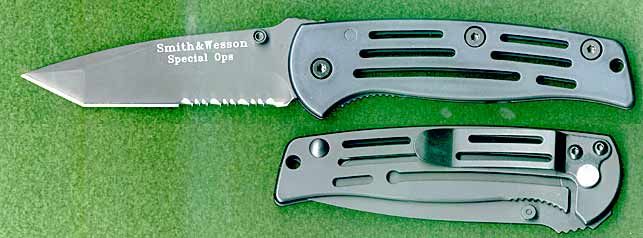
One more thing though. About the flat side on the left of the blade being more useful and precise for a right hander. I do believe that all the tanto folders i have seen the flat sides were on the right side.

griffsmblack.jpg


CQC-7B-BT.JPG


frameblack.jpg


Does that mean i am at a disadvantage because i am right handed?
 
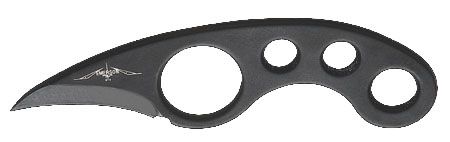
Here's a pic of a Warren Thomas neck knife that has a right handed chisel grind. Unfortunately his stuff is hard to come by this days.

fe16e75c.jpg

(pic from yamash*ita.org)
Looks a nice light knife that would be easy to carry and would never rust.

Frank Q.
 
DB,

you aren't SOL with the blades you have. It is just that a righty cuts utility stuff better if the grind is on the right side of the blade. You may find that the knives curve into stuff you cut, assuming you cut stuff thicker than string and cardboard. So, don't throw your knives out at all! If you like them and they cut well for you, keep 'em. But, in the future if you get a chisel ground utility piece you may want to try the right side grind.
 
Love the knife fq55. The holes could have been arranged better though. Also thanx Crayola for your opinion. I'll keep it in mind but why do they only grind the blade on the left side for folders???
 
As I do like a chisel grind and they do work great for alot of cutting, I have found that 50% of the time the grind is on the wrong side no matter what side the grind is on. So for me at least the chisel grind is not a very good carry knife. Cray's first post shows this some what and I have found it to be that the grind seems to always be on the side I don't want it on while cutting something :)
 
DB,

The reason the blades are usually ground on the left side is because it looks better that way. Seriously! When you use a knife as a righty, you see the left side of the blade WAY more than the right. typically a maker's mark is put on the left side so you can see it there. And, grinds look better than flats (to many I guess) so the grind goes on that side too.
 
In ancient Japan the chisel point so popular as at tactical advantage on westernized (read: U.S.) tanto style knives was found on Japanese eel skinning blades.

The eel is laid out for skinning and the chisel point is perfect for the fine, swift work necessary to dress the eel out with.

Later on the chisel point found its way into Japanese sword design. In the most general of discussions it's doing so was as much experimentation with new design features as it was durable when it came to penetrating Japanese / Chinese body armor on the battlefield.

The traditional Japanese tanto point is actually rounded, like those points found on the majority of Japanese battle swords. Interesting fact - broken swords were often reworked into shorter swords or knives. Hence you see the sword point on a knife because it may have been a sword at inception.

Chinese-American custom maker Bob Lum introduced the first chisel point on a knife that caught folks' attention to any degree. He's been doing them ever since. CS took the chisel point thought process to new heights and with a great deal of study / testing introduced the now legendary CS Tanto.

And it grew from there.

A properly ground chisel point on a knife is quite functional (just ask any Japanese eel skinner) and it is wonderfully durable when penetrating a number of different things that can be penetrated with a fairly good knife or sword or hatchet or other edged instrument / tool.

And design wise the feature is very cool looking.

As for "comma cuts" and stuff like that...

As the Filipino knife masters have said for many, many years. Three strikes and the man is down. Meaning - Get in there and get the job done quickly, brutally, and efficiently. Anything else will probably get you killed.
 
That was a great post Sierra! I like what you wrote.

One part confuses em though. Exactly what did you mean by this?


As for "comma cuts" and stuff like that... As the Filipino knife masters have said for many, many years. Three strikes and the man is down. Meaning - Get in there and get the job done quickly, brutally, and efficiently. Anything else will probably get you killed.


I agree that one ought to get in, get the job done and get out. But this may take more or less than three strikes. In Tae Kwon Do, practicioners train under the goal of intercepting one attack and responding with one defense. That is a nice ideal and is a great motivator on many levels, but to say that all it takes is one shot to beat a guy is to ignore the chaos of the street! The same goes for 3 strikes or 5 or whatever number. It takes as many as it takes.

Also, if you are poking fun a bit at comma cuts, I think this is a bit unwarranted. A comma cut is simply a turn of your wrist as you withdraw a knife from a guy you stabbed. You have to pull the knife out anyway, so why not turn the wrist? It takes no more time to do, it makes pulling a knife out easier in many cases and it created a larger wound channel that is less likely to close in on itself. What is wrong with that?
 
The objective of any physical confrontation is to end it as quickly as possible.

By doing so one incurs less possible injury to one's self, and lessens the unnecessary potential of unwarranted injury to the opponent.

The Filipinos promote the "3 strikes and you're out" rule as they often found themselves fighting mulitiple opponents. I.E. Spanish invaders attacking the village. In a multiple opponent situation there's no time to mess around with fancy stuff...you hit, hit hard, hit fast, and start looking for where the next attacker is coming at you from.

Three strikes is commonly taught to create an opening (bridge the gap), attack or deflect the opposing weapon / hand wielding it, then deliver a crippling or killing strike to a vital area. Then you move on to the next fella and start all over again. Economy of motion, force, proper targeting, and tactical awareness make it work.

Re: Comma cuts. This form of cutting is also called "coring" and "gouging". I describe this technique in Chapter Two of my book "Modern Knife Combat - The Training of a Knife Fighter". It is a valid technique for inflicting a specific degree of damage against a soft tissue target. However, it is also - like many other techniques - fairly easy to do in training against soft material targets that aren't moving and or trying to cut you. They are darned difficult to pull off in an actual confrontation or realistic sparring session.

You can prove this to yourself by taking a Red El Marco marking pen and going up against a training partner using a black such pen. Wear a tank top. Start back to back and have someone time you for 30 seconds after the "GO" command is given. Wear eye protection! Go for arm and upper/lower body cuts and slashes. Try to deliver "comma cuts" or whatever term one likes better. At the end of the match count the marks on your torsos and arms where a distinct "comma cut" can be identified.

You'll be hard pressed to find one that you'd honestly say "Hey, a comma cut!" And 30 seconds is about 25 seconds longer than most knife to knife confrontations will last. You will see lots of clear slashes and direct impact "stabs". If you're really unfortunate you'll also learn how swiftly you can lose your "knife" due to the clash of combat and how much fun it isn't to then rely on empty hand techniques to keep from being sliced and diced with impunity by your now very happy opponent.

Finally, I know Mike Janich and think the world of him and his work. We've trained a bit together,and enjoyed each other's company in discussions just like this one. He calls it "comma cutting". I call it "coring".

We both understand getting in there and getting the job done as quickly and brutally as possible, using whatever technique works at that particular moment, is the desired objective.

:D
 
Sierra,

Thanks again for your awesome post. I am glad you are here to share your knowledge. I for one will squeeze you dry if possible! :)

The three strikes idea I like as far as a strategy goes. In my training we had pretyt much a 3 stage approach to fighting with a 4th special stage. We would first try to cause pain. Throw something, finger jab to the eyes, ball slap, ball kick, whatever it takes to get a reaction. The we'd close the gap and get to the neck. Finally, we'd finish using brutally efficient tools. You know, eye gouges, headbutts, knees and elbows, biting, etc. I think we are on the same page :) The fourth "stage" is the F$%k up factor.

Oen thing I'm still not sure about with comma cutting is whether or not training with "El Marko" reflects stabs all that well. Pwehaps comma cuts or corign are easier to do when 4" of steel is inside someone, as opposed to .25" of red felt. I am not sure of this, and I've doen hardly any trining to test this. I'll take your experience and knowledge very much to heart.

By the way, can we order autographed copies of your books from you?
 
Actually the "stab" or thrust marks are pretty definite.

The exercise demonstrates how truly difficult it is to try to twist as you withdraw in such a manner that a definite "comma" is actually attained.

The reason this happens (or fails to happen) is found in the sparring exercise (which is where you can test and evalulate all the nifty cool things folks advocate in terms of technique to see if they really work). People move when they're fighting, and move real fast when they're trying to kill you and avoid being killed by you.

A proper coring with a blade best occurs after you've delivered a solid thrust that has gone in deep. As you withdraw the blade you begin the twist inside the full depth of the wound channel, coring the wound itself as the blade is pulled free.

Again, people move even - and especially - if they've been hit hard. So a solid coring also best occurs when you have really hammered the opponent and have him somehow stunned, held, or pinned long enough so you can safely (fraction of an instant) withdraw the blade in this manner.

Comma cuts, or coring/gouging, is essentially a pain inducer or distractor. It requires great finesse to pull off, as does any meaningful technique in any martial study. Again, spar it and make your own determination of the concept's value to what you might do, or not do.

If it works for you, keep it and master it. If not, then lose it and be glad you discovered what is valid for you on the basis of working the technique in training, and not in battle.

Yes, I like the straightforward approach to taking an opponent out. Sifu Paul Vunak spent 3 days with me many years ago now. He taught me the same program he originally developed and taught to SEAL Team SIX.

Size up the opponent as to his fighting style and capability - This must be done swiftly and is accomplished before the first blow is struck.

Deliver a distracting strike, most often a low line kick to the shin, as you begin your attack / entry.

Immediately shift into full forward pressure in conjunction with the straight blast.

Close the gap and begin delivering head butts, knees, and neck manipulations all in one fluid burst. Throw in elbow strikes to the head, face, jaw.

Finish by taking the opponent down (neck manipulation - where the head goes, the body must follow) and applying finishing strikes if necessary.

If you train this sequence and these strikes hard it is a pretty difficult system to defend against to any degree. Throw in a knife during the straight blast and feed it into cuts, slashes and pommel strikes as you're manipulating the head, delivering elbow strikes, knees, and head butts...



:D
 
I like your style!

I originally trained in Tae Kwon Do for 5 years. My instructor (who became a good friend) was ex SAS so we sometimes got some interesting military techniques in too. I trained for 2 years with a JKD instructor (certified through the Vunak line, so it was good stuff). Also, beign at university helps a lot as far as being exposed to people and ideas. I took Judo and fencing for credit and I did a semester of hapkido. And a bunch of us med on occasion to go train.

It is amazing how simple my later stuff is as compared to my earlier training. I couldn't do a spinning reverse crescent kick today if my life depended on it! However, though I haven't trained formally for 2 years I can still eye gouge, head butt, knee and elbow easily. Whenever I get a free afternoon to train with a buddy I notice that my skills on those tools are still pretty sharp. And like you said Greg, where the head goes the body follows. Control the neck, you control the head. Cool stuff.

The killer instinct training that Vunak developed is pretty cool stuff too. We spent 2 hours dedicated to killer instinct training during one seminar. I haven't forgotten one word. That is gold.

Hey Greg, you forgot to answer my question! Can I order a signed copy of Battle Blades and you rknife fighting book from you?
 
Back
Top