Tanto handle/ guard options

Joined
Jul 31, 2015
Messages
3,118
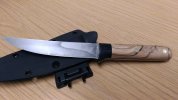
I have been putting off making a tanto a friend of mine had asked for. Mostly because I'm not sure I'm up for the learning curve to make all the fittings of a traditional style (at least, not yet). I made a kaiken recently I'm happy with, but made just a bit of a guard of the tang and bolster. I am interested in making a full tang Tanto, with a Tsuba. Is this even possible? I would think that having the tang hole relieved perfectly on the handle side so there is no gap at the edges (as there would be no scale there to hide it) would be nearly impossible. thoughts? Picture below showing what I have done in the full tang realm in this regard up to now.

kaiken.jpg
 
sure, you can do it. i have done them several ways. on a full dress tanto, the habaki hides any gaps between the seppa , tsuba and the blade. when using no habaki, the seppa will hide any gaps between the tsuba and the blade. the seppa are usually thin copper or brass, so it is easier to carefully get a tight fit. and if you screw it up, its quick to start a new one because you didnt invest an hour filing away. you can also just use a tsuba if you wish but the fit becomes more of a concern. i use a contour gauge to get and idea of half the tangs profile. then i scribe that on the seppa and file it out. once i get the seppa the way i want it, fit up tight to the front, i use the seppa to scribe the outline of the cutout on the tsuba. the scribe makes quicker work of the tsuba cutout, because you dont have to keep checking if you are going too far until you hit the scribe line. here is a pic of some of my no habaki blades. i am looking forward to hearing how others do it.
 
I was thinking of using a seppa on the handle side. Your description really lays out a good way to go about it. Thanks!
 
sure, you can do it. i have done them several ways. on a full dress tanto, the habaki hides any gaps between the seppa , tsuba and the blade. when using no habaki, the seppa will hide any gaps between the tsuba and the blade. the seppa are usually thin copper or brass, so it is easier to carefully get a tight fit. and if you screw it up, its quick to start a new one because you didnt invest an hour filing away. you can also just use a tsuba if you wish but the fit becomes more of a concern. i use a contour gauge to get and idea of half the tangs profile. then i scribe that on the seppa and file it out. once i get the seppa the way i want it, fit up tight to the front, i use the seppa to scribe the outline of the cutout on the tsuba. the scribe makes quicker work of the tsuba cutout, because you dont have to keep checking if you are going too far until you hit the scribe line. here is a pic of some of my no habaki blades. i am looking forward to hearing how others do it.


what is the guard material? Looks like maybe nickel?
 
yes, good guess. nickel. lots of tutorials on this stuff on youtube. if you have a jewelers saw it makes the job easier.
 
A tanto is a pretty simple project, so I say you should go for it. There are few rules, and most of them can be tweaked as you wish.

There have been many threads on tanto, and on habaki with good photos and tutorials. The custom search engine in the stickys will help find them.

A tanto can be aikuchi, or with tsuba. Most new makers make the mistake of making the tsuba way too big. Personally, I feel anything that sticks out over 1/4" is too large. Many I make have just a bare bump of a tsuba.
I like buffalo horn (black micarta or G-10 work as good substitutes). 3/16" thick is all the thickness a tanto tsuba needs ... and I feel 1/8" is just about right.

My opinion on a seppa on a tanto is it isn't necessary, and will create problems fitting the saya. If you use one, it must be the same size as the saya cap ,so it looks like a spacer when the blade is in the saya.

As John's photos show, a habaki in not necessary on a tanto. If you do build one, make it small and thin.

The blade grind can be traditional or a western double bevel. There is just a tad of sori, if any at all. I like about 1/8" to 1/4" sori ( tip to nakago-jiri) in a full size tanto.

The nakago/tang on a tanto can be a somewhat stubby hidden tang used with traditional two-piece tuska, or a more western huden tang in a one piece drilled out handle. I usually go with the full tang and traditional two-piece tsuka. On a tanto is actually closer to a 3/4 tang.. I grind down the sides of the tang an appropriate amount when wrapping with paracord or other maki. The kashira can be a cap of metal, buffalo horn, or just a hole you wrap through and around.

The underlayment for the wrap can be leather, or same' - stingray skin. On a tanto, there is no need for rawhide same' ( as is done for a katana/wakizashi tsuka), and the softer black and other colors of same' are fine. Menuki are also not needed. If used, they are small and thin. Coolest tanto menuki I ever saw was a post war, 10,000 yen note folded as an origami fish. When doing scales, a single stud through the handle with a small round emblem or other symbol screwed into each side is used as the menuki.

The kissaki on a classic tanto is not an abrupt angle. That is what I call an American tanto ( usually done with a double bevel).
The traditional tip is a gradual curve to a point. It shortest is should ever be is the width of the blade near the tip ( saki-haba). It can curve up anywhere from the last inch from the tip (Ko-kissaki), to a medium curve tip like a hunter ( Chu-kissaki), to something like a fillet knife ( O-kissaki), to a tip so long it ends at the middle of the blade ( Osaraku-tsukuri).

 
Stacy, when you say full Tang, I'm assuming you mean almost full Tang where the spine and blade edges are not visible, but the tsuka is thin there, perhaps 1/4" of tsuka covering? Also, would it be blasphemous to create the tsuka in three parts where the middle piece is the thickness of the tang? It has been easier to do a nearly full Tang handle doing this in my experience.
 
When I said full tang, I meant just like any normal knife with scales. The tang shows all the way around in the middle of the handle. This works OK with burl wood an figured wood tanto handles.

Your description is the more normal "3/4 tang", where the scales are inletted to fit the tang, and when closed together on it appear as all wood. The tsuka can be only lightly glued together with paste or rice glue if being wrapped, or glued together with stronger glue to make a hidden tang construction. I like Titebond II glue for tsuka and saya.

Your question on a three piece tsuka is fine. It is done from time to time on handles, and is also a popular way to fit a saya.
 
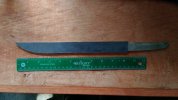
ok. So if Stacy says it's easy, how hard could it be? I got this profiled It seamed smaller in my head. I'm going to try for the traditional 3/4 hidden tang and just learn as I go. P_20170613_161717_vHDR_Auto (1).jpg
 
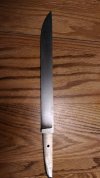
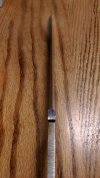
Questions, If you don't use a habaki, what retains the blade in the saya? Also, is a beveled spine in order? If so, what is a good way to go about that. I don't have a work rest, though I am going to be making one soon. Oh, and this is how it's looking now. Lot of metal to take off. I don't use .25" stock very often especially in an 11" blade.

P_20170613_211949_vHDR_Auto.jpg P_20170613_212014_vHDR_Auto.jpg P_20170613_212028_vHDR_Auto.jpg P_20170613_212055_vHDR_Auto.jpg
 
The saya on a tanto can retain on the ricasso on one with no habaki. Just make the ricasso a bit thicker than the blade. Also, have the moto-haba ( width at the habaki area) a tad wider than the blade .
 
Stacy, was is the best material to use to try to make a home made habaki? I have had an 11.5 inch OAL W2 tanto "blank" sitting around for a long time and want to do something with it.
 
i set my workrest somewhere between 45-60 degrees and do the spine on a 2x72. but i do it before the blade bevel so it sits flat on the workrest. if you have a really long tool rest you can still do it by making sure the ricasso stays flat on it. i use 1/8" copper for habaki, the 092 should work fine.
 
I have seen some guys using thick copper, like 3/16 and filing away the excess and others splitting a piece of copper plumbing pipe.
 
What's your take on beveled spines and how do you do them?
I like them on wakizashi, but they are sometimes overkill on a tanto ... unless it is O-tanto.

Stacy, was is the best material to use to try to make a home made habaki? I have had an 11.5 inch OAL W2 tanto "blank" sitting around for a long time and want to do something with it.

For a simple first try habaki, try copper pipe. Get the heavier tyle L thickness. It is also great for making the koi-guchi and kojiri. You can hammer finish it, file it, carve it,etc. I also patinas to a dark silvery-black that looks great. Use Livers of Sulfur for the patina solution.
 
Back
Top