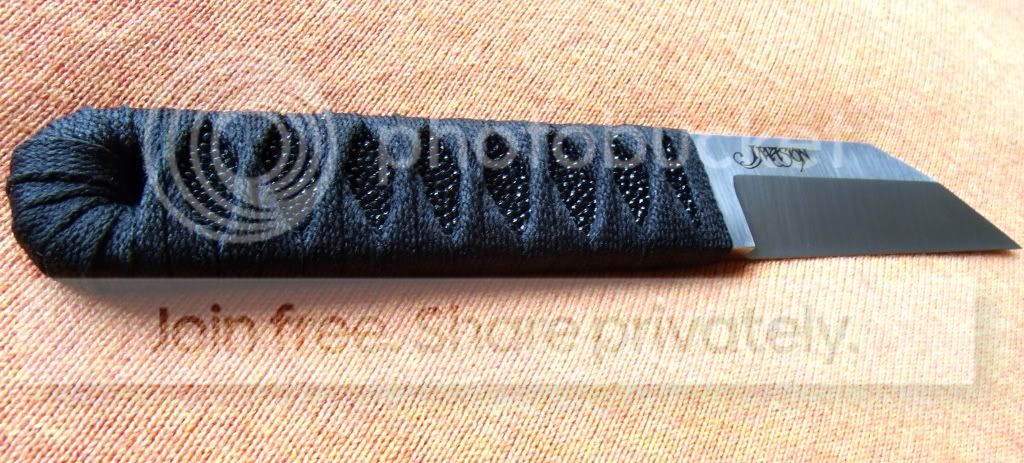
Tanto handle help

Joined
Mar 3, 2011
Messages
1,010
Well me and my nephew (16) got in the shop yesterday and just had fun yesterday! He even made a tanto type knife and wants to do a wrapped handle. Problem is Ive never done it before. After looking up some info I realized we need to drill a hole toward the end but most of the tantos i've seen like this have more of a slot type hole. Anyone able to help me figure out what to do for the hole?
 
I believe Rick Marchand is our biggest wrapper on here, wait a bit and he may comment but if he doesn't just throw him a note and he will probably help out.
 
Th end of the handle for many wrapped handles is often just a hole or small slot. On other styles, the slot goes all the way down the center of the handle. Without a photo, I don't know what shape your tang is,or whether it is heat treated yet.

The "slot: in a tactical wrapped handle - like a paracord wrap - can be nothing more than series of large holes. If you want a full slot, use a drill press to make a row of holes and then file/grind the metal out between them to make a slot. A dremel too will help do this. File the edges smooth after the holes are connected.

Look up "Paracord Handle Wrapping" and you should find lot of ideas on wrapping styles.I put some at the bottom of this post to help.

If making a slot isn't going to work, just a hole at each end will do .
You can start and end with a Turk's head knot, and have no hole at all. The best way to keep the wrap tight is to give it a light soaking of resin after it is done. Use a small paint brush and apply thin epoxy resin onto the wrap. Use just enough to soak in but not build up. Blot off any excess with an old tee shirt and wipe away any that gets where you don't want it with a little acetone on a cloth. Let cure and the handle will be rock solid, but look like it is just wrapped cord.

Paracord can be found at most outdoor shops, surplus shops, and ordered from many places online. The type used is called 550. You can pull out the core strands and use it like the flat tape type wrap,too.

Here are good tutorials:
http://ecosknives.com/wrapping.html
http://www.northcoastknives.com/northcoast_knives_tutorials_CordWrap.htm
 
Thanks alot! Exactly what I was looking for. Its not heat treated yet so wanted to do this now and wasnt sure. never paracorded anything or wrapped. I think he wants a traditional cloth wrap. ill have to talk with him when he wakes up.
 
You can use paracord to do a handle that looks pretty traditional if you take the core out to make it flat. This will give you a wrap that is about half the width of the traditional material, but it looks pretty good. Here's a knife that I finished recently using paracord:
2uqdjb9.jpg

You'll also notice that I didn't use a hold to finish it. One traditional style of tsukamaki (handle-wrapping) has the cord go around the end of the butt instead of through it.
If you are doing a traditional wrap with paracord, you may have to modify the pattern slightly. In the video below, both ends of the wrap get two folds as they twist. Paracord, for whatever reason, does not like to fold nicely. There are a few solutions that I have found work really well. The simplest is to do a different style of traditional wrap. The one depicted in the video below is called "hinerimaki," where both ends fold twice as they cross. Another style is called "hiramaki," where both sides are flat as they cross. This doesn't give the thickness of hinerimaki but it is easier to do and it works better with paracord.
Here's a picture of a knife I did a while ago in hiramaki. I screwed up a little on the end knots, so just ignore that:
30a5nk6.jpg

I actually use a combination of these two methods (it's similar to a style called "tsumami" but it is a little different), where I fold the bottom strand twice but the top strand does not fold. As you fold the bottom strand, you will notice that it doesn't fold nicely as other materials do, but it sort of twists. If you twist it in the right direction (the standard direction for hinerimaki), it makes a sort of groove that the top strand fits nicely into.
There is a third solution that is a traditional wrapping style that uses a cord that is about the same width as paracord with the core removed. Unfortunately, I don't know what it is called and I don't have a picture of it. But if you can imagine it, it is hiramaki that is done with two pieces of cord instead of one. All four ends cross at the same point Maybe someone else knows what I'm talking about and has a picture of it.
Paracord doesn't usually look exactly like traditional materials, but the real stuff is hard to find in acceptable quality and is pretty expensive.
Coating the whole thing with epoxy or resin will give you a really good handle, but may detract from the traditional look. Another alternative is to add a drop of superglue on the ends of the handle each time you wrap (not where the cord crosses, but where it lays flat and bends around to the other side).

Here's a good video on tsukamaki:
http://www.youtube.com/watch?v=IZhNWU9cepM&feature=related
Tying the Ura knot:
http://www.youtube.com/watch?v=EbDETzm39oQ
Tying the Omote knot:
http://www.youtube.com/watch?v=GjjButNY_54

see also: http://www.tsukamaki.net/tsuka/

- Chris

 
Last edited:
Are you using any type of stingray skin or anything underneath the wrapping?

Oh, and here's a great tutorial on tsukamaki. You can look it up on youtube, and they have some fine examples on how to do this.

http://www.tsukamaki.net/tsuka/

On my knives, I drill a 1/4th hole in the tang at the butt, trace the handle and the hole placement on the fleshy part of the stingray, cut the stingray with a stout pair of scissors, punch the hole out with a leather hole punch, glue the stingray scales down onto the handle (leaving a bit of room for the ricasso) and trim any excess stingray hanging over the edges with a pair of straight toenail clippers (Hey, it works! lol) I then lightly bevel the edges of the stingray with my grinder.

I do my wrap starting at the top of the handle. You can use paracord with the middle taken out, the flat nylon cord sold by knifekits.com, or a stout boot lace (alot of guys who make this style swear by it.) I try to use a foot of cord for every inch of the handle. Better to have excess cord hanging than not enough.

Do the tsukamaki wrap as instructed on the tutorials here, and make it as tight as you can. It takes practice. When I get to the bottom where the hole is, I just feed each end through the hole one at a time and wrap it around the butt of the handle. It should be tight. Use a small allen wrench or somethin to push the ends through the hole. It's not traditional, but it works and looks good. You can try the ura and omote knot if you want to for the ends, but its really not necessary. If you do the method that I suggested, you should have two pieces of your cord sticking out of one side of the handle. I usually epoxy my handles and wait until they are 80% dry before I cut these ends off. You cut them off early, and the ends could retract back through the hole. Probably got to do the whole thing over then.

Guys who do this type of knife usually get a couple of cans of west system epoxy to put on the finished handle. That stuff is pretty expensive and it comes in two big ol' cans. I think if you were wanting to do a couple of these, some good quality 2 part epoxy should be fine. I have experience with superglue and titebond (on the kirby lambert wrapping dvd) but they have been a nightmare for me. I'm sure a good 2 part epoxy should be fine. Wrap your blade up with some paper towel and tape. Use a small acid brush dressed off at an angle, and carefully paint it on your wrap, careful to not get any on your stingray etc. It should soak right in. I clamp up the blade with a cheap clamp and prop the handle vertically to dry. Your handle should be rock hard in a couple of days and ready to go!

Hope this helps!

Here is one of mine.

GEDC0015.jpg
 
Last edited:
Back
Top