
-
The BladeForums.com 2024 Traditional Knife is available! Price is $250 ea (shipped within CONUS).
Order here: https://www.bladeforums.com/help/2024-traditional/ -
America has reached 250 years, and I am grateful to be here, in the best country in the world. Thank every one of you who helps make this country a better place, those who have gone before and risked it all, and those who've paid the ultimate price to make the United States what we are today.
Happy Birthday America! Let Freedom Ring for all time!
You are using an out of date browser. It may not display this or other websites correctly.
You should upgrade or use an alternative browser.
You should upgrade or use an alternative browser.
tell me about khukris
- Thread starter RescueRiley
- Start date


- Joined
- Sep 14, 2006
- Messages
- 4,409
I have quite a few khuks, all of them from HI. I use some of them around the place for brush clearing, and cutting back branches from trails, and clearing brush from fencelines.
IMO, the most useful khuks are the Pens, the BAS, and the WWII models, from 15-18" long. Mind you these are made for chopping harder woods, not clearing softer materials such as grass or such, but oak limbs, osage orange, hackberry, elm and ceder.
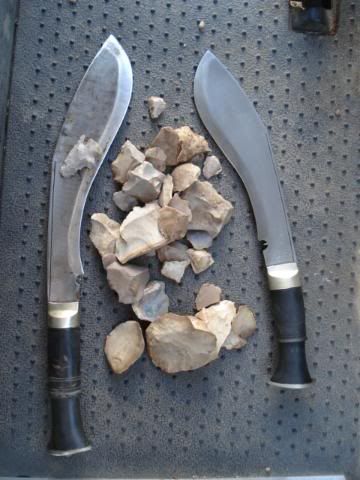
My personal favorite are the Pens mainly because they are shaped more to my liking, and they aren't as thick. Here is a pic of two of my pens, an 18" and a 12" -
I like khuks better than machetes because a machete isn't heavy enough for the kind of brush I have to deal with. I like them better than hatchets because I think they are both easier to use, and safer to use, than a hatchet. They are also more versatile. Khuks are also tougher than hatchets and machetes, IMO, because the blade is stronger and there is no haft to get beaten up in use.
Andy
IMO, the most useful khuks are the Pens, the BAS, and the WWII models, from 15-18" long. Mind you these are made for chopping harder woods, not clearing softer materials such as grass or such, but oak limbs, osage orange, hackberry, elm and ceder.
My personal favorite are the Pens mainly because they are shaped more to my liking, and they aren't as thick. Here is a pic of two of my pens, an 18" and a 12" -
I like khuks better than machetes because a machete isn't heavy enough for the kind of brush I have to deal with. I like them better than hatchets because I think they are both easier to use, and safer to use, than a hatchet. They are also more versatile. Khuks are also tougher than hatchets and machetes, IMO, because the blade is stronger and there is no haft to get beaten up in use.
Andy
.I was considering a 15 inch model..Possibly the "british" one..THanks for the input so far guys...
That was the biggest step: to set what you want.
As for the model, Ang Khola and BAS are nice all arounders, the chiruwa ang khola is nice too, but a little more expensive. I was in your situation and it was between those 2, the first deal that suited me would be my new khuk. Then I saw that BAS for 60$ and attacked.
- Joined
- Jan 27, 2007
- Messages
- 3,504
I purchased my first real Khukuri from khukurihouseonline.com
It took 1 full month to get the knife after I paid for it but it was worth the wait:thumbup: Mine is the Jungle Model 10" - its hand made from a military truck leaf spring (high carbon rolled steel) w/ water buffalo horn handles!
It's a real beast at 3/8" thick blade & hair shaving sharp ! cost shipped from Nepal was $45.00 :thumbup:
 [/IMG]
 [/IMG]
 [/IMG]
 [/IMG]
It took 1 full month to get the knife after I paid for it but it was worth the wait:thumbup: Mine is the Jungle Model 10" - its hand made from a military truck leaf spring (high carbon rolled steel) w/ water buffalo horn handles!
It's a real beast at 3/8" thick blade & hair shaving sharp ! cost shipped from Nepal was $45.00
:thumbup:
- Joined
- Sep 22, 2003
- Messages
- 13,182
Khukuris are us.
Fun to chop with.
My suggestion is think about weight.
The great thing about a khuk is it chops or machetes.
Get a heavy one and it's too heavy to swing at brush.
Get a light one and it's too light to chop.
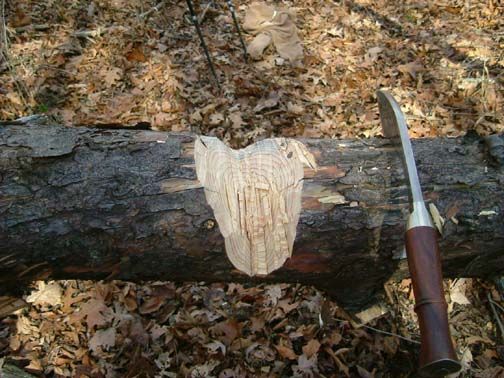
Get one in the 20 to 27 oz range about 16 to 18" and you have something you can carry on your hip, can cut small brush and can easily chop stuff up to about 7"
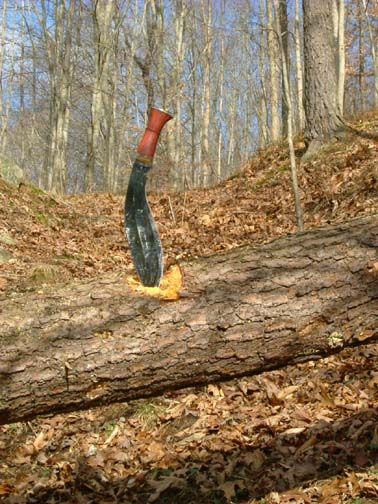
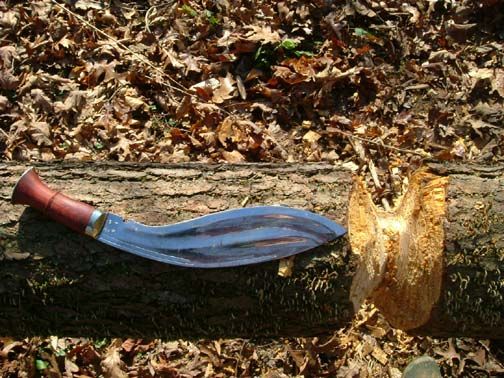
17" 23 oz Ganga Ram Villager
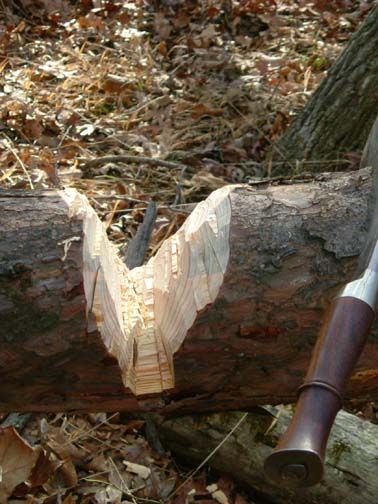
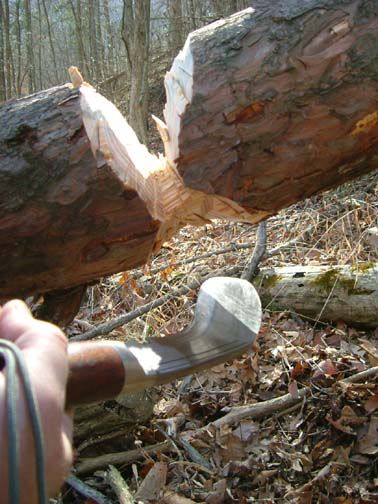
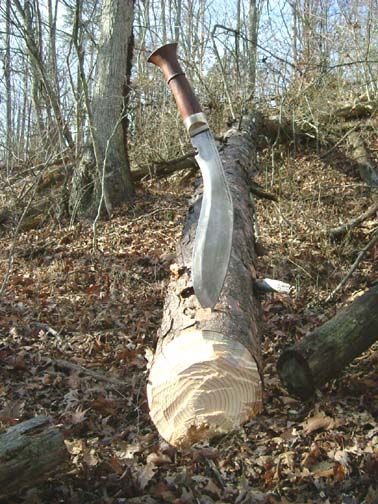
17" 23 oz Foxy Folly


Fun to chop with.
My suggestion is think about weight.
The great thing about a khuk is it chops or machetes.
Get a heavy one and it's too heavy to swing at brush.
Get a light one and it's too light to chop.
Get one in the 20 to 27 oz range about 16 to 18" and you have something you can carry on your hip, can cut small brush and can easily chop stuff up to about 7"
17" 23 oz Ganga Ram Villager
17" 23 oz Foxy Folly
- Joined
- Sep 22, 2003
- Messages
- 13,182

15" 20 oz Ganga Ram Villager
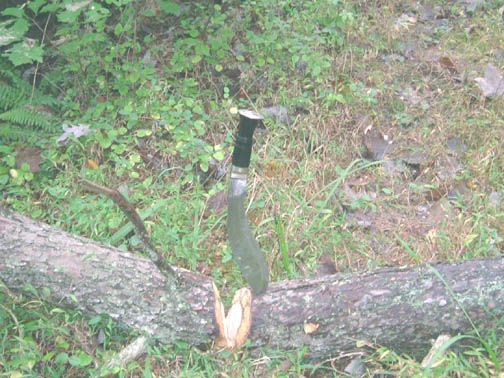
18" GK Bonecutter (can't remember weight)


- Joined
- Oct 19, 2005
- Messages
- 20,029
And the goats win again!
- Joined
- Nov 29, 2005
- Messages
- 887
You ask good questions. Here are my two cents' worth.
A khukuri's design seems to give you a chopping advantage over a straight knife of similar length. This (if my perception is accurate) lets you carry more chopping power in a smaller space with a khukuri than with, say, a golok or bolo. (I didn't say "machete", since most machetes are thin of blade, and seem better suited to very light brush than a golok or bolo.) e
As mentioned by someone else before, khukuris, with their longer edges than axes, seem to do better at cutting what you're aiming at and not missing or glancing off. This also makes them great at cutting lots of small, thin branches or twigs off of a larger branch or tree trunk: you can chop multiple twigs in one stroke, which might take 5 or 6 blows with a hatchet. As with a hatchet or axe, YOU MUST BE CAUTIOUS ABOUT WHAT YOU'LL HIT IF YOUR BLADE GOES THROUGH THE TARGET--good idea to stand on one side of the log you're limbing, for example, while cutting off the branches on the other side.
A khukuri, unlike an axe or hatchet, also doubles fairly well as a knife--it does have a point, which, though sometimes not hardened as well as the edge in the prime cutting zone just distal to the curve, will still let you skin animals, cut things, etc. in a pinch. For what it's worth, traditional khukuris also come with a small by-knife, or karda, and sharpening steel, or chakma, so you actually are getting a little extra for your money. Karda and chakma quality and hardening are hit-and-miss, but if you want, I'm sure you can melt the adhesive holding the steel into the karda and chakma handles (this adhesive is called "laha"), heat the steel to non-magnetic, quench it in water or whatever, re-melt the laha (or use epoxy), and you'll likely have them functional, if you don't find them so initially.
Khukuris---especially the quality handmade ones--have a lot more character than production knives you'll get. I mean, there's just something to a quality wilderness knife that started life as a truck spring, was hand-forged over a charcoal fire near Kathmandu, and handled with water-buffalo horn. Beats Kraton for character any day. Also, I imagine that smiths in Nepal's "untouchable" caste may need your cash a little more than, say, Cold Steel LLC does. (No offense, Lynn!)
In the case of Himalayan Imports, the warranty and customer service are almost unbeatable. H.I. encourages buyers to chop their new knives into logs, etc., and lean on them and pry them to make sure they won't break. A very few do--it is theorized that sometimes the khukuri-smiths' old-fashioned heat-treatment method (consisting of pouring hot water from a teapot onto the cherry-red edge, gauging the temperature change by eyeing the color) misses, leaving the tang or ricasso area harder and more brittle than intended. If the original purchaser breaks an H.I. khukuri (other than by intentional abuse), H.I. (as I understand it) will replace it, free. Two exceptions: they have a model called the "kobra", sort of a thin, fast, martial-arts knife, that may be exempt from the usual warranty, just as a necessary function of its exceptional thinness. They have another model, the chiruwa ang khola ("chiruwa" means "split", referring to the handle construction, which uses scales on either side of the tang, instead of a rat-tail tang like most khukuris have) which is so heavy-duty that H.I. offers to send you TWO chiruwa ang kholas if you break or bend one. What this means for me is that I can actually afford to test the heck out of each H.I. khukuri I get, BEFORE I take it way out into the middle of nowhere (or give one to my wife or one of my kids to do the same) and rely on it. I don't believe Ontario or Ka-bar will look as kindly on a knife returned in multiple pieces because you chose to chop it into a hardwood log and lean hard on it.
Finally, as to price, the list prices you see are usually well above what one can get by lurking on the H.I. subforum on BladeForums and watching for the almost-daily "deals of the day" posted by the proprietress, Yangdu Martino (Reno, NV-based widow of H.I. founder, the late Bill Martino; I think she's the daughter or other relative of the master smith in Nepal--who, incidentally, before the recent end of the Nepali monarchy, was supposedly the khukuri-maker to the king of Nepal). One very often sees H.I. khukuris offered for sale for maybe $65 and up. You need to have a good idea of what you want, and of what kind of blemishes you're willing to live with, and then to be VERY FAST to e-mail Yangdu with an e-mail saying you'll take it, with details of your address and payment method. The best deals tend to disappear about 5 minutes after they're posted. But a little bit of rust that you can take off in 5 minutes can drop the price by 50%, sometimes--as can a small handle-crack that you can fill with epoxy.
As to the particular model for you to try, I'd recommend the British Army Service ("BAS") model. It's 15 inches overall, which means a 10-inch blade. It'll chop respectably, but isn't absolutely huge, and I tend to find myself picking up a BAS when I'm going on an outing, leaving the more-monstrous knives behind. The ang kholas are usually thicker in the blade, which makes them a little more unwieldy for things other than heavy wood chopping. If you keep an eye out, you can probably get a slightly-blemished but fully-functional BAS for in the neighborhood of $75. (The H.I. prices include shipping within the continental U.S., by the way.) Actually, even the narrower-bladed knives such as the sirupati and chitlangi are often substantial enough to do some woodchopping--wouldn't want to build a log cabin with one, but if you just want to cut a few inch-thick branches and drop a couple of ten-inch trees, you could do that with any chitlangi or sirupati I've seen. Might take you a few more blows, but, hey, they'd work. There IS a lot of blade-to-blade variability in these handforged knives. One of my favorites is a chiruwa ang khola "villager" (H.I.'s designation for a less-polished knife, typically sold at a discount, though the unpolished finish may mean that the heat treatment stays better intact); it's got a blade that's only maybe 3/8 of an inch thick--unusually thin for a chiruwa ang khola, whose blades are often a full 1/2 inch thick at the spine); great heat treatment, with a nice, razor-sharp convex edge that I've developed over years. It sails through wood with surprising and dangerous ease.
Happy shopping. And happy chopping!
A khukuri's design seems to give you a chopping advantage over a straight knife of similar length. This (if my perception is accurate) lets you carry more chopping power in a smaller space with a khukuri than with, say, a golok or bolo. (I didn't say "machete", since most machetes are thin of blade, and seem better suited to very light brush than a golok or bolo.) e
As mentioned by someone else before, khukuris, with their longer edges than axes, seem to do better at cutting what you're aiming at and not missing or glancing off. This also makes them great at cutting lots of small, thin branches or twigs off of a larger branch or tree trunk: you can chop multiple twigs in one stroke, which might take 5 or 6 blows with a hatchet. As with a hatchet or axe, YOU MUST BE CAUTIOUS ABOUT WHAT YOU'LL HIT IF YOUR BLADE GOES THROUGH THE TARGET--good idea to stand on one side of the log you're limbing, for example, while cutting off the branches on the other side.
A khukuri, unlike an axe or hatchet, also doubles fairly well as a knife--it does have a point, which, though sometimes not hardened as well as the edge in the prime cutting zone just distal to the curve, will still let you skin animals, cut things, etc. in a pinch. For what it's worth, traditional khukuris also come with a small by-knife, or karda, and sharpening steel, or chakma, so you actually are getting a little extra for your money. Karda and chakma quality and hardening are hit-and-miss, but if you want, I'm sure you can melt the adhesive holding the steel into the karda and chakma handles (this adhesive is called "laha"), heat the steel to non-magnetic, quench it in water or whatever, re-melt the laha (or use epoxy), and you'll likely have them functional, if you don't find them so initially.
Khukuris---especially the quality handmade ones--have a lot more character than production knives you'll get. I mean, there's just something to a quality wilderness knife that started life as a truck spring, was hand-forged over a charcoal fire near Kathmandu, and handled with water-buffalo horn. Beats Kraton for character any day. Also, I imagine that smiths in Nepal's "untouchable" caste may need your cash a little more than, say, Cold Steel LLC does. (No offense, Lynn!)
In the case of Himalayan Imports, the warranty and customer service are almost unbeatable. H.I. encourages buyers to chop their new knives into logs, etc., and lean on them and pry them to make sure they won't break. A very few do--it is theorized that sometimes the khukuri-smiths' old-fashioned heat-treatment method (consisting of pouring hot water from a teapot onto the cherry-red edge, gauging the temperature change by eyeing the color) misses, leaving the tang or ricasso area harder and more brittle than intended. If the original purchaser breaks an H.I. khukuri (other than by intentional abuse), H.I. (as I understand it) will replace it, free. Two exceptions: they have a model called the "kobra", sort of a thin, fast, martial-arts knife, that may be exempt from the usual warranty, just as a necessary function of its exceptional thinness. They have another model, the chiruwa ang khola ("chiruwa" means "split", referring to the handle construction, which uses scales on either side of the tang, instead of a rat-tail tang like most khukuris have) which is so heavy-duty that H.I. offers to send you TWO chiruwa ang kholas if you break or bend one. What this means for me is that I can actually afford to test the heck out of each H.I. khukuri I get, BEFORE I take it way out into the middle of nowhere (or give one to my wife or one of my kids to do the same) and rely on it. I don't believe Ontario or Ka-bar will look as kindly on a knife returned in multiple pieces because you chose to chop it into a hardwood log and lean hard on it.
Finally, as to price, the list prices you see are usually well above what one can get by lurking on the H.I. subforum on BladeForums and watching for the almost-daily "deals of the day" posted by the proprietress, Yangdu Martino (Reno, NV-based widow of H.I. founder, the late Bill Martino; I think she's the daughter or other relative of the master smith in Nepal--who, incidentally, before the recent end of the Nepali monarchy, was supposedly the khukuri-maker to the king of Nepal). One very often sees H.I. khukuris offered for sale for maybe $65 and up. You need to have a good idea of what you want, and of what kind of blemishes you're willing to live with, and then to be VERY FAST to e-mail Yangdu with an e-mail saying you'll take it, with details of your address and payment method. The best deals tend to disappear about 5 minutes after they're posted. But a little bit of rust that you can take off in 5 minutes can drop the price by 50%, sometimes--as can a small handle-crack that you can fill with epoxy.
As to the particular model for you to try, I'd recommend the British Army Service ("BAS") model. It's 15 inches overall, which means a 10-inch blade. It'll chop respectably, but isn't absolutely huge, and I tend to find myself picking up a BAS when I'm going on an outing, leaving the more-monstrous knives behind. The ang kholas are usually thicker in the blade, which makes them a little more unwieldy for things other than heavy wood chopping. If you keep an eye out, you can probably get a slightly-blemished but fully-functional BAS for in the neighborhood of $75. (The H.I. prices include shipping within the continental U.S., by the way.) Actually, even the narrower-bladed knives such as the sirupati and chitlangi are often substantial enough to do some woodchopping--wouldn't want to build a log cabin with one, but if you just want to cut a few inch-thick branches and drop a couple of ten-inch trees, you could do that with any chitlangi or sirupati I've seen. Might take you a few more blows, but, hey, they'd work. There IS a lot of blade-to-blade variability in these handforged knives. One of my favorites is a chiruwa ang khola "villager" (H.I.'s designation for a less-polished knife, typically sold at a discount, though the unpolished finish may mean that the heat treatment stays better intact); it's got a blade that's only maybe 3/8 of an inch thick--unusually thin for a chiruwa ang khola, whose blades are often a full 1/2 inch thick at the spine); great heat treatment, with a nice, razor-sharp convex edge that I've developed over years. It sails through wood with surprising and dangerous ease.
Happy shopping. And happy chopping!

- Joined
- Sep 4, 2007
- Messages
- 6,583
I have a big one that a friend gave me a while back. I don't know who made it or if it's worth fixing up. He found it in a old grain bin and the mice hate eaten the handle off. There is some rust on it but not really to bad. I suppose I should send it to one of our knife makers here and see if it's worth a new handle and regrind.
- Joined
- Sep 22, 2003
- Messages
- 13,182
:thumbup:
This man totally gets it :thumbup:
Khukuris---especially the quality handmade ones--have a lot more character than production knives you'll get. I mean, there's just something to a quality wilderness knife that started life as a truck spring, was hand-forged over a charcoal fire near Kathmandu, and handled with water-buffalo horn. Beats Kraton for character any day.
This man totally gets it :thumbup:

- Joined
- Mar 22, 2006
- Messages
- 5,944
Some great advice here boys.....Looks like I'm going to have to get one...THe HI modesl, Are they convex ground?
Some great advice here boys.....Looks like I'm going to have to get one...THe HI modesl, Are they convex ground?
If they're not they can be. I think it differs from model to model. I convexed my cak,but left my kobra and sirupati's be. You won't go wrong getting one from HI.

- Joined
- Sep 9, 2005
- Messages
- 4,363
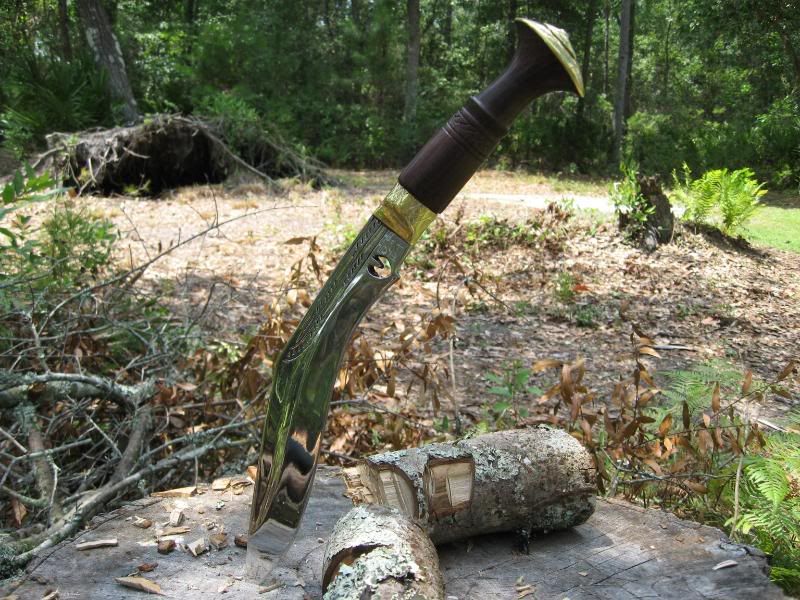
I recently got my first HI, a 15" Chitlangi. It is the nicest kukri I have ever owned. There is nothing wrong with the CS Gurkha, but the HI is much nicer for the money. And it isn't just for looks, either. Mine chops very well for a "small" kukri.
Last edited:
- Joined
- Sep 22, 2003
- Messages
- 13,182
I recently got my first HI, a 15" Chitlangi. It is the nicest kukri I have ever owned. There is nothing wrong with the CS Gurkha, but the HI is much nicer for the money. And it isn't just for looks, either. Mine chops very well for a "small" kukri.
I have a 15 like that too and I've also been impressed at it's chopping:thumbup:
- Joined
- Sep 22, 2003
- Messages
- 13,182
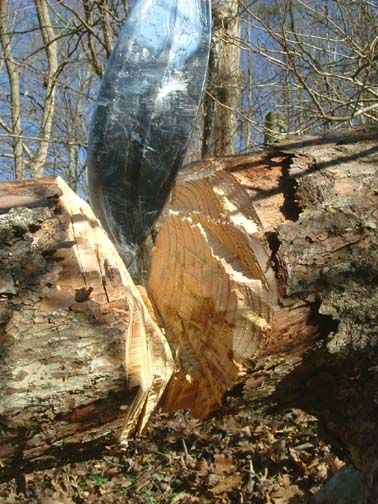
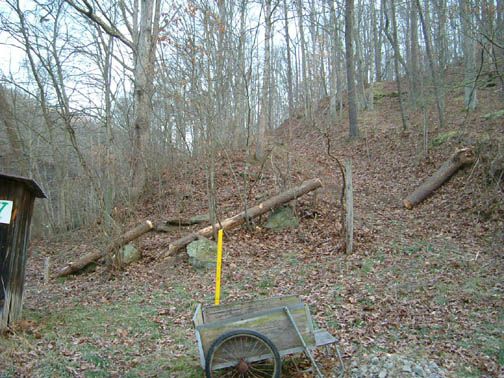
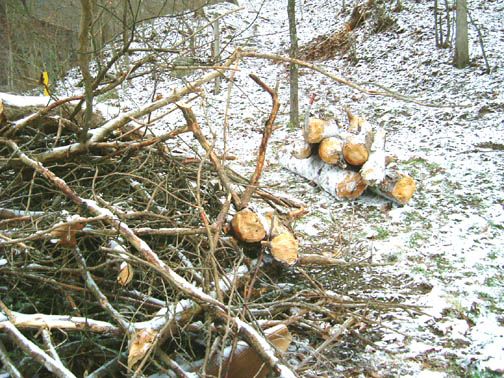
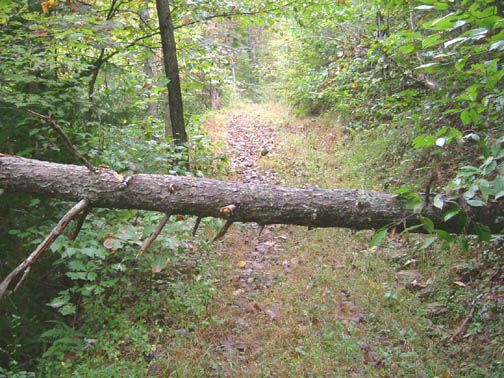
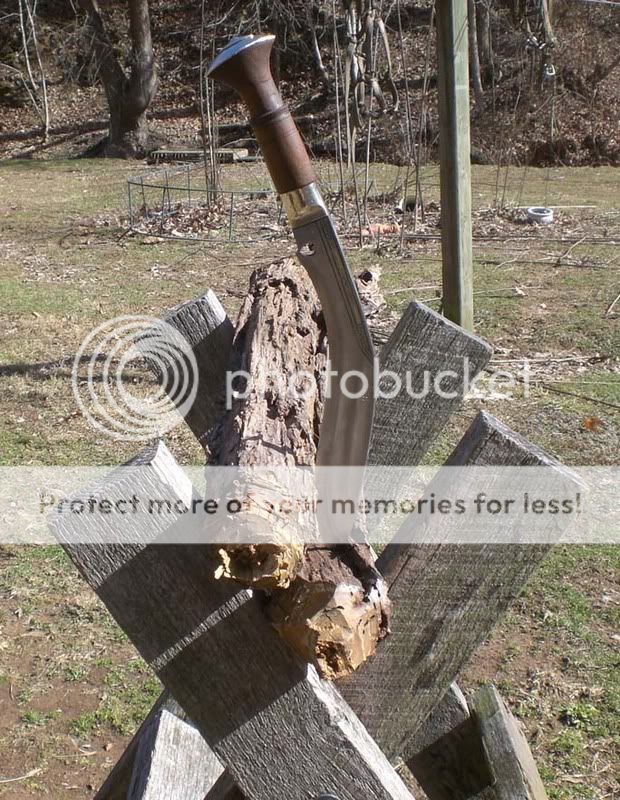
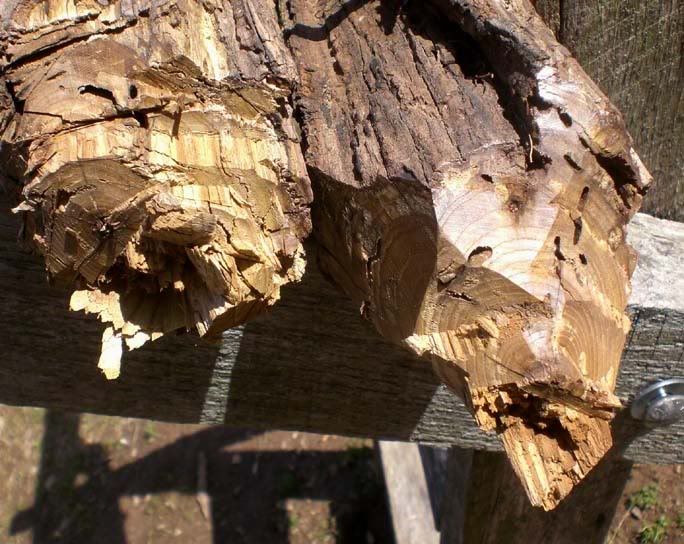
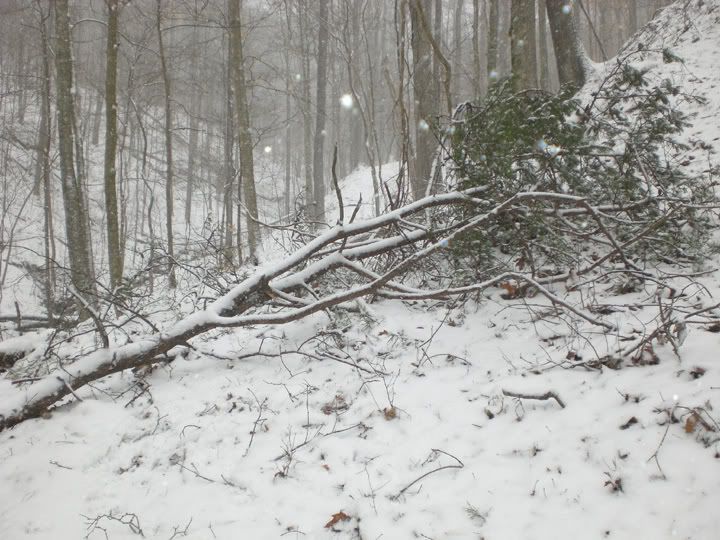
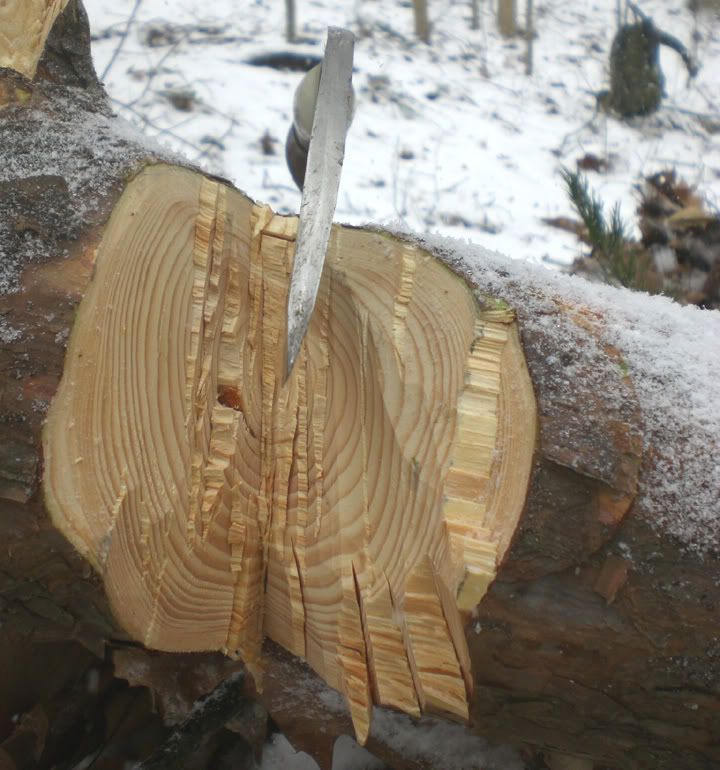
Here's a good sequence showing what a 17" 23 oz Ganga Ram Villager can do:thumbup:
Tree down across my path
Mr Ganga

With the khuk I stand on one side and the khuk cuts over and under on the other side:
Then I step over and do the same thing from the other side:
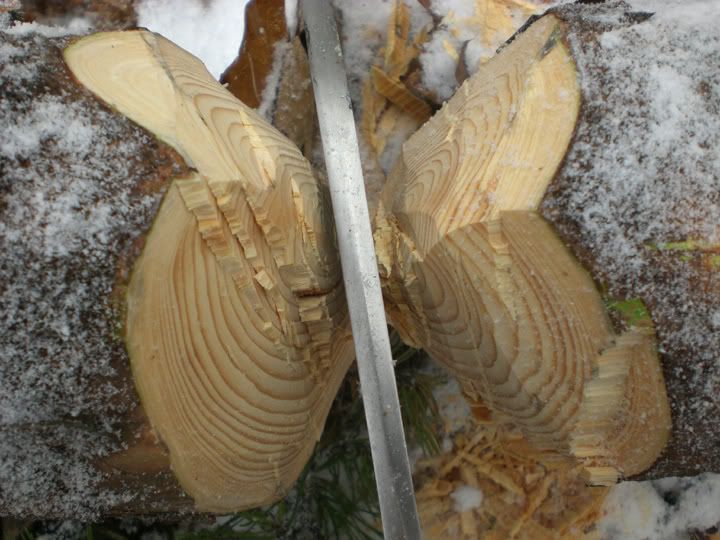
about halfway
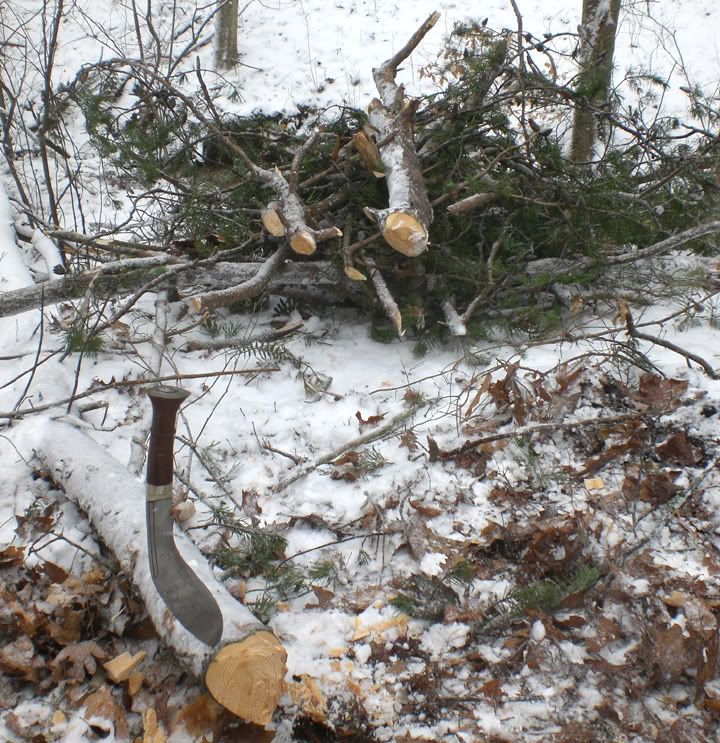
Done
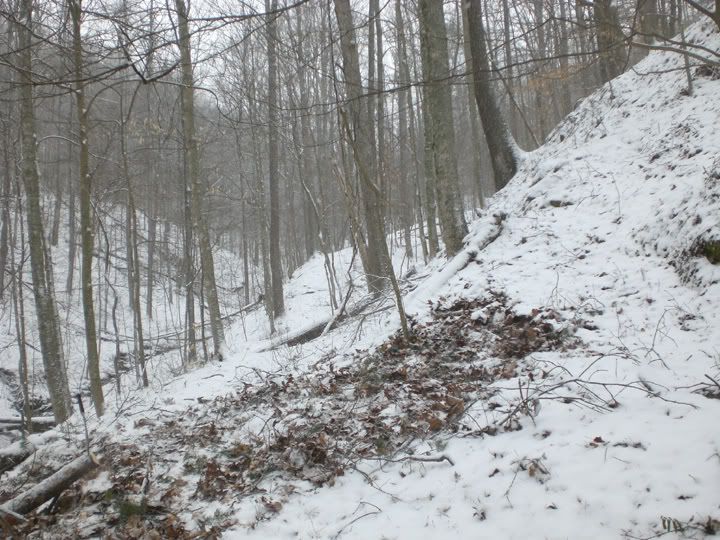
Another obstruction
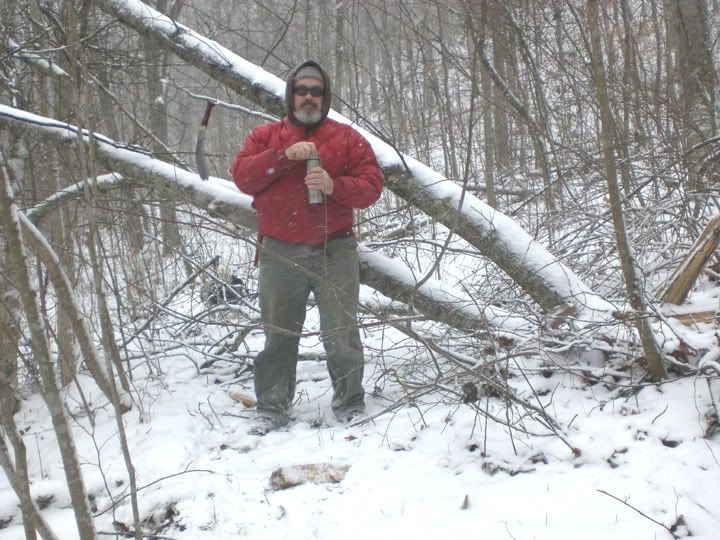
Lower one all cut out
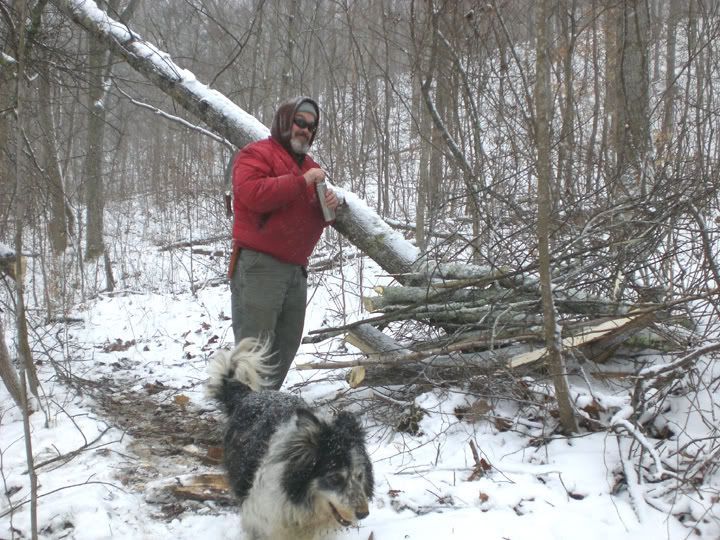
Shot showing the pile
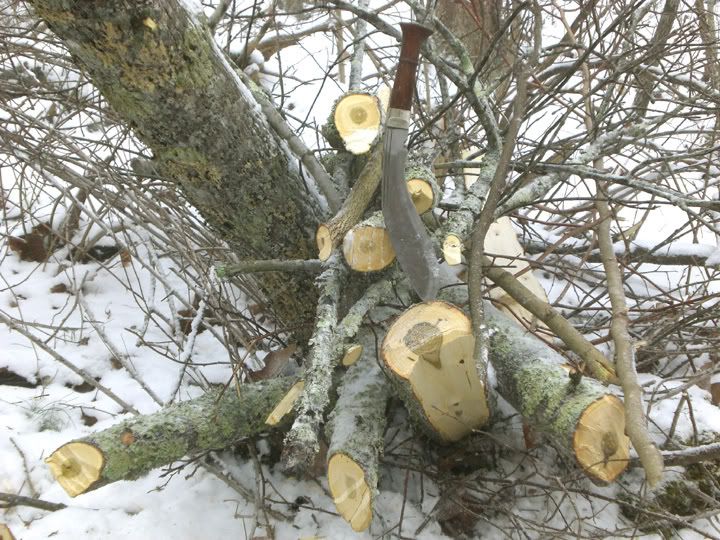
Tree down across my path
Mr Ganga
With the khuk I stand on one side and the khuk cuts over and under on the other side:
Then I step over and do the same thing from the other side:
about halfway
Done
Another obstruction
Lower one all cut out
Shot showing the pile