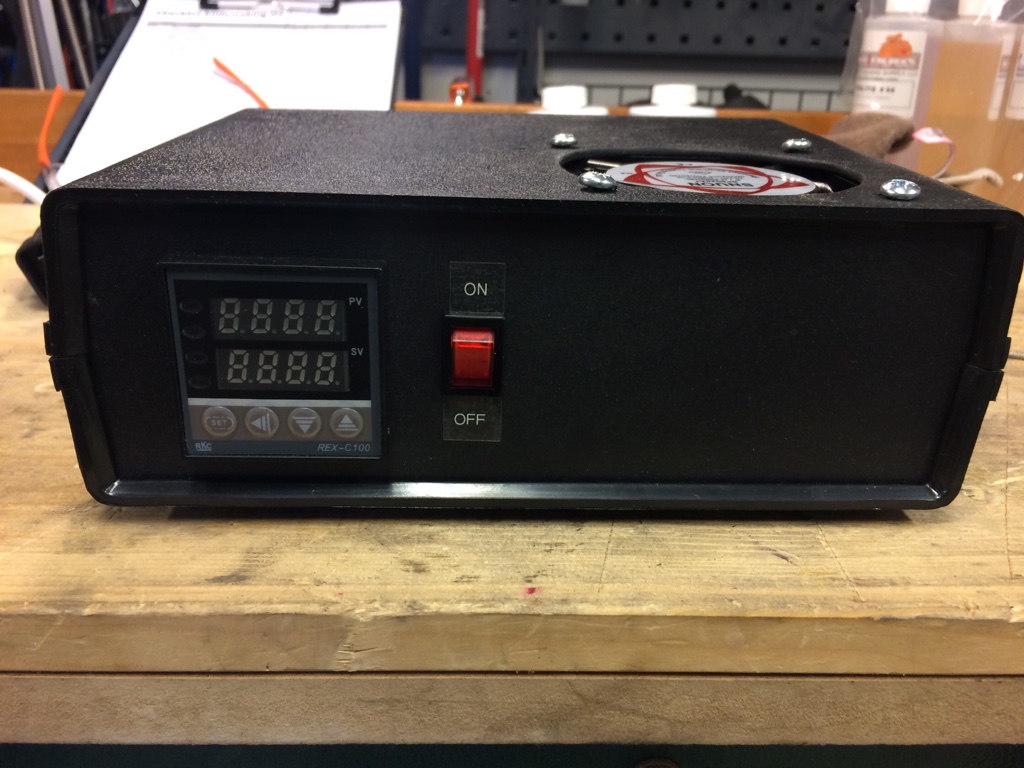
tempering oven

I thought about that, but an hour after I turned it off, with the door open, it was still 800°F

Relax.
Wait until it cools off and do the second temper. If you do a simple one hour snap temper in your kitchen oven at 350, you don't need to be afraid of over-shooting your temper, and you will relieve your steel enough nothing strange is going to happen until you get the controlled temper done.
 
I also use kitchen oven with inline PID.

51286b05dd6c84e0d937a26d9dafdbc2.jpg

eb55cde09691fb06e6495bf496a0726c.jpg

cf4817bfc42570c94b992e9ec942bd5e.jpg
 
Good setup to run any plug-in device. My only caution would be that with the load of an oven, a heat sink on the SSR would be a good idea.
 
Your fan installation shows a common error in in design engineering. I have dealt with this from pros before, so you are in good company in your oversight.

The fan either brings in fresh air or evacuates warm air - so far so good. But, where is the air exchange? There is no vent or screen to allow air in or out. A fan in a small enclosed space does almost no cooling. It needs an opening equal to the fan opening to allow air exchange. Preferably, this opening should be placed to make the air move across the heat generating component.

Drill a grid pattern of 20 or so 1/4" holes in the back of the plastic case behind the SSR.
 
Your fan installation shows a common error in in design engineering. I have dealt with this from pros before, so you are in good company in your oversight.

The fan either brings in fresh air or evacuates warm air - so far so good. But, where is the air exchange? There is no vent or screen to allow air in or out. A fan in a small enclosed space does almost no cooling. It needs an opening equal to the fan opening to allow air exchange. Preferably, this opening should be placed to make the air move across the heat generating component.

Drill a grid pattern of 20 or so 1/4" holes in the back of the plastic case behind the SSR.

Thanks for your comment. I see what you mean. This is an area I'm reasonable knowledgeable about. I've been building computers for several decades. In this configuration I was going for air flow with a negative air pressure. Since we're not creating a vacuum there will always be air sucked into the case. In this case it will mostly come from the hole for the probe.

But I agree, a couple more holes would greatly increase the air flow - but it would also increase the dust inside the case.
 
I've used a toaster oven with a piece of ceramic floor tile .Simple and cheap .
 
i use a kitchen oven with firebricks as thermal mass, a pipe section muffle and a TC going next the blade into the muffle.
It takes a lot of time to reach the temperature, but it is steady. I set the temperature a bit higher and as soon as it equalizes i walk down to the target and then insert the blade.
A PID would make my life easier, as well as would a low temp salt tank :)
 
Back
Top