
Tempering question

Joined
Jul 18, 2013
Messages
12
So I just heat treated my blade, and tempered for the first time in a toaster oven. The blade turned a light blue:
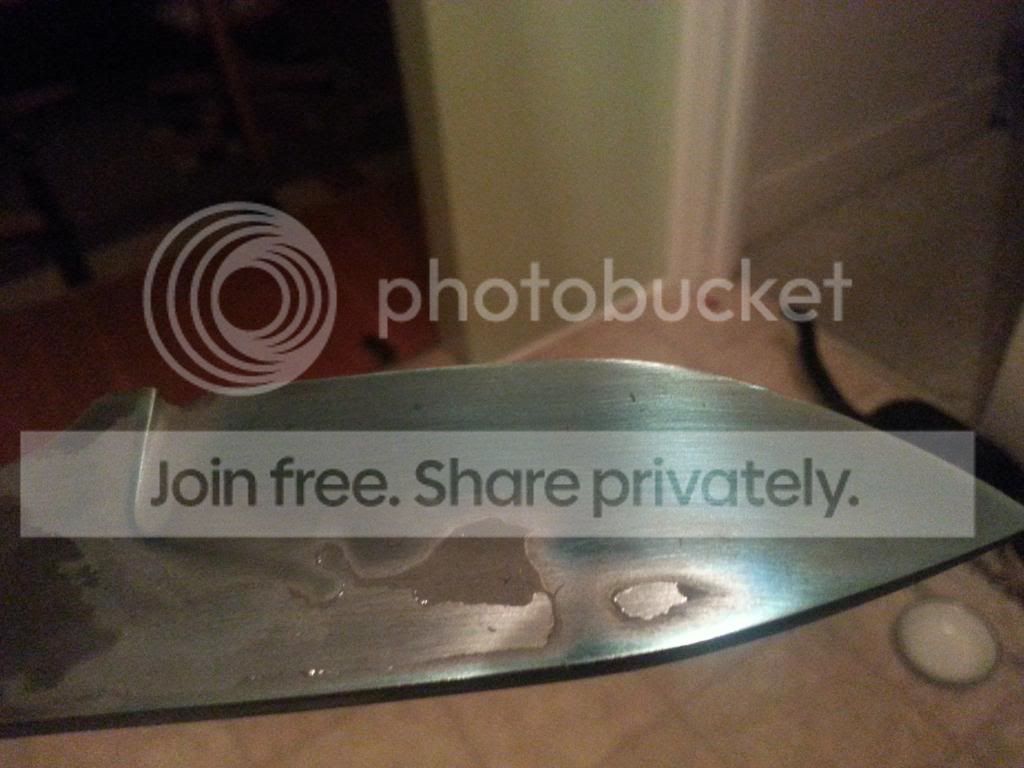
20131213_213950_zps4dcec50b.jpg


I tempered at 400, at least the thermometer said that, for 2 hours. From what I have read here, it seems like the blade was hotter than 400 though the air did not. The blade was wiped of excess oil and then sanded with 220 sandpaper after quench.

My question is, as I assume I ruined the HT, am I able to re-HT this blade or is it ruined? Would I have to do anything special if I did try to re-HT?

For the long-term, how would I make this toaster oven better for tempering? I have seen Stacy's post in regards to modifying the toaster oven and the steel plate. Could I just use a low setting? What are these baffles I have been reading about?

Thanks
 
It may be a bit more blotchy than it shows in the picture.

Maybe it is just oil residue?


Oh, and it's 1084!
 
Last edited:
Sharpen it and do some cutting. If it was properly hardened, you should be ok.

Color from temper means very little. Get an extra oven thermometer to use in your toaster oven, that's more accurate than the dial.
 
Thanks. I did use an oven thermometer. It stayed at 400, but I have yet to see the blue tint before, so it scared me. Would I be okay to do another temper cycle? Or should I finish the edge and test first?

I tried bending the blade and it didn't flex at all, but this is the first time using .2" thick stock.
 
Single temper for 1084 should be sufficient. I would sharpen and test. Watch for edge retention, rolling, and chipping.

Holds an edge ~ good to go
Edge rolls ~ reheattreat
Edge chips ~ retemper at 25 degrees higher

Be sure to get past any decarb before testing!! 400 should be about top end for 1084 from my experience. But, like I said before, it all depends on a proper heattreat to begin with.
 
There has been a lot of discussion of radiative heating from the coils, especially when soaking at higher temperatures in a kiln. So heat from your coils could heat your blade faster than the surrounding air or the thermometer. You could preheat a pan of sand and bury your blade in it to help moderate the temperatures if your current blade doesn't come out as you desired.
 
I went to finish it up, and it was grinding a lot slower than before. Guess it may have worked out alright. Thanks for the tips and advice.
 
If I do have to re-HT, do I have to normalize the steel or anything? Haven't seen any information on what to do in this case?
 
If it was never over about 1500f it will not need normalized. After hardening getting it hotter than the target temp just tempers it softer.
BUT
The color from the tempering oven means little or nothing. I have had carbon steel come out anything from gold to blue and sometimes both. Part of it depends on anything on the blade and the atmosphere in the oven. Some ovens do have a radiated heat problem. You can shield with a cookie sheet and some tin foil or take a cake pan and some sand and bury the blades in sand and then bake

What is the shiny stuff on your blades? ?t looks like cooked on foil I used to get a little of sometimes when hardening super clean D2 at 1850. No need for ss foil on 1084 and if its stuck on that hard how hot did you get it during harding?
 
I believe it is scaling, I did not use foil. Or it is just the blade itself after sanding, not sure which part you're talking about. I did not sand the blade entirely before tempering.

I used a two brick forge, got it hot enough to lose its magnetic properties and soaked for a minute. The 1500deg thermostick I bought, doesn't seem to work - it just crumbles - so I am not certain of the temp it got to.
 
The colors can be very inconsistent especially if there are any contaminants on the steel. I read a post a while back where a guard was blued at 350f when the etchant wasn't cleaned off of the guard. That is a few hundred degrees cooler than expected.
 
It didn't get to 1500, because at 1500 the temp stick would smear kind of like wax. Temp sticks act kind of like bad chalk until they reach there temp then it melts when you rub it on the heated material
 
It didn't get to 1500, because at 1500 the temp stick would smear kind of like wax. Temp sticks act kind of like bad chalk until they reach there temp then it melts when you rub it on the heated material

Yes, the 1400deg stick does this, and it won't crumble at lower temps like the 1500deg stick. I will try soaking longer on a scrap piece.

I did the brass rod test on the edge and it looks like I will have to heat treat again. Gonna have to try the pan of sand tip, I'll let you know how it goes. I could have messed up the HT as well, but hopefully that stick works better than I originally thought.
 
Back
Top