
-
The BladeForums.com 2024 Traditional Knife is available! Price is $250 ea (shipped within CONUS).
Order here: https://www.bladeforums.com/help/2024-traditional/
You are using an out of date browser. It may not display this or other websites correctly.
You should upgrade or use an alternative browser.
You should upgrade or use an alternative browser.
Tempering question
- Thread starter krap22
- Start date
- Joined
- Oct 3, 2007
- Messages
- 36
What was the temperature and how long did you temper it?
It's probably OK. When I was using a toaster oven I had it lined with kaowool to insulate it. It was about the cheapest, most beat up oven ever, but it held +/- 2 degrees all day. Just get a Harbor Freight cheapie pyrometer to monitor it and you're good.
-d
-d

DanGraves
Knifemaker / Craftsman / Service Provider
- Joined
- Mar 5, 2006
- Messages
- 2,700
Here is a chart. Should help. I think you are a little on the hard side. This chart is from Admiral steel

Uploaded with ImageShack.us

Uploaded with ImageShack.us

- Joined
- Mar 28, 2007
- Messages
- 1,171
To help keep the temprature in the oven at a more constant temp, Put a Fire Brick or two in and let them heat up, before you put your knife in. the bricks will keep the heat in and stabilize the temp in the oven so the oven doesnt cycle so much causing temp variances. Works for full size ovens too.

Stacy E. Apelt - Bladesmith
ilmarinen - MODERATOR
Moderator
Knifemaker / Craftsman / Service Provider
- Joined
- Aug 20, 2004
- Messages
- 38,720
Soft fire brick is made to insulate, don't use that type; hard fire brick will work . A better choice is a steel plate ,which will add much more thermal mass. A 1" plate will take a while to heat up, but even out the temperature fluctuations a lot.
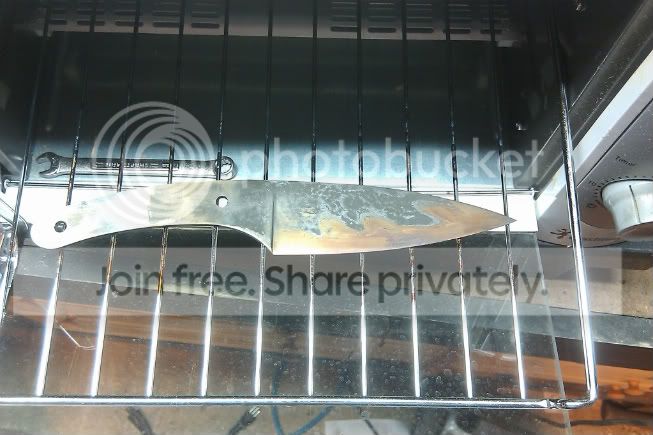
As to the color of the blade after temper, the color is mostly a factor of the stuff on the surface, not the temper colors. Unless the blade was sanded to bright metal and cleaned scrupulously, the oils and such will turn all sorts of colors. Tempering by color is done when using a torch or the coal forge. It can be very inaccurate.....use a PID controlled oven of some sort and you will be miles ahead of that technique.
Here is a tutorial I wrote on converting a toaster oven to PID control:
http://www.bladeforums.com/forums/showthread.php?t=599423&highlight=PID
As to the color of the blade after temper, the color is mostly a factor of the stuff on the surface, not the temper colors. Unless the blade was sanded to bright metal and cleaned scrupulously, the oils and such will turn all sorts of colors. Tempering by color is done when using a torch or the coal forge. It can be very inaccurate.....use a PID controlled oven of some sort and you will be miles ahead of that technique.
Here is a tutorial I wrote on converting a toaster oven to PID control:
http://www.bladeforums.com/forums/showthread.php?t=599423&highlight=PID

- Joined
- Jul 27, 2003
- Messages
- 5,711
And don't forget that most important factor of all - tempering, and the successful and calculable results thereof, are only relevant to the degree of achieving proper hardness in the first place.
The "colors" on the steel tell you absolutely zilch.
The "colors" on the steel tell you absolutely zilch.
- Joined
- Nov 8, 2009
- Messages
- 1,533
Be sure to let the oven stabilize before putting the blades in. My toaster oven will overshoot by around a hundred degrees when first coming up to temp.
Why don't you let the knife tell you your answer? Do a brass rod test. Put a working edge on the blade, run it across the rod, and if it chips it's still too hard. If it flexes and stays, it's too soft.
We can't give you an answer if even you don't know what temperature was maintained in your oven, for whatever amount of time.
We can't give you an answer if even you don't know what temperature was maintained in your oven, for whatever amount of time.
- Joined
- Sep 9, 2003
- Messages
- 2,361
And don't forget that most important factor of all - tempering, and the successful and calculable results thereof, are only relevant to the degree of achieving proper hardness in the first place.
The "colors" on the steel tell you absolutely zilch.
My friend Karl has really hit the bullseye with this post, allow me to expand even more on it.
Tempering colors actually mean very little and while Rc numbers and tempering colors can be related to temperature (and loosely at that for the colors), they cannot be related to each other. It is like we can both know my Aunt Shirley but that doesn’t mean we have ever met each other. Most only ever work with those colors in tempering and assume they have been told facts about colors for exact temperatures, however anybody who has ever done heat or “fire” bluing, looking for a particular color, knows that it is quite a bit more complicated and that time and surface conditions are just as influential as temperature.
For clean steel about 2 hours in an oxygen rich environment will get you a straw color, 10 minutes will get you nothing and 4 hours will get you crimson. When heat bluing I never settle with the color I get in the kilns since that color will deepen dramatically over the next few minutes that it is exposed to fresh air outside the kilns- air that is room temperature, I might add. When tempering with a torch in order to get the same colors that would have been the result of 2 hours at 400F in the matter of 4 seconds you will probably be subjecting the process to at least twice that temp, the only reason your blade doesn’t soften to putty is that tempering also takes a while.
The next thing you will notice is that in this thread 2 sets of Rc numbers are given for the suggested temperature range, with one being from an industry spec sheet. Which numbers are correct? Well, to make it even more complicated- they both are! The industry specs show an exact hardening temperature, a temperature that was held for a specific soak time. The amount of carbon put into solution and locked there in the quench will determine how much heat needs to be applied in the temper to move that carbon around. It is common for guys who heat treat with a magnet and a forge to use tempering temperatures below 400F, while guys who use ovens and soak times start at 400F. Time at the soaking temperature puts greater amounts of carbon into solution and makes the steel hold higher HRC longer, with a steel like 1095 being very stubborn and requiring heat that many would think would ruin a blade just to get it to HRC 60.
One other reason that I like precise temperatures and soak times is that it allows us all a common reference point. To determine what temperature to temper at without knowing precise details about the soak is little more than a shot in the dark, if you are shooting for a particular HRC value. But to make a serviceable knife, the old standards work. I believe the reason why things like the brass rod test are prevalent is that its shortcomings measure a range which widens the expectations to cover all of these variables.
Also if your quench is not spot on (which can be critical with 1095) fine pearlite will make 375F-400F more than adequate to reduce hardness and above 400F can result in too drastic a loss of hardness; taking us back to Karl’s point of achieving full hardness to begin with. Heat treating operations should be viewed as an accumulation of the effects of all the previous heat treatments, making the last, tempering, full of the most variables of any.
Now if I have complicated your world enough I will also leave you with this- change the alloy just a bit and all of the tempering numbers will also change.


- Joined
- Dec 24, 2005
- Messages
- 1,254
Decker, Do you have a link to the harbour freight pyrometer?? I can't find it on their website.
Decker, Do you have a link to the harbour freight pyrometer?? I can't find it on their website.
It's the model 92242, but it doesn't seem to be on their website anymore.

-d
And the great information keeps coming. Thanks for all of the information, my wallet thanks you. 
Being a newb at knife making, i'm still working on aquiring all of the right equipment,skills and knowledge to make great knives. Information like this is almost overwhelming, but very helpful.
Being a newb at knife making, i'm still working on aquiring all of the right equipment,skills and knowledge to make great knives. Information like this is almost overwhelming, but very helpful.