Testing 5160

G L Drew

Knifemaker / Craftsman / Service Provider
Joined
Feb 3, 2005
Messages
4,807
When I started forging about 4 years ago I destroyed a lot of knives and did a lot of rockwell testing until I was happy with the results of my heat treating. At a show last week end someone asked me if I did ongoing tests and being kind of a smart ass I answered "yes, I give them to my wife to use in the kitchen and I take them hunting". But, I thought it might be time to do some more tests just to prove that my heat treating recipe was still working.

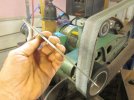
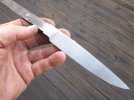
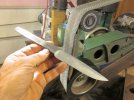
I forged a small knife thin and ground it thinner. I have never worked a knife down this thin before heat treating but I wanted to see if it would stay straight.
10-26_5.jpg10-26_6.jpg
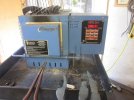
The first part of my heat treating procedure for 5160 is two 1520 degree normalizing cycles for 20 minutes each.
10-26_8.jpg
Looks good after normalizing; still straight.
10-26_2.jpg
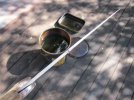
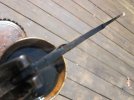
Here it is right out of the warm oil quench and still straight. (I love 5160)
10-26_9.jpg

Looks like I overloaded with photos here so more to come.....
 
After two one hour 350 degree cycles in the toaster oven the knife is ready to finish. Sorry, no photos of the toaster, it is just too nasty looking with baked on quenching oil. It has started making my pizzas taste funny too :)
I hand sanded the blade to 120 grit just to make sure I didn't have any deep scratches that could create a weak spot.
10-26_10.jpg

Now the testing. I really hate doing this to a good piece of steel but here goes.
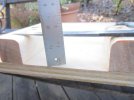
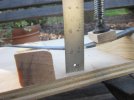
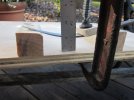
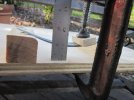
I set up this jig to try to bend the knife as uniformly as possible trying not to put too much stress on one spot. This also will test to see how well I did at a distal taper; if I ground too thin in one spot that is where it would fail.
I have 1 1/2 inches of room to bend the blade.
10-26_15.jpg

Add a clamp and twist
10-26_13.jpg
 
Last edited:
More bending
10-26_17.jpg 10-26_18.jpg

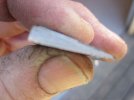
I thought I was getting to the point of failure and wanted to take the blade out of the jig to see if it had taken on a residual bend from this abuse but I went back into my shop to get something I heard a snap. The testing is over....
10-26_19.jpg 10-26_20.jpg

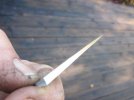
It looks like there might be a slight bend at the point half of the blade but it is hard to tell from such a small piece.
I looked at the break with a 10X glass and I am pleased with the fine grain. I guess the only conclusion I can make from this non scientific test is that a 5160 knife heat treated using my recipe will stand up to more abuse than anyone should ever put to a knife.
 
It's always interesting seeing posts like this. Thanks for taking the time to document and share this GLDrew.
 
Thanks for posting your testing. I agree it's hard to see a nice piece of steel broken like that, but as they say you gotta break some eggs (knives) in order.....

In addition to breaking the blade to check grain growth, what other testing do you do? Are there any cutting tests, manila rope etc. that you do?

I need to do some testing also to see if my newbie attempts at heat treating are doing ok and I need some idea of what types of tests will show me how I'm doing.

Randy
 
Thanks for the info.
1. Are you takign orders?
2. How does 5160 compare to O1 as I am currently considering that steel for a custom.

I am serioulsy sharpening challenged and work a knife very hard. Mainly cleaning game but lots of ranch work. I have broken tips off lesser knives diggining out fence staples as I am to lazy to walk 1/2 mile back to the truck for fence tools. So I am looking for an easily sharpened steel with enough edge retention to get through a minimum of 2 deer(dragging on spine to remove backstrap) without resharpening, and tough enough to makeup for my lazy attitude adn dumb mistakes.
 
I'll let GL fill you in as far as his orders go but I can answer your steel question. While both O1 and 5160 are good "hard use" steels I would say that 5160 is the tougher of the two (especially under impact) when both are hardened to the same level. O1 typically will give a bit of an edge holding advantage in terms of abrasive cutting, but 5160's ductility helps it avoid other kinds of edge loss (chipping) a tad better. Finally, O1 rusts much more aggressively than 5160, and thus will experience corrosive edge loss more quickly if you don't watch it and take proactive steps. Granted, continued use helps negate that somewhat but it still is an issue. Both steels are highly machinable and will take a fine edge without fighting back. As to the particular use you mention (staple prying) I really, really, really have to suggest you start carrying a small screwdriver or tiny pry bar (I mean, look at this cute little guy---fits in a shirt pocket and they even MENTION broken knife tips http://www.countycomm.com/widgy.html) but if you insist on using the knife, you'll need to specify that the tip be left very thick, though of course that means that it'll be harder to get under the staple. Steel nearly at file-hardness just isn't great at prying.
 
In addition to breaking the blade to check grain growth, what other testing do you do? Are there any cutting tests, manila rope etc. that you do?

I need to do some testing also to see if my newbie attempts at heat treating are doing ok and I need some idea of what types of tests will show me how I'm doing.

Randy

Randy;
Yes, I have cut ropes and chopped pine 2X4's like they do in the ABS tests but I was only slightly kidding when I said my knives are tested in our kitchen and in the field with the kitchen being the tougher test. It gets dropped in the steel sink cuts into a granite counter top, hits bone, chops frozen meat etc, etc. In the field, my most memorable test was helping to field dress, bone out and cut up 4 caribou plus acting as the camp cook using one of my knives. Couldn't shave with it when I got home but it was still very working sharp.
I attend a couple of shows on a regular basis and it is always fun to hear from people that have bought my knives and will brag about field dressing their second, third or fourth whitetail without having to put their knife on a stone. I feel that these results are as credible as cutting rope.
 
Thanks for the info.
1. Are you takign orders?
2. How does 5160 compare to O1 as I am currently considering that steel for a custom.

I am serioulsy sharpening challenged and work a knife very hard. Mainly cleaning game but lots of ranch work. I have broken tips off lesser knives diggining out fence staples as I am to lazy to walk 1/2 mile back to the truck for fence tools. So I am looking for an easily sharpened steel with enough edge retention to get through a minimum of 2 deer(dragging on spine to remove backstrap) without resharpening, and tough enough to makeup for my lazy attitude adn dumb mistakes.

Sorry RTW but I am not taking orders at this time.
Thank you Timpani for your input, I have never done anything with O1 and could not have answered that one.
Field dressing and cutting up two deer is absolutely not a problem with a 5160 knife properly heat treated; done in myself several times.
Please don't use one of my knives as a pry bar; as you can see they break when you do that.
 
Thanks for the information and the link to the widgy bar. That is on my list and I will see if a sheath maker can build a slot in the sheath to carry it. I never intentionally damage a knife, but it is the one item I always have on me. Normally a folder, but now I am looking to move to fixed blades as I have found them stronger than the folders. Already had a small lockback give on me causing a nice cut in my hand.
 
If you look on that widgy bar page, there's a titanium one that's even smaller (and definitely lighter) which may be easier to fit on a sheath, though obviously you'd lose some leverage. It's more expensive, but nothing on the expense of a custom knife (which feels far more expensive when it breaks). :)
Another neat option:
http://pockettoolx.com/collections/frontpage/products/brewzer
 
Sounds like you need to start carrying a Leatherman multi-tool, or a pair a fencing pliers.

I would hesitate to use a knife on a wire staple, much less the much larger staples typically used for wire fencing. Knives are should not be expected to double as prybars.
 
If you need to use a knife to pull barbed wire staples could you design the end of the tang to resemble the point on a pair of fence mending pliers? That would seem to be ideal but it also would make the tang of your knife sort of a specialty tool.
 
GL,

I've heard various temps regarding 5160, ranging from 350-375 degrees, and even higher. Have you ever tempered past 350, and was the knife servicable?

Dave
 
Last edited:
Back
Top