Testing out a short sword

Joined
Nov 20, 2008
Messages
10,188
Hi Guys,

Yesterday I tested a short forged sword (1095 steel), 16" blade, 21 OAL. The sword was designed for martial purposes, not really utiltarian, but... I first started with a 2x4, no problems, I went on to rope, again, no problems. Then I tried it out on a nasty ole gnarled hickory log. While the blade bit, there was quite a bit of bounceback. Hickory is tough! Afterwards, I noticed I had some small blade deformation at the impact points. No chipping or anything, just an almost invisable deformed araes (not sure how else it describe it). Now, the area this happened in was also very thinly ground, to almost a zero tolerance edge.

So my questions. First, inasmuch as the blade edge was thin (perhaps too much), was my test on the hickory a resonable test? Should I have expected the blade to deform slightly? Or did I just get a bad HT?

I'm thinking the blame lays in doing a test on a blade what was not designed for that task, but....any and all input is appreciated.

Dave
 
Can you tell us a little bit about your heat treat method?

Hard knurly wood and very thin edge....more than likely you will have some issues...be it chiping or rolling.
Mace
 
I'm no expert, but I would think the heat treat and edge geometry should be accomplished with the intended target of the sword in mind.

Is it meant for cutting or poking into bare flesh or through armor? I suppose if it could be expected to possibly hit bone it should stand up to a reasonably sized wooden dowel or the like.
 
Hi Mace and guys,

I do pretty basic stuff. I bring the blade up to critical in my coal forge, test it by quickly running a magnet down the blade, put it back in for a minute so it brings it back up to critical, and then quench in 140 degree veg oil. In this case, I used a vertical quench. I am pretty sure I got a good solid HT, even though this is my first short sword.

Bad Example, this sword can best be described as a persian short sword, basically, a slashing sword.

Maybe I was a silly doing that partcular test. I tried to take pictures of the impacted area, but they didn't come out well at all.
 
Hi David,
Not sure if the veg oil will be fast enough a quench for 1095. Parks #50 would be my choice.

How bout a pic of the sword?
Mace
 
David,
I think you have answered your own question. A flesh slashing blade is not meant to chop hard wood. I would cut rolled newsprint, tatami ( doing tameshigiri), or rope, but not wood with a near zero edge.
Stacy
 
Mace,

I've been using veg oil for quite awhile, and it does okay. But, I have been planning on getting some Parks and will soon. Do you have a good source for it?

Stacy, I guess I had too high expectations. My test was inappropriate. I'll have too set something else up what reflects a proper test for this type of sword.

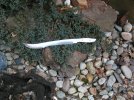
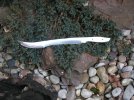
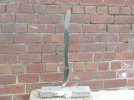
Mace, you wanted to see some pics, here they are.

Thanks Guys

Dave
 

Attachments

  • Short Sword 003.jpg
    Short Sword 003.jpg
    103.1 KB · Views: 94
  • Short Sword 004.jpg
    Short Sword 004.jpg
    102.3 KB · Views: 108
  • Short Sword 005.jpg
    Short Sword 005.jpg
    95 KB · Views: 103
Wow! Thanks Kingdom

When it's finished it will have a french gray finish, wraught iron furniture and either a black paper micarta or white polished bone handle, still need to decide on that.Again, thanks

Dave
 
Looks very nice David.:thumbup:
Mace

I got some parks from Darren Ellis. Need to get a new bucket myself.
 
Thanks a lot for the thumbs up, Mace. I really appreciate it. Chidzplay, thank you very much! I guess I better make sure I take some really good pictures when I finish it. Again, thanks all!

Dave
 
I think another problem is not enough heat. If you are quenching at non-magnetic, it isn't hot enough. A couple of shades of red higher in heat should be about right. You are looking for 1475° to 1500°. Non-magnetic is only 1414°
 
LRB, no, no, I test the blade by running a magnet down the blade, if it doesn't stick, then I very, very quickly quench. If it does attract the magnet, then back it goes into the fire and stays there until I get the right result. I've never quenched a blade that did not test non-magnetic. That's simply elementary.

Dave
 
I have always tested my swords on flesh and bone, being something from a butcher shop, a coyote, or during deer season, deer parts. Cow pig ect is all "soft" bone, but coyote and deer are strong and hard, and will chip or curl anything with a shallow flat grind. And anything with too beefy an edge won't cut that well. I suspect with the right edge geometry and heat treat yours should make it through a 200lb deer neck without difficulty. What I like to do is give it a full flatgrind down to about .020" at the edge, and then do a convex second bevel. Sometimes I think that deer bone is even harder on the edge than cutting say 1/4" mild steel rods.

Hard/tough wood like that tests not only the edge, but the entire blade integrity.... wich is also important.

If you want to impress people by cutting mat's paper ect ect... well that's an entirely different objective.

Oh and yeah that thing looks incredible!!!!
 
Last edited:
John,

Some really good ideas; I'm not going to the butcher shop just to chop up meat, but now that you brought up the subject-I see dead deer on the roads all the time. Just got'a make sure the wifey isn't there, LOL. Seriously, you are absolutely right. That would be a good test. We have cayotes here too, but they are darned hard to catch. They do seem to like dog food tho.

I refined the edge geometry today, changing the grind from a shollow to more of a micro-v grind and tested it on a quart water jug, it passed cleanly. I also changed the handle shape, and was surprised at how much more power I got in the swing.

But, your point is very well taken. And thanks for the nice words.

Dave
 
I think another problem is not enough heat. If you are quenching at non-magnetic, it isn't hot enough. A couple of shades of red higher in heat should be about right. You are looking for 1475° to 1500°. Non-magnetic is only 1414°

LRB, no, no, I test the blade by running a magnet down the blade, if it doesn't stick, then I very, very quickly quench. If it does attract the magnet, then back it goes into the fire and stays there until I get the right result. I've never quenched a blade that did not test non-magnetic. That's simply elementary.

Dave
I think what he means is that just testing with a magnet is not going to give you consistent results. This is because steel becomes non-magnetic at a bit lower temperature than the transformation temperature (which is what you need to reach for heat treat).
 
LRB, I misunderstood what you meant, and thank you for the advice. I'll look for the deeper red next time. Justin, thanks for pointing out my mistake.

Cheers,

Dave
 
I agree with the idea that rather than dumbing down your test and just cutting fluff, it might be more prudent to make changes in your blade construction, heat treat and/or edge geometry...such as you've already started doing.
 
Hi Phil,

I've really learned a lot in making this blade. Still have a long way to go, but the trip is the fun.

I did indeed change the sword edge and handle shape, etc. and am looking forward to re-testing (but not on that nasty ole hickory log:)

Cheers

Dave
 
Back
Top