Testing results from old saw blades

Ltortorich

Formerly known as Rocketmann
Platinum Member
Joined
Jul 12, 2022
Messages
58
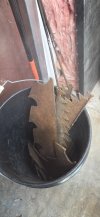
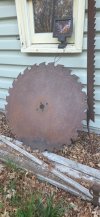
So I had some very old saw blades that I picked up a few years ago.
2 of them have replaceable NON CARBIDE teeth and the 3rd one had teeth cut into the main body.
I cut some test coupons out of both blades and did some testing.
As is without any work from me they both tested between 30 and 35 on my Wilson rockwell tester.
I then heated the coupons to 1550 F and quenched them in Parks 50.
The blade with the replaceable teeth tested 65 rockwell C.
The blade with built in teeth tested 61 rockwell C.
I tempered them both at 400 f for 2 2hour cycles.
Both coupons tested 59-60 rockwell C.
I then placed the coupons in a vice and struck them with a ball peen hammer.
Both coupons shattered like glass after tempering..
Obviously This indicated a need for a higher temp temper cycle to increase toughness.
I plan to do more experiments on this steel prior to using any of it.
Does anyone have a idea of a good temp to try on the temper test?
At least the steel is hardenable. I may try a soft back draw in addition to other tempering tests.
I also plan to etch this steel in ferric chloride along with some 1084 to compare for nickel content.
Any ideas for further testing??
 

Attachments
  • 20260503_190419.jpg
    20260503_190419.jpg
    150.4 KB · Views: 4
  • 20260503_190449.jpg
    20260503_190449.jpg
    105.1 KB · Views: 3
Last edited:
I'm thinking that I will repeat the test in the next few days.
Changes I will be making next time.
1, I will use my heat treat oven instead of the forge to have better temp control.
2, I will do some thermal cycles and an anneal before austenizing.
3, I may do 2 coupons of each, quench one in parks 50 and the other in gulf super quench 70 to see if there is a difference.
Any other suggestions?
I need to order Larins book...
 
If you just want to know what it is, you can rent a handheld XRF analyzer from an environmental sampling supplier like Pine or Field. Would work well if its a tool steel, but it cant detect carbon so if its a simple carbon steel it might not work, you would have to send it off for ICP-OES.

If you just want to have fun trying out heat treatments, not sure. Your HT looks like what I use for 80CrV2 which is a good guess for a saw blade.
 
It’s more than likely a variant of 1095. I asked Jerry Fisk this very question a few years ago and he said to heat treat it like 1095.
 
A lot of the older large diameter saw blades generally used steel in the 1070-1080 range. The larger blades generally needed more toughness than 1095 could provide to keep from cracking. They were generally only hardened to the mid 40’s to low 50’s HRC. A very very small number were made out of L6 and other alloys. Older hand tools were often made of 1045 or similar.

The basic heat treatment for 1080 and 1095 is pretty much the same. So, heat treating like 1095 is a good place to start.
 
I looked at the cross section of the coupons under 200x magnifcation after breaking them.
There appears to be grain growth which would explain the lack of toughness.
I hope to have time this week to do more testing under tighter tolerances in order to refine the grain.
 
I’d say starting from scratch would be the best bet. Use an oven and do a full anneal and all of that. Depending on how old they are and who made them they may not have had the best heat treatment to start with. How they were tensioned might have some affect on it too. It was also common to add a little nickel to saw blade steel back in the day for added toughness

Even though there’s not a huge difference you might want to treat it more like 1075 or 1080.
 
I agree,
I'm on the hunt for a bag of vermiculite today.
Mice got into my bucket to have babies and then died..
I threw it all out..
 
I would say to drop your aust. Temp down to about 1475 for a batch and see what happens. The initial as quenched hardness numbers you gave at the beginning would indicate different steels. For the higher as quenched hardness piece I’d suspect something like 1075, 1080/1084, or 1095. Not sure about the other. There were some blades made from 8670 and other 86 series steels but those steels came along around WW2 as did L6. Any idea the age of the blades?
 
Not sure about the age of these blades.
Look to be OLD.
 
Larrin or Hoss would probably know more but if they’re really old my guess is they’re probably closer to the 10 series steels listed earlier. I’ve spent a lot of time down the old tool/steel rabbit hole but I’m certainly not an expert.
 
I just ordered Larins book.
Had to get the hardcover.
I figured that i have a oven and a rockwell tester. It cant hurt to experiment.
 
It’s also worth noting that if one of them used something similar to what we call 1075 or 1080/1084 with 1.5-2% nickel added (fairly common to add toughness) it is essentially 15n20 at that point if memory serves me correctly. That also tracks with the higher as quenched number.

Older steels weren’t standardized like they are today. Many of the naming conventions and formulas got standardized in the 1930’s and 40’s around WW2. Many of the older “high carbon” steels used in cutting tool applications fall in what would be the 1075-1095 range today with several “proprietary blends floating around.
 
Back
Top