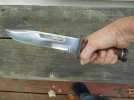
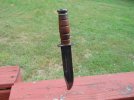
Thanks for Forum help on my stacked leather handle-results shown

Joined
Nov 20, 2008
Messages
10,188
Hi Guys,

I recently asked you guys for help on doing a stacked leather handle. I just couldn't get the finishing right. Thanks to you guys, I got the best results I have yet acheived. Now, for a bit of a backstory. I've been looking for a 1940's era KA-BAR for a long time, and haven't found one yet. There's a lot of fakes out there, though. Anyway, I decided to make my own. It's not historically accurate, it's an 8.25" blade 1095 steel, and wider than the original version. But I'm happy with the results. So, what do you guys think?
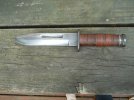
 

Attachments

  • Bushcraft sword-KaBar 004.jpg
    Bushcraft sword-KaBar 004.jpg
    82.9 KB · Views: 185
  • Bushcraft sword-KaBar 005.jpg
    Bushcraft sword-KaBar 005.jpg
    63.5 KB · Views: 138
  • Bushcraft sword-KaBar 007.jpg
    Bushcraft sword-KaBar 007.jpg
    73.6 KB · Views: 135
Thanks Stacy, I'm actually quite pleased with it. The key was letting the leather harden. It made all the difference.
 
Very cool, thanks for posting pics. Did you end up drying the leather in the sun or oven?

I think you did well with the vintage look you were going for.
 
Thanks Vintagefan, somehow the shiney new look just didn't seem right.. I used old leather scraps from other projects, they were as hard as rocks.

Thanks Stan. i got a lot of satisfaction out'a this one. In fact, I have a couple more on my bench.
 
That looks awesome. We use a kabar to "cut" plugs of earth when metal detecting. The plug will go right back in without upsetting the grass or leaving a visible hole. I'm about to do a stacked leather handle on an old M7 bayonet with the intention of making it look like an M3 fighting knife. Did you just sand the grooves in after the leather was hardened? What thickness or weight was the leather that you used? Did you make your own leather washers? Did you use CA glue to harden the leather? One last question, how did you do your fullers? I have a JPK rendition on my drawing board and it will require a similar fuller and a stacked leather handle which is why I am going to practice the latter on the old bayonet. Thanks for posting and continuing the circle of learning.
 
That looks awesome. We use a kabar to "cut" plugs of earth when metal detecting. The plug will go right back in without upsetting the grass or leaving a visible hole. I'm about to do a stacked leather handle on an old M7 bayonet with the intention of making it look like an M3 fighting knife. Did you just sand the grooves in after the leather was hardened? What thickness or weight was the leather that you used? Did you make your own leather washers? Did you use CA glue to harden the leather? One last question, how did you do your fullers? I have a JPK rendition on my drawing board and it will require a similar fuller and a stacked leather handle which is why I am going to practice the latter on the old bayonet. Thanks for posting and continuing the circle of learning.

Hi Perrin,

I used a stone grinding wheel dremel to make the grooves, I put a nice finish on them using a cotton wheel dremel attachment. I could have put spacers in, but I just like the pure leather handle better: The leather is 8/9 oz., from Janz supply. Yes, I made the washers, using old hardened leather I'd saved from previous sheaths, I stacked them until the handle was complete, then shaped them on my grinder using an old, worn 120 grit belt. I did use CA to further harden, shine and waterprof the leather. I also used spar varnish, rubbing it into the leather until dry.

I did my fullers using my dremel also. The steel has to be in a softened state. If it's hardened, as with your bayonet, using a dremel will just sent the grinding attachment spinning wildly off the blade. I'v never tried to do a fuller on a hardened blade, and would guess it's just about impossible without seriously damaging the blade and your equipement. I hope that helps, and good luck with your project.
 
Thanks for the info, I feel pretty confident with what I have learned here and previously. Oh, I don't want to try and put a fuller in the bayonet's blade, I am just going to re-handle it due to breaking off the original scales and the guard throwing it at trees when I was a kid. The blade that I will need to make fullers on will be a modern rendition of a JPK (Jet Pilot Knife). They have a broad flat bottomed fuller much like you achieved here. I will make it completely as opposed to using an existing blade and will cut the fuller in before HT. Just been trying to figure out the best way without a mill. I remember seeing someone use a Dremel mounted in a drill press like apparatus making a little vertical milling machine. I've also seen jigs and templates used. Those fullers are usually pretty narrow though. Thanks again.
 
Thanks for the info, I feel pretty confident with what I have learned here and previously. Oh, I don't want to try and put a fuller in the bayonet's blade, I am just going to re-handle it due to breaking off the original scales and the guard throwing it at trees when I was a kid. The blade that I will need to make fullers on will be a modern rendition of a JPK (Jet Pilot Knife). They have a broad flat bottomed fuller much like you achieved here. I will make it completely as opposed to using an existing blade and will cut the fuller in before HT. Just been trying to figure out the best way without a mill. I remember seeing someone use a Dremel mounted in a drill press like apparatus making a little vertical milling machine. I've also seen jigs and templates used. Those fullers are usually pretty narrow though. Thanks again.

Cool! I hope you post up some pictures of the finished work, and good luck!
 
Nice look. Could you describe the finish of the blade-steel more in depth?

Sure peppen,

It has a 600 grit finish, very little handsanding at all. Basically, it's a fast dip or two in ferric chloride followed by cold bluing. I then "sand" with 800 grit sponge sandpaper (I'm not sure of the proper name, perhaps someone can chime in with the correct name). It removes almost all of the cold blue and ferric chloride, leaving a fairly uniform gray. It's a look I like a lot. For some reason, I've recently developed a distaste of bright, shiney steel. It just looks undone, unfinished to me.

Another simple, but effective way to deeply stain a blade and turn it into a blade into one that look like it's been around for a long time in plain old lemon juice. Hope that helps.
 
Back
Top