

- Joined
- Feb 28, 2007
- Messages
- 9,786
Thanks to Garrett who gave some nice tips by providing graphics of the stropping method quoted below. Following his advice I was finally able to make a breakthrough in covexing a couple of my knives.
For the first time I was able to put a convex edge on them and bring them to shaving sharpness and also to push cut through paper. They just feel great! Now I want to convex all my knives
I started off with my JK's first because John's kephart already came to me convexed, even though I had sharpened it earlier with the sharpmaker. I used 3M lapping paper pinned to a mouspad onto a piece of 2x4 wood. I ran through a full grit series (200, 400, 600, 800, 1000 and 2000).
These things are now just as sharp as I like my v-grinds. Admittedly, I did put a slight touch of a micro-bevel at 40o with a few feather strokes on the sharpmaker (old habits are hard to kill). Love this grind now! Again thanks to all the kind suggestions and particularly to Garrett whose diagrams and patient advice led to my breakthrough.
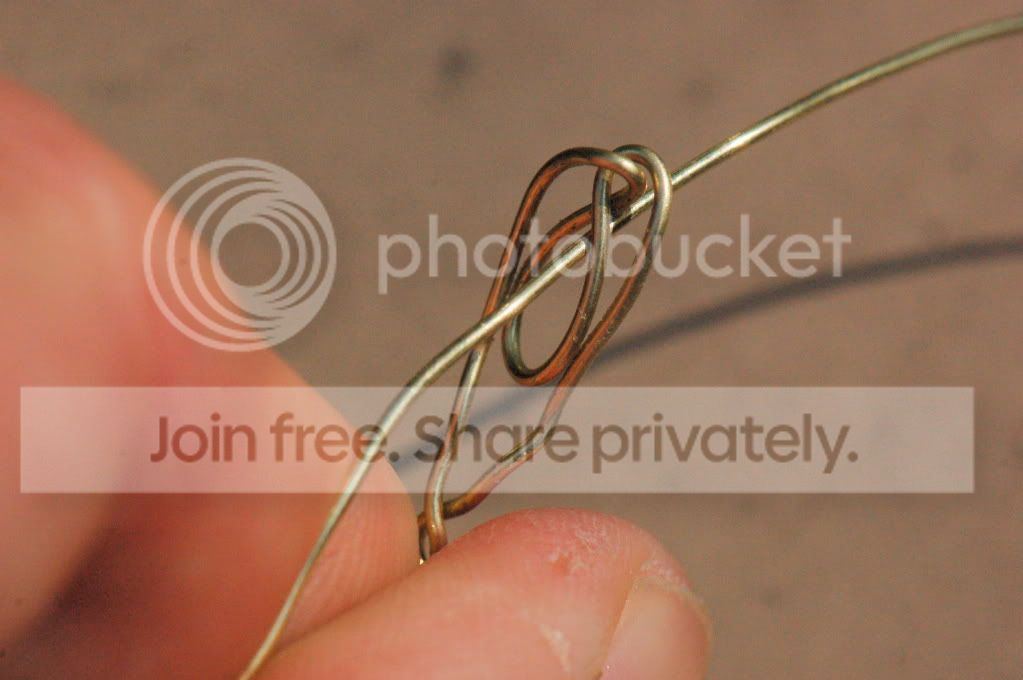


For the first time I was able to put a convex edge on them and bring them to shaving sharpness and also to push cut through paper. They just feel great! Now I want to convex all my knives
I started off with my JK's first because John's kephart already came to me convexed, even though I had sharpened it earlier with the sharpmaker. I used 3M lapping paper pinned to a mouspad onto a piece of 2x4 wood. I ran through a full grit series (200, 400, 600, 800, 1000 and 2000).
These things are now just as sharp as I like my v-grinds. Admittedly, I did put a slight touch of a micro-bevel at 40o with a few feather strokes on the sharpmaker (old habits are hard to kill). Love this grind now! Again thanks to all the kind suggestions and particularly to Garrett whose diagrams and patient advice led to my breakthrough.
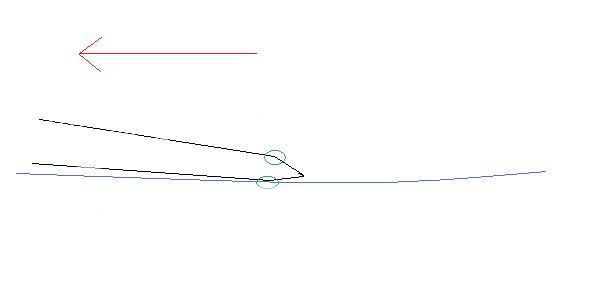
I agree. Here are some really rough paint drawings that explain how I see the convex taking shape.
Here is where I see the 220 doing the most work. Basically, we are trying to knock the shoulder off of the v-grind. At this point we are not trying to sharpen the edge as much as we are trying to establish a smooth curve.
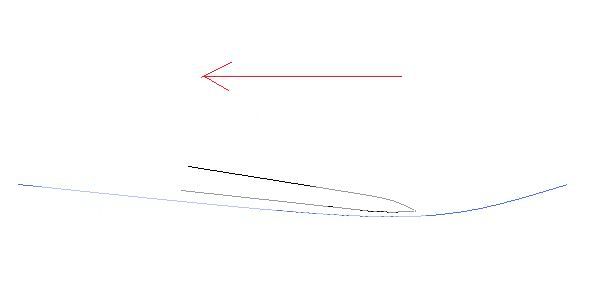
If that was done correctly, then all we have to do is run up through the grits using the right amount of pressure and it should sharpen it up real nice. In the drawing, I have left space between the blade and the paper in order to show what shapes they have formed. In reality they are touching obviously and the paper should be just barely touching the edge while we draw backward.
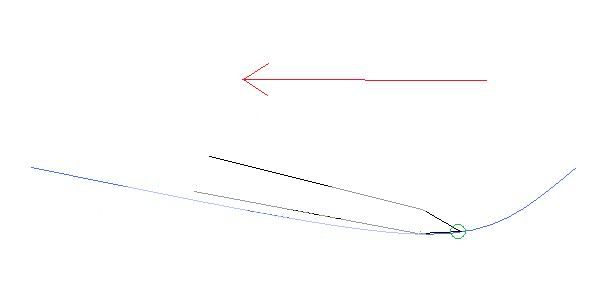
This is what I think happens when you apply too much downward force on the blade as you pull back. It is rounding the edge, but too much. It is making the final edge angle so steep that it isn't an efficient cutter anymore.
I am by no means an expert at any of this but this is kind of what I think is happening. Sometimes it helps in explaining to draw it out.
Last edited by a moderator:


