THAT is an ugly weld if I ever saw one!

Joined
Aug 13, 2002
Messages
5,703
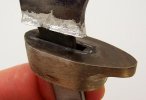
Well, not even a weld since it did not take.
Stainless guard 304, 1095 blade. Plain jane solder and flux.
Obviously it did not work. Guess I need some better solder.
 

Attachments

  • bad_weld.jpg
    bad_weld.jpg
    66.4 KB · Views: 480
I would not take a chance with brazing. Probably too hot.
I agree that the flux overheated, gotta be more careful about that.
But even then it stuck to the blade. Not to the guard sadly.
Robert, that might be a big part the problem.
 
It may not be as strong but I just fit the face side of the guard very tight.It's tight enough that it doesn't need anything to fill the gap to look good.Then I epoxy the guard on with JB Weld to keep everything sealed.You can wipe off any JB Weld before it dries that got on the finished face. It's a lot easier than any solder joint and I've tested it on choppers with no problems.I do however fill all my hidden tangs with acraglass that will also go into the back of the guard.
 
Stainless can't be soldered with lead solder. Use silver-bearing solder. Clean the metal to bright immediately before soldering. I use Stay Clean flux. Heat both parts equally until solder flows, then immediately remove heat. Spray with water.
I solder with the blade tip down in a vise, and apply solder from the rear. Make sure your vise is far enough away from the joint that it won't act as a heat sink. Solder flows toward heat. Use a soft lead pencil to outline where you DON'T want the solder to go. Unless you use too much solder, it won't flow over the line.
 
the slot for the tang needs to be a snug fit, the gaurd needs to get heated to draw the solder in, the blade got hot before the gaurd even got warm

-Page
 
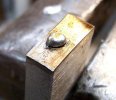
I took a piece of the stainless (304), sanded (600) and cleaned well (acetone). Applied flux and on top a thin (hammered) sheet of solder. Applied heat from underneath until the solder flowed. I never coated the stainless, just made one big bead. (don't mind the brown color, the flux was still clear when the solder melted, it just browned in the minute or 2 after I left everything there to get the camera).

So now at least some of the possible causes have been been removed leaving, I think, the stainless itself or the solder/flux as mentioned before.
 

Attachments

  • bad_weld1.jpg
    bad_weld1.jpg
    52.4 KB · Views: 105
Is it lead solder? If so, it won't work on stainless. You need solder with a little silver content. What type flux are you using?
Sand, wipe and flux immediately. Stainless "passivates" itself rather quickly.
I use Stay Brite solder and Stay Clean flux, and have not had a problem.
 
Why solder it in the first place? Use stainless rod and arc it. Then heat-treat. If you have to solder, be aware that it is not like welding where just the joint gets heated. The entire piece, or enough of it to keep the heat from running away from and concentrated upon the joint, has to be at soldering temp. Cleanliness is next to Godliness. No oxides in the joint whatever. Emery to bright. Flux galore. Brown the flux until dry. Put little-- no bigger than 1/8 by 1/8"-- paillons of fluxed silver solder all along the joint. Gently heat.
 
Bill, I am using the generic flux that came with the solder, obviously lead. I'll try and find some with silver content, thanks.
Miles welding is not something I want to do. I am curious though about "browning" the flux. I thought that it meant it had overheated?

Thanks guys.
 
Browning the flux-- just heat it slightly, enough so that it gets crusty, not enough to cook it off. Then I would put the fluxed paillons on-- browning the piece keeps the paillons from moving around when you put the heat on the piece. If they do move, gently prod them back into position with your soldering pick, any sharp-pointed clean rod of steel will do. You want to use paillons, not wire or stick because they do not require a lot of heat to flow. It does not take a lot of solder to make a beeeyoootiful fillet-- if the two piece to be joined are at the right heat. You d not want a high velocity jet of flame for this because it moves the paillons out of place. Take your time and watch the color of the metal. You want everything nice and red near the joint. Silver soldering, or silver brazing takes a lot of heat. Soldering a thin piece like the tang to a thicker piece like the guard is always tricky. It looks to me as you did notget nearly enough heat into the guard to get the solder to flow. Just as well, because plumber's solder has no real strength. You've assigned yourself a tough first lesson!! Keep trying! Just don't lose the temper in the blade!
 
You can solder SS but need a different flux. We did it at work last month. I will get the info for you in the next couple of days and post it here for you.
Dan
 
I've had good luck with the stuff that comes in the little white plastic tub with the blue lid, Handy Flux. Works for me with stainless to brass, brass to ferrous, copper to brass, brass to silver, silver to silver, ferrous to ferrous, etc. Check out their website. http://www.handyharmancanada.com/ This may be an old URL, but it works.
 
You can't solder stainless with lead solder, regardless of the flux used.
 
I have used acetone, but started getting better results from just scrubbing the pieces hard with dawn detergent right before soldering. +1 on Stay-Brite and Stay-Clean.

I too use small pallions of solder. I don't play the torch on them, I solder tip-up and heat mostly from below. A soft brushy flame and carefully, evenly and slowly bringing it up to heat helps.

Using a stainless solder pick can help. If your solder is not flowing well, dip the tip of the pick in your little capful of Stay-clean and then gently spread the solder along the joint with it.

I believe Miles is talking about silver brazing, or hi-temp silver soldering. I followed the link and was unable to find any type of Handy Flux for sale there that was in the lower temp range of a silver bearing solder. Flux acts a bit differently for those applications. In my experience it's a bad thing when low-temp soldering if the flux turns brown.
 
You can't solder stainless with lead solder, regardless of the flux used.

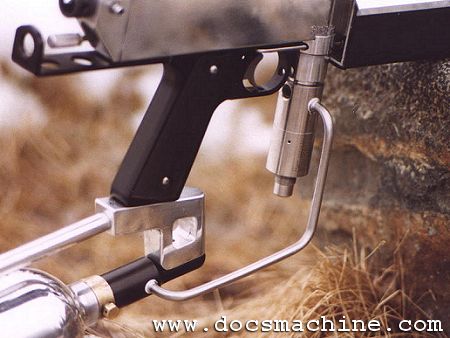
-I made this pressure line using stainless instrument tubing (probably 316) with threaded collars (304) soldered to each end with off-the-shelf 60/40 lead/tin plumber's solder. The flux was a liquid, meant for silver soldering.

hardline1.jpg


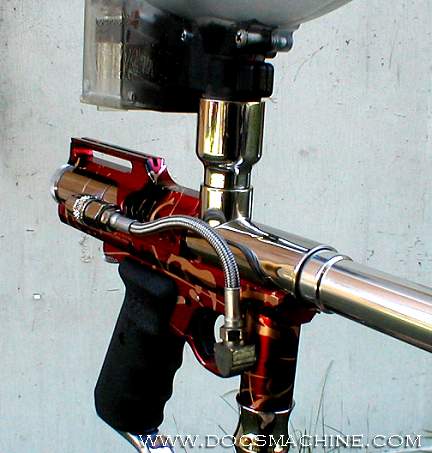
The vertical feed neck collar on this marker was soldered to the body of the gun (both 304) with what I originally thought was silver-bearing solder, but which turned out to be some flavor of conventional lead/tin as well. Same liquid flux.

afredmag.jpg


I have stacks of other examples. I've been soldering stainless components with "plumbers" solder for fifteen years. :D

Doc.
 
Back
Top