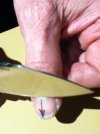
That Spyderco "Sticky Edge"

I did really think about it, and if they have the same angle, I ascribe them the same level of sharpness, and if there is a disparity in finish grit, then I ascribe them a disparity in finish grit. If toothy always cut everything more poorly than refined/polished, then I would be on board with the "higher edge refinement means sharper" thesis. Geometry is king. Edge finish determines in which kingdom.
I agree. For instance, during Christmastime when I'm wrapping presents, I don't use scissors, I use a highly polished blade because wrapping paper is as thin & delicate as can be. If I used a toothy edge on that it would rip. You basically want something that will glide through it.
 
I'd also like to add that BUCK & Kershaw both have had that sticky edge from my experience. It's still not as extreme or consistent as Spyderco though.
 
I've had some really sticky edge Kershaw's as well. Interesting points made about grit and sharpness here. It's so crazy how much thought and complexity can be around something as simple as a wedge designed to divide things in two (a blade) that there can be a whole forum dedicated to it that is never running out of posts.
 
I think the key is an acute edge that is sharpened to 400 to 600 grit. That makes them very sharp but also a little "toothy" to grab material. Polished edges look good in pictures but do not cut nearly as well as a lower grit edge, especially for EDC purposes (I am sure there are scenarios where a polished edge is preferred).

Agreed. I remember early in my sharpening experience that I finished with a hard, black Arkansas stone that was formerly used to touch-up microtome blades. The edges would shave and slice paper ridiculously easy, but would often slide across plastic, rope, or tape without biting into it and cutting. Then I read some articles from Steven Dick in which he would get a custom knife that was buffed mercilessly on felt wheel with jeweler's rouge. They often would not cut, even though they had a good apex. His solution was a few strokes on a Norton India stone to roughen the apex just a little and they all cut exceptionally well. Once I stopped the polishing steps, I got much better results in cutting. I once cut a free hanging one-inch manila rope with a Buck 422 with one swipe. The smiths I was visiting laughed at me (they were testing a big bowie on the rope and not doing well) when I asked to try with my little three inch Buck. The key was 1) a very sharp and grabby apex, 2) edge alignment/technique, and 3) hand speed.
 
Last edited:
Ah so you equate toothy with less sharp. I’ve always just seen it as different sharp. Thanks for sharing your perspective.

I would describe it the exact same way. If you want a highly polished shaving edge for say... umm shaving then that's the way to go, but my work knives I usually stop at 800 grit for the type of work that I'm doing. OTOH lately we've been using synthetic roofing underlayment & it has changed the game. I need an edge that won't snag whatsoever so I've been going to 2000 grit & stropping my work knives. & yes, I realize I have contradicted myself in this short paragraph. 🤦🏼‍♂️😁

My generalization is: push cuts (like wood carving) favor a polished apex. Slicing favors a toothy/grabby/sticky apex. There are exceptions, but it works for a lot of cutting applications.
 
Back
Top