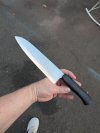
The bunka - If Superman were a kitchen knife,...

Joined
May 25, 2018
Messages
260
3kRxD61.jpg


MbAgG0j.jpg


The bunka is more than the the answer to "What should I do with my chef's knife after I break off the tip?!?!"

🤣

The bunka is that rare master of all trades, levels above all the other attempts at a versatile blade. It's gently curved edge slices and chops like God's gyuto or santoku, its fine but strong tip performs delicate paring tasks, and its broad, strong back shoves stuff back and forth around the cutting board like a snow shovel. Strong as a bull, delicate as a scalpel, I expect this to be my favorite blade for at least a month, possibly even a little longer. Because these things cut and feel perfect.

The important things are the SG2 steel, the very thin blade, and the intense sharpening angle of about 12 degrees. Like I learned in a recent thread, that blade geometry (thin blade plus sharpening angle) and steel that performs when its that thin are the keys to a killer edge.
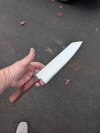
 
I prefer a straighter edge profile and height like a bunka has over a normal chef knife or Gyuto, especially if its a shorter blade length like a 180 or 240; it gives me more room to work.

PXL_20241122_164809518.jpg

This is one I did for a pass around a while back on another forum. 80CRV2 steel, 1/8" thick barstock, but I did a S grind with a 36" radius wheel on it, then convexed down to the edge. It's got a stiffer spine, more height and heft behind it, and a 220mm or so blade length. It has a long very flat spot at the heel, so it's almost like a nakiri, but with a point for finer tasks. I gotta thin down the rear portion of the blade a touch more and do a nicer handle, but the profile performs well for a shorter blade length! I am usually using a 245-255mm gyuto I made with a similar, but thinner grind.

I like the longer, flatter edge profile, even in a gyuto!
PXL_20241023_214443924.jpg

Speaking of thin behind the edge, this is the choil shot of the carbon fiber handled gyuto above:
mcc handle.jpg
The choil doesn't show the S curve and 36" radius grind (I start it before the heel to keep that thicker so I can round it out for more comfort), but the thickest part where the convex and concave grinds meet is .040" thick, so the hollow goes even deeper! This one is 64 HRC magnacut and no issues with chipping/edge stability! Thin, hard edges and flat profiles are my jam! I used to like Funayuki blades with the shallower edge, but they were often shorter height wise at the heel.
 
That's good info. It seems "K-tip" santoku or gyuto is probably the best verbiage. The profile and thickness of my Kobayashi (labeled as a) bunka and santoku are identical except for the tip.

The language evolves, the designs evolve, but it is funny that Japanese dealers are so imprecise with their labeling, since we should think they would know best. I sense that the knives earmarked for export (with the English "export billboard" ground into the blade) are maybe intended for those with less discerning taste!
 
We saw some nice examples of the bunka and gyuto on display at Williams-Sonoma. Excellent quality, but the prices were outrageous!
 
I think some of those Williams Sonoma stores in the better neighborhoods would sometimes put out display knives, cutting boards, and produce for customers to test out as they shopped for their new knives. What could go wrong?
 
I think some of those Williams Sonoma stores in the better neighborhoods would sometimes put out display knives, cutting boards, and produce for customers to test out as they shopped for their new knives. What could go wrong?
My experience at the Williams Sonoma stores is that they would sponsor cooking demonstrations for their customers, using Williams Sonoma products, but their own staff performed all of the functions. Their kitchen knives were kept in locked glass display cabinets and customers were not allowed near the food prep/cooking area. I never saw a customer handle a live blade at any WS store and I have been in a number of them in several states.
 
Back
Top