The Cowbell Build Thread

Nice! I need to get one of those. They're good people down there, I enjoyed my trip to their shop. They were super friendly and helpful when I saw them at the leather show. I can count on two fingers businesses that are that attentive to their customers, the other being the tire shop here in town. Thor is such a cool dog, he might be part human. Seems to me they have pretty good lifespans for a larger breed, I hope he's got a lot left in him!
Yeah she's loving it so far.Thats our 6th Cobra machine. We have the 4, the 26, the 18, the NP4 skiver, the finisher and the strap cutter. Probably pick up the splitter this year too.

Last time we were down Thor seemed to be feeling his age a lil more, a lil gimpy. That was a lil over a year ago. This time quite a bit more spring in his step. They have another dog too, a black lab mix. She came a nd laid down on my feet why we were talking. Didn't catch her name.

First purse sewn up on the 26:

a9hpjTR.jpg
 
Yeah she's loving it so far.Thats our 6th Cobra machine. We have the 4, the 26, the 18, the NP4 skiver, the finisher and the strap cutter. Probably pick up the splitter this year too.

Last time we were down Thor seemed to be feeling his age a lil more, a lil gimpy. That was a lil over a year ago. This time quite a bit more spring in his step. They have another dog too, a black lab mix. She came a nd laid down on my feet why we were talking. Didn't catch her name.

First purse sewn up on the 26:

a9hpjTR.jpg

Nice looking purse, that stitch on there looks great. I know we've talked about it before but now that you have a 4, 18, and 26, what do you think would pair well? A 4 with an 18, or a 4 with a 26? A lot of factors to consider there but what would cover the spread the best in your opinion?
 
Nice looking purse, that stitch on there looks great. I know we've talked about it before but now that you have a 4, 18, and 26, what do you think would pair well? A 4 with an 18, or a 4 with a 26? A lot of factors to consider there but what would cover the spread the best in your opinion?
Definitely a 4 and a 26. Not even close. The 26 is really a slightly beefier 18 but in a cylinder arm configuration instead of the flatbed of the 18. In your case I’d get the table with the 26 because that converts the 26 to a flatbed. Thats handy particularly if you are doing some belts or more notebooks for the kids etc. We didn’t get the table because we have the 18 but the table is really handy for certain things you are sewing. Lots of things ya need a flatbed for and lots a cylinder arm. For instance on that purse, the strap and the the stitching on the pockets, canvas lining etc all done on the flatbed. The construction of the purse itself, putting all the parts together, on the 26 cylinder arm.
 
Definitely a 4 and a 26. Not even close. The 26 is really a slightly beefier 18 but in a cylinder arm configuration instead of the flatbed of the 18. In your case I’d get the table with the 26 because that converts the 26 to a flatbed. Thats handy particularly if you are doing some belts or more notebooks for the kids etc. We didn’t get the table because we have the 18 but the table is really handy for certain things you are sewing. Lots of things ya need a flatbed for and lots a cylinder arm. For instance on that purse, the strap and the the stitching on the pockets, canvas lining etc all done on the flatbed. The construction of the purse itself, putting all the parts together, on the 26 cylinder arm.
Thanks Dave, that makes sense. A dedicated flatbed would be nice but having both options with the cylinder arm sounds like the way to go.
 
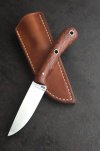
A big thank you to John and family for putting together this beautiful piece. It hasn’t left my side since it arrived, and like the forum bunny I can’t see it spending too much time off my hip going forward.
View attachment 3081028
Glad it made it and thanks again Jack.
1000020945.jpg
 
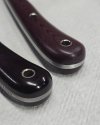
Side grain Lacewood?
I think they're related but it's Sheoak, really neat looking stuff!

The stitching is among the best I've ever seen come from a machine.

Love the simple understated style man, gets me everytime.
Thanks, it's taken me a while to get a process down. I'll have to show how I stitch them, it's bizarre but it's the only way I can get it to work. Since the back side of the sheaths abruptly change thicknesses at the belt slot like a little shelf, the foot tries to bend it down and because the belt loop is right next to it, it gets crooked and will skewed the stitchline.

I fugured out a way to avoid it by leaving the welt about a half inch proud from the rest of the pieces and temporarily tacking pieces of leather onto the welt to make little skis that keep the thinner part of the sheath from getting smashed by the foot. It let's the sheath ride flat in the machine, preventing the bend and keeping a straight stitch line. As long as the knot is set at a good depth it works out. Stitching them upside down would technically work but would give me the ugly back side stitch that happens with a machine on the front.

For those of you that are reading this and are lost so far, don't worry, just know that I have your back 🤣

A little bit to explain why one side looks better in a machine stitch. First off it's just cosmetic. A machine stitch will very rarely look as good on the backside as it can in the front because of the way the needle pierces leather. When the needle pierces into it, it pushes the leather into the hole, when it punches out the back side, it pushes leather out along with it. Imagine puncturing a thin piece of tin with a nail, one side would be smooth and concave while the back side would be jagged and raised up like a tiny volcano. Same thing applies to leather and your thread looks smoother when it's.going into the concave hole as opposed to the tiny volcano. That's why a machine stitch will always have a better top side.

With handstitching you punch the holes from each side so you never have that little volcano every exposed hole is concave so the thread glides down and gives you a cleaner appearance. It's a cosmetic difference mostly. Is a handstitch stronger theoretically? Yes, but having ripped apart both machine stitch and handstitch pieces that I've screwed up, they are bith insanely strong for their purpose, insanely. I think people think machine stitched leather is like a hem in your shirt, with leather it's nothing remotely like that, the knots are deep inside the thickness and won't run.

A lot of that probably made absolutely zero sense whatsoever without pictures I know.

Maybe I'll record a video of what I mean and make things even more confusing!!!

skeletor-myah-myaah-myahahaha-laughing-dasmemistgut.gif
 
Makes sense on the holes and stitching. Must also be hard to get through the welt too?
The machine will stitch up to 7/8" of leather, and a finger bone I imagine. The Cowbells are made of 4 pieces of leather, (a front, back, belt loop piece, and a welt. When I handstitched I'd punch each piece individually and line them up, a ridiculous and completely unsustainable practice. It would take me longer to make a sheath than it did a knife!
 
The machine will stitch up to 7/8" of leather, and a finger bone I imagine. The Cowbells are made of 4 pieces of leather, (a front, back, belt loop piece, and a welt. When I handstitched I'd punch each piece individually and line them up, a ridiculous and completely unsustainable practice. It would take me longer to make a sheath than it did a knife!

I punch each layer and transfer the holes :(

1. Pilot hole punch top side
2. Glue up
3. Punch through pilot holes to backside (break glue)
4. Glue welt
5. Punch through pilot holes and welt
6. Glue up
7. Diamond awl to release glue
8. Stitch

Guess I should look into making clean stitches with a drill press, would spare me the other two punchings.
 
I think they're related but it's Sheoak, really neat looking stuff!


Thanks, it's taken me a while to get a process down. I'll have to show how I stitch them, it's bizarre but it's the only way I can get it to work. Since the back side of the sheaths abruptly change thicknesses at the belt slot like a little shelf, the foot tries to bend it down and because the belt loop is right next to it, it gets crooked and will skewed the stitchline.

I fugured out a way to avoid it by leaving the welt about a half inch proud from the rest of the pieces and temporarily tacking pieces of leather onto the welt to make little skis that keep the thinner part of the sheath from getting smashed by the foot. It let's the sheath ride flat in the machine, preventing the bend and keeping a straight stitch line. As long as the knot is set at a good depth it works out. Stitching them upside down would technically work but would give me the ugly back side stitch that happens with a machine on the front.

For those of you that are reading this and are lost so far, don't worry, just know that I have your back 🤣

A little bit to explain why one side looks better in a machine stitch. First off it's just cosmetic. A machine stitch will very rarely look as good on the backside as it can in the front because of the way the needle pierces leather. When the needle pierces into it, it pushes the leather into the hole, when it punches out the back side, it pushes leather out along with it. Imagine puncturing a thin piece of tin with a nail, one side would be smooth and concave while the back side would be jagged and raised up like a tiny volcano. Same thing applies to leather and your thread looks smoother when it's.going into the concave hole as opposed to the tiny volcano. That's why a machine stitch will always have a better top side.

With handstitching you punch the holes from each side so you never have that little volcano every exposed hole is concave so the thread glides down and gives you a cleaner appearance. It's a cosmetic difference mostly. Is a handstitch stronger theoretically? Yes, but having ripped apart both machine stitch and handstitch pieces that I've screwed up, they are bith insanely strong for their purpose, insanely. I think people think machine stitched leather is like a hem in your shirt, with leather it's nothing remotely like that, the knots are deep inside the thickness and won't run.

A lot of that probably made absolutely zero sense whatsoever without pictures I know.

Maybe I'll record a video of what I mean and make things even more confusing!!!
skeletor-myah-myaah-myahahaha-laughing-dasmemistgut.gif
Excellent summary on the stitching John! Really lays it out there, stitch by stitch!

Makes sense on the holes and stitching. Must also be hard to get through the welt too?
Thats why there are different styles and sizes of stitching machines. John and I both use a Cobra 4 for sheaths, where you are punching through multiple layers of thicker leather. The 4 is a heavy saddle making style of machine that can sew up to 7/8”s thick of leather. Easily. It works well with larger needles and heavier thread. Just like we’d use on a sheath, holster, rifle scabbard etc.

On certain projects like a water buffalo overlay sheath for a Buck 110, I will use a smaller machine too. I’ll use it to sew down the overlay over the open throat of the sheath. This is done prior to concsturction. Then when I put the parts together I’ll use the big 4 for that.
 
Last edited:
Back
Top