The Itchy and Scratty Show!

I just googled checkering tools, and got a zillion possibilities! The spacing and patterns indicate some kind of multiple cutting tool. I suspect you would need good quality ones to deal with bone. And a book if you've never done it.
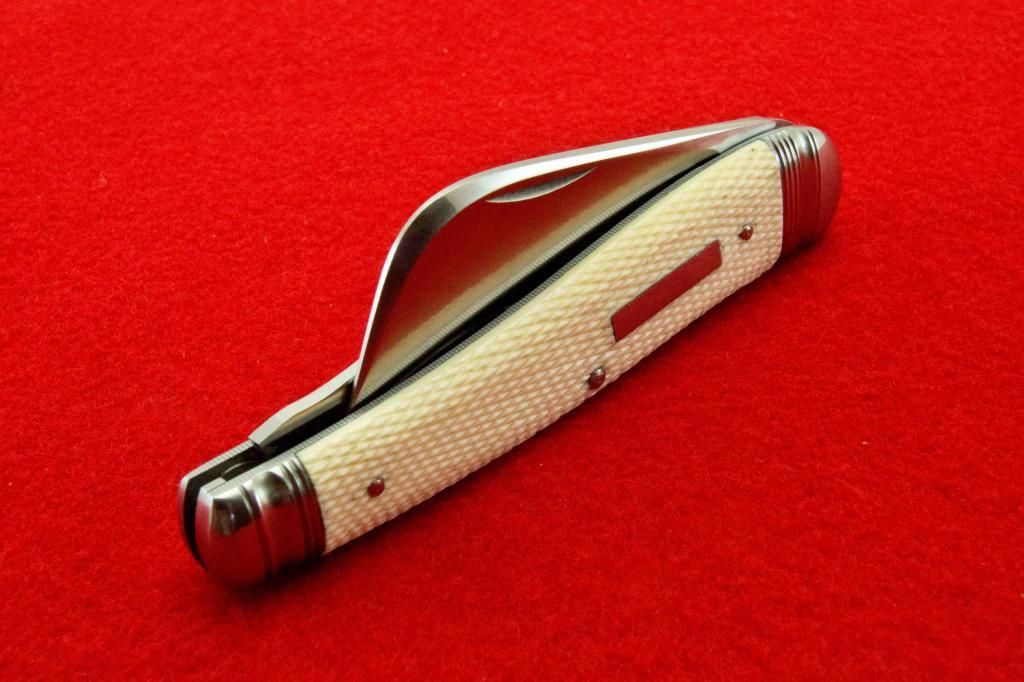
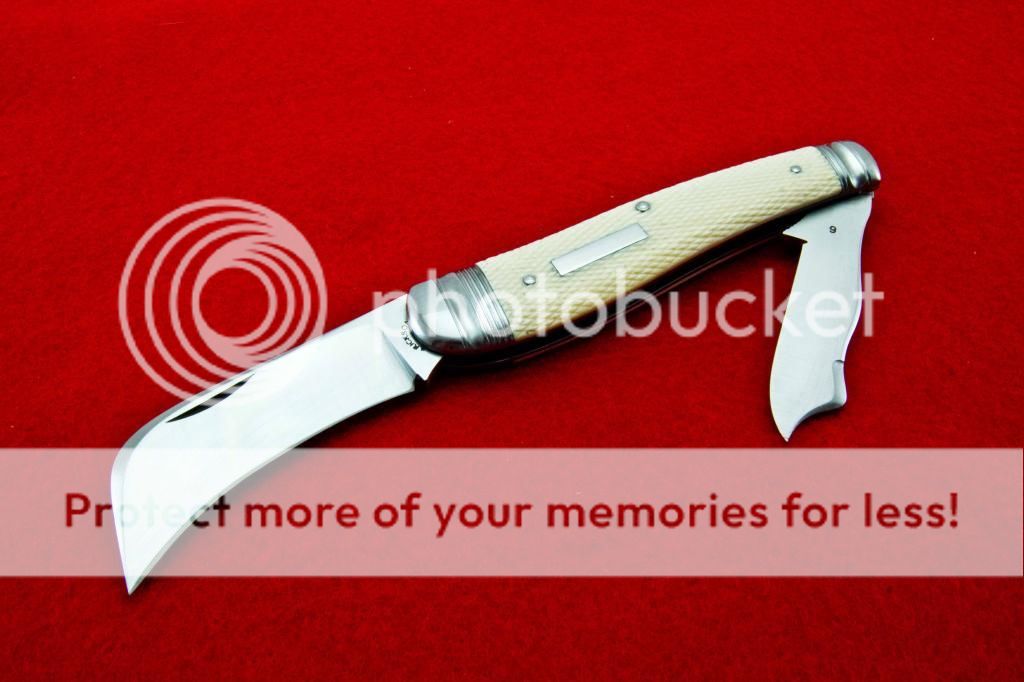
The handle on the Hawk is quite rounded, and much fuller at the "barehead" than at the bolsters.
I guess everyone has noticed the clean and square joint. Not as obvious, the backspring tapers from
.148" to .191" BTW, the knife is just over 4 3/4", a real bushwacker!
 
True...and how bout those bolsters!:eek: Stuff out of No.6 Norfolk St. is just flat cool :thumbup::cool:

Im with sunnyd as well...would love to see how they did the scrat thing. The lines are really straight and spacing of the design elements are right on the money.

I will dig out the tools used, and post them up....

Probably should say the ones I would use.......
 
Surprisingly thick scales on the knife too and they've held up magnificently over the years.

Is it bone or tusk?
 
Surprisingly thick scales on the knife too and they've held up magnificently over the years.

Is it bone or tusk?
It's bone for sure.

Interesting history re: Port Stanley, Ontario, where the knife was found. It's a lake port, on the north shore of Lake Erie. It was founded as the settlement of Kettle Creek in 1812, and renamed Port Stanley in 1824, in honor of a nearby visit of the 14th Earl of Derby. His son, the 16th Earl of Derby became the Governor General of Canada, and was a hockey enthusiast. His name was Frederick Stanley, and he donated the first Stanley Cup, for the hockey championship at the time, in 1893!! Hockey goes back a ways.
I'll bet a lot of knives were shipped through Port Stanley, via the Hudson River, and the Erie Canal, which was completed ca. 1825.
A lot of Sheffield cutlers got off the boats in New York State back then also!
 
Now that's something special Charlie, Anything Joseph Rodgers is very collectible. The condition is outstanding for the age, someone must of looked after that very well or it was hiding away somewhere. Coming from the UK, I'm very partial to English knives, not that I have many. The bulk of my collection are USA made.

Russell
 
Wow, congratulations on a NICE score. Thanks for sharing that.
 
Russell, I'm glad it strikes a chord with you. I have just a few myself, but each one is special. And of course we are lucky enough to have s-k, and others, to help us understand them!
Glad you like it knarfeng; you are welcome! I like your forum name, even though I don't understand it!
 
OK Charlie I'm digging them out, and a few samples of a cut or two, later this evening, I have to set my light box back up......
 
Would love to see those tools D.P! And maybe a sample of how they cut??

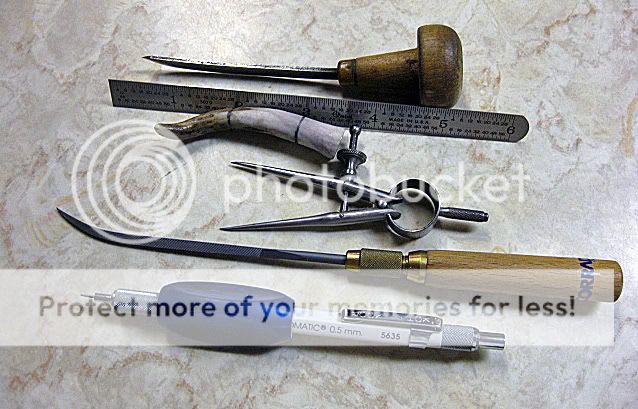
OK Charlie these are the basic tools that I would start with.

I have old Pipe tamper that I've made. Going to checker it for the crowd, sure hope I can pull it off maybe I can, maybe I can.......

I have a checkering tool with different cutters. and I'm going to try to get at least some of it straight going around in a circle......

I will show different tools as I progress......

Hope this OK in this forum, and in this tread.....

A_TOOLS_1.jpg
 
If it's going to take several posts, it might deserve a thread of its own, Darrell!?
 
If it's going to take several posts, it might deserve a thread of its own, Darrell!?

I won't post any more till I'm finished.....

One more post with the finished product, with tools used.... ?

I'll even show a Bose Knife I used while doing it...... :D
 
Looks like that'll keep you busy for a few minutes D.P!:D
Lookin' forward to the finished product:thumbup:.
 
Further speculation on this pruning knife. My downstairs tenant is a nice old gal, who grew up in a Mennonite farm family in Southern Ontario. I was showing her the knife, which she much appreciated. How many times can you say that about showing a big honking pocketknife to an old lady??
Anyway, she pointed out that Port Stanley, Ont, where it was found, is right in the middle of the Tobacco Belt. Tobacco started to be commercially grown in that region in the early 1800s, and still is grown there. Even though this knife is listed in a 1910 catalog as a coffee pruner, I can imagine it being used to cut the outside tobacco leaves as they matured, which is how some of it is harvested.
From Sheffield, across the Atlantic, up the Hudson river, across the Erie canal, and through Lake Erie to Port Stanley, to harvest Tabac!!
Speculation for sure, but plausible don't you think??
 
Might check out gunstock checkering tools to get idea how it might have been done. One manufactor is Dem-Bart Tools.

My first reaction is that carver had some instruction or experience working at gun shop over in England.

Picture is the small (1/4") cutting head that goes on a handle, as you can see it will make a double line, you cut and mark the next line at the same time. Photo from Brownells Gunsmith Tool catalog. D.P. can finish this as I only did this once or twice an realized you needed skill I didn't have. I know the layout of design is real important.....I have a cheap wooden handle sheath knife with half checkered grip(poorly)...........300
dembart.jpg
 
Last edited:
300Bucks, "scratting" was a separate skill in Sheffield, in the 1800s.
Many knives were handled in this traditional way. According to Bernie Levine, the skill nearly died out in the late 1800s, but some of the old methods lingered with Joseph Rodgers, into the early 1900s. This knife is not a "one - off", but a ca. 1910 production item, handles included.
 
Might check out gunstock checkering tools to get idea how it might have been done. One manufactor is Dem-Bart Tools.

My first reaction is that carver had some instruction or experience working at gun shop over in England.

Picture is the small (1/4") cutting head that goes on a handle, as you can see it will make a double line, you cut and mark the next line at the same time. Photo from Brownells Gunsmith Tool catalog. D.P. can finish this as I only did this once or twice an realized you needed skill I didn't have. I know the layout of design is real important.....I have a cheap wooden handle sheath knife with half checkered grip(poorly)...........300
dembart.jpg

The cutter you Have shown Is for deepening after it has been lay-ed out.....
 
Absolutely beautiful Lyle :thumbup: Nice 'diamonding' ;)
 
Back
Top