The Kephart thread

Joined
May 7, 2011
Messages
3,426
Good morning folks!
Many of us here enjoy the pleasure of using a fixed blade in the outdoors....and even more so, if it's a traditional pattern. Or, at least, I do ;-)
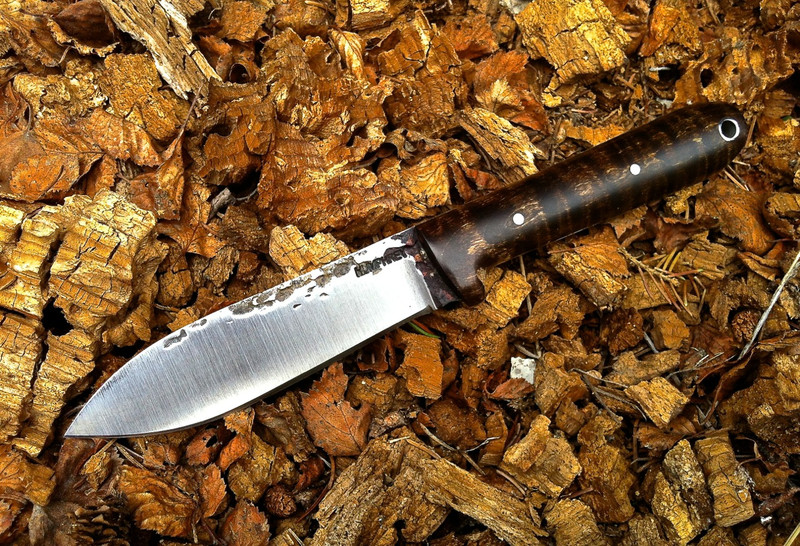
Before I joined BF, I knew nothing about the Kephart pattern and the history behind it. Moreover, spear blades are very rare in outdoors knives here in this part of the knife world. Yet, since I saw it, the Kephart struck me for its simplicity and usefulness, and now I'm after one.
So chime in and post your Kephart knives, old and new, custom and production (not sure there's any in current production), provide some feedback about the design, and inspire me (not that I need much inspiration :rolleyes: but it's good to get some anyway).
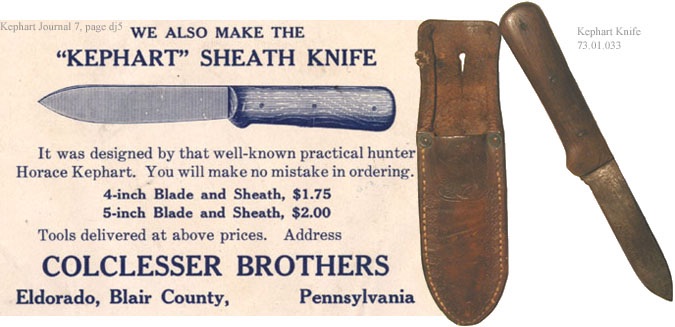
Since I do not own one yet, I will start with an early picture of its design:
6aVT1tZ.jpg


Fausto
:cool:
 
Fausto, Bark River makes their version of a Kephart in some nice handle materials and they use top notch stainless. :thumbup::)
 
This one isn't as nice as a BR :o but it gets used EVERY day since I got it! My wife has officially confiscated it for kitchen use though :rolleyes:

 
If Smithhammer posts his Kephart again, my wallet is in trouble! :eek::D

Which one? :D

Lon Humphrey:

Overall length Approx 9"
Blade Length Approx 4""
1095 Carbon
Thickness 3/16"

k9iemw.jpg


Bark River:

Overall Length:8.775 Inches
Blade Length: 4.250 Inches
Cutting Edge: 4.1 Inches
Blade Height: .775 Inch
Blade Steel: CPM 3V @ 58-60rc
Blade Thickness: .093 Inch

SAwx4x.jpg


The Kephart design can be a bit deceptive, and maybe even unappealing compared to 'flashier' designs, until you get one in hand and put it to use. And then the genius behind the simplicity really starts to shine through. The blade length is ideal - not too big, not too small. The handle is comfortable, no matter how you hold it. It strikes a very good balance between a blade design that will do general woods-work and camp chores, and one that is still capable of being a good hunting knife that performs well for skinning/dressing tasks.

Of the two examples above, they both share the characteristics described, but the Bark River version is quite a bit lighter, with a thinner blade that takes advantage of the tough 3V stock. I was actually quite surprised when I first got it just how thin the blade actually was - certainly thinner than Kephart's 1/8" recommendation, but then again, steels like 3V weren't a reality in Kephart's time. That said, I've worked with the BR Kephart quite a bit in the last month, from carving to fire prep to dressing small game with it, and it's plenty tough for anything that a knife like this is intended for.

That said, the Humphrey version is just as capable, but with character and 'feel' that can only come from a hand-forged and hammered blade.

I love them both in their own way, and I love the general design and simplicity of the Kephart in general. If I had to grab one knife to head into the woods, a Kephart would be it. :thumbup:
 
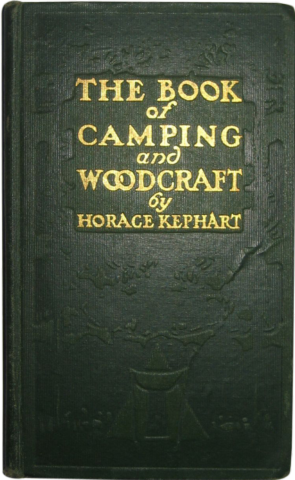
Mr. Kephart's thoughts on an all-around woods knife (ecerpted from "Woodcraft and Camping" which I would recommend getting a copy of, if you haven't already):

"On the subject of hunting knives I am tempted to be diffuse. In my green and callow days (perhaps not yet over) I tried nearly everything in the knife line from a shoemaker's skiver to a machete, and I had knives made to order. The conventional hunting knife is, or was until quite recently, of the familiar dime-novel pattern invented by Colonel Bowie. Such a knife is too thick and clumsy to whittle with, much too thick for a good skinning knife, and too sharply pointed to cook and eat with. It is always tempered too hard. When put to the rough service for which it is supposed to be intended, as in cutting through the ossified false ribs of an old buck, it is an even bet that out will come a nick as big as a saw-tooth — and Sheridan forty miles from a grindstone! Such a knife is shaped expressly for stabbing, which is about the very last thing that a woodsman ever has occasion to do, our lamented grandmothers to the contrary notwithstanding."

A camper has use for a common-sense sheath-knife, sometimes for dressing big game, but oftener for such homely work as cutting sticks, slicing bacon, and frying "spuds." For such purposes a rather thin, broadpointed blade is required, and it need not be over four or five inches long. Nothing is gained by a longer blade, and it would be in one's way every time he sat down. Such a knife, bearing the marks of hard usage, lies before me. Its blade and handle are each 4 1/2 inches long, the blade being 1 inch wide, 1/8th inch thick on the back, broad pointed, and continued through the handle as a hasp and riveted to it. It is tempered hard enough to cut green hardwood sticks, but soft enough so that when it strikes a knot or bone it will, if anything, turn rather than nick; then a whetstone soon puts it in order. The Abyssinians have a saying, "If a sword bends, we can straighten it; but if it breaks, who can mend it? " So with a knife or hatchet.

The handle of this knife is of oval cross-section, long enough to give a good grip for the whole hand, and with no sharp edges to blister one's hand. It has a 1/4 inch knob behind the cutting edge as a guard, but there is no guard on the back, for it would be useless and in the way. The handle is of light but hard wood, 3/4 inch thick at the butt and tapering to 1/2 inch forward, so as to enter the sheath easily and grip it tightly. If it were heavy it would make the knife drop out when I stooped over. The sheath has a slit frog binding tightly on the belt, and keeping the knife well up on my side. This knife weighs only 4 ounces. It was made by a country blacksmith, and is one of the homeliest things I ever saw; but it has outlived in my affections the score of other knives that I have used in competition with it, and has done more work than all of them put together."


GXUvfm.png
 
Still have your mind set on a Kephart Fausto? I will never understand how a man who grew up with the graceful resolza can be drawn to such a homely knife. :p
 
Mr. Kephart's thoughts on an all-around woods knife (ecerpted from "Woodcraft and Camping" which I would recommend getting a copy of, if you haven't already):

GXUvfm.png

And it's available in various electronic formats:
https://archive.org/details/bookofcampingwoo00keph
http://scoutmastercg.com/wp-content/uploads/2012/11/campingwoodcraft.pdf

Just google Kephart woodcraft book.

If you want to chase down a printed copy, I suggest you try at http://www.bookfinder.com, which is like Amazon for used book dealers (and has a wider selection of used books than Amazon itself does). Just read the descriptions carefully, as the condition of copies varies greatly.

My own two "Kepharts" are a 1947 reprint of the book, and Condor's version of the knife (like 556hunter, see below).

Macmillan (Kephart's publisher) issued a two-volumes-in-one edition starting in 1921, and that's what was most often reprinted. With the knife, I scoured off the black coating, as a bare carbon-steel blade seemed more authentically Kephartian. (Your mileage, etc. etc.)

 
Last edited:
Still have your mind set on a Kephart Fausto? I will never understand how a man who grew up with the graceful resolza can be drawn to such a homely knife. :p

If you're surrounded by steak most the time, a hamburger looks good after a while. ;)
 
Great thread! This my favorite style of knife for outdoor use. Simple, but with an elegance born of its utilitarian value. I have both the Lon Humphrey and the Condor version. The Lon Humphrey is gorgeous and performs beautifully for everything I've ever used it on. The Condor is as homely as Horace's but performs just as well as the Humphrey. The Condor has the thinner blade of the two. I think the slightly thicker handle on the Lon Humphrey is a little bit more comfortable during extended use, but the Condor is closer historically to the original used by Kephart himself. I must admit, I use the Condor every time I'm in the bush-it's my most used bush knife. That being said, I ususally pair it with an Esee 6, a Condor Solobolo, or a hawk. My advice would be to start with the Condor and if you find the style is one you like using, then start looking at custom versions. Hope you enjoy the Kephart style as much as I do.
IMG_0243_zpsqodueiwn.jpg
[/URL][/IMG]
 
Last edited:
Still have your mind set on a Kephart Fausto? I will never understand how a man who grew up with the graceful resolza can be drawn to such a homely knife. :p

If you're surrounded by steak most the time, a hamburger looks good after a while. ;)

I assume Carl got it right. Also, you can't be stylish all the time ;)
Thank you for your feedback folks. I have read many pages of that book, and that's one of the reason why this pattern makes even more sense to me.
Personally, I never really liked thick knives for outdoors use; I guess my cutting tasks are better accomplished with a relatively thinner blade (1/8 to 1/10 of an inch).
I sure don't need anything longer than 9" overall (to be honest, the longest FB I've ever owned and used is a Mora Companion), so 9" might feel a bit large. We'll see :p
I do like the BRKT version, I'm just not sure I can handle a convex CPM 3V the way I can handle a 1095/1084 v-edge... :o

Fausto
:cool:
 
Sometimes beauty is more than skin deep. You'll find the 'beauty' in the Kephart, much like most good tools, when you put it to use. :thumbup:

Don't let a convex edge put you off - they are actually very easy to maintain. The key with a steel like CPM3V is to not wait until the knife is truly dull - just keep ahead of it. I keep a small leather strop loaded with black compound in my day pack and a larger one on my desk. After using the knife, I simply give it a few strops to keep it razor sharp. And with the edge durability and retention of 3V, it isn't something you'll have to do a lot of. I spent a whole week using that BR Kephart for everything from prepping/eating all my meals, to carving a wooden kitchen spoon, to splitting kinding and making shavings for a fire, and dressing a pheasant, without touching up the edge once. It was still cleanly slicing paper at the end of the week, and a couple minutes on the strop brought it back to perfection.
 
It's not really the convex edge that puts me off...but the only convex edges I deal with are Opinel knives.
I have no experience with 3V so I'm kind of reluctant...but I take your word for it :)

Fausto
:cool:
 
Sometimes beauty is more than skin deep. You'll find the 'beauty' in the Kephart, much like most good tools, when you put it to use. :thumbup:
.

So Sooo true!!

Sometimes you have to really use something to appreciate the beauty of the design. The Kephart is like an old Green River skinner, or an Opinel, or the old BMW motorcycle. It needs no explaining to the faithful. It just works.
 
So Sooo true!!

Sometimes you have to really use something to appreciate the beauty of the design. The Kephart is like an old Green River skinner, or an Opinel, or the old BMW motorcycle. It needs no explaining to the faithful. It just works.

I like how you tied old Beemers into that comparison. :D

I do think that vonrichthofen54 offers some good advice in trying out the Condor version, if you just want to get a feel for the design without dropping much cash.

Also, while I haven't tried one, ML Knives makes a good looking version of the Kephart as well:

kephart_Knives_group_Pic_ML_Knives1.jpg


I've been toying with the idea of ordering on of his 'Short Kepharts' as more of a 'daily carry' version of one of my all-time favorite knives. :thumbup:
 
Nice pics so far, I have seen a lot of Kepharts (and Nesmuks) that look nothing like the originals; I see no need for it, if you are making a Kephart, make a Kephart, if you make something else then call it something else.

I think Joe Flowers really nailed the Condor model when you compare it to the original ad as well as photos of the top of the knife, Joe Flowers didn't have Condor put flat slabs on the knife but rather he got them to put tappered slabs just like the originals.

As for spear points, I don't like them much; I can handle a inline point like on some Moras and clip points but I still like to see more belly on the sharpened edge than on the top side. I had a German army knife with a spear point and it seemed neither sharp enough for piercings and not belly enough for other tasks. Still one day I would like to own a Condor Kephart (their Nesmuk needs a bit more tweeking to make the shape look like the one in the book).
 
I have recently become pretty infatuated with the Kephart. I have considered buying a Humphrey Kephart but wish it wasn't 3/16" thick. I did recently buy a L.T. Wright Genesis (should be here this week) and while it's not considered a Kephart it certainly draws inspiration I would think.

DSC_2483__36690.1409908656.1280.1280.jpg
 
Back
Top