The Quest for Axecalibur - Paragon of axe steels?

Joined
Dec 13, 2012
Messages
12
Hi Guys, now I know this is strictly speaking the 'knife forum' but I don't think a group of more knowledgeable steel fetishists exist.

I'm making an axe under the tutlige of an experienced blacksmith and was wondering (partially hypothetically) what the paragon of axe steels would be. Now I know this is a classically vague 'What's the ultimate steel?' question but I'm more interested in interesting or outlandish suggestions. Would 1kg of S30V make a nice axe?

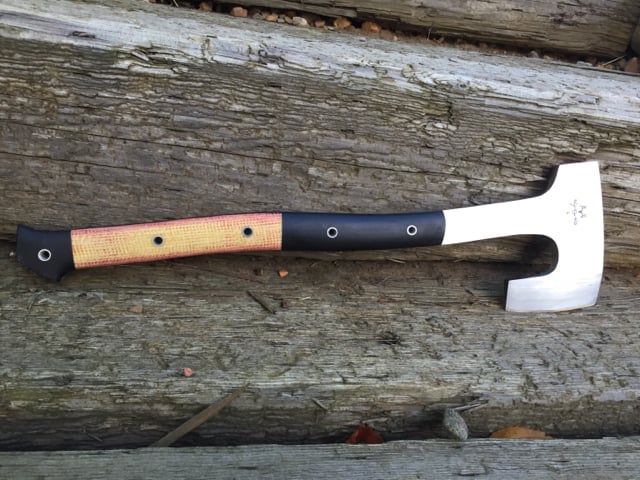
The axe will be pretty close to the attached picture, I'm also open to suggestions for the profile of the blade as per the below 'objectives':

1. To maintain a fine edge after cutting Australian hardwood as long as possible.

2. For the Poll to be hardeneable and used as a possible hammer (not at the loss of edge holding ability).

The steels I'm thinking about so far are 52100, 5160 and S5. I'm no master metallurgist though and price isn't an objective in this hypothetical so throw any crazy ones this way.

I'm not worried about the steel's workability as there's a 250kg Massey power hammer involved. We'll differentially heat treat it too if applicable.

Thanks guys and girls. Let the quest begin.

http://imgur.com/tNNmcsG
 
i saw a pretty cool hammer the other day, was wrought iron with the striking face welded on 5160. I would think an Axe could benefit from having one material on the cutting edge and a different for the body.
 
80crv2 or S7 Or if money isn't an issue 3v.
I did this one out of 80crv2 and it has been unstoppable
bda3de78941d9fee64a5816e37482be6.jpg
 
Well I'm no expert, so I'll gladly give my useless opinion!😜

First off, that's a great looking design! From the pic, and your mentioning a power hammer, I'm assuming this is going to be more of a forging project then stock removal. This will limit the choices. A 3v axe would be cool, but I think the cuss jar would be overflowing half way through the first one! I have forged s7 once or twice, it does work, but not all that much fun. Pretty hard on tools to get the eye punched and drifted.
I think 80crv2 would be an excellent choice, and maybe 52100. That said, I have never made an axe out of these, so take it with a grain of salt.

Post pics when your done, or even Better, a WIP!
 
80crv2 seems to be ideal for this application. I like 15n20 for tough applications too, but you would have to stack weld a bunch together. I've made hatchets out of W1 and 1075. I've got a couple of orders for next month in 80crv2. I think the S series of steel might give up to much in fine edge holding. Great for a hammer, or other such blunt tool, but if an edge is needed, other steels might be a better choice. Nothing wrong with 5160 either. I just don't have any and don't need to learn another steel at this point.
 
L6 anyone? Some of the high end custom axes use it for the bit of the blade forge welded to a mild steel body.
 
I always recommend 4140 for axes. This steel is:
• Easy to work
• Very tough
• Edge holding is OK
• Easy to resharpen with a file
• Available in thicker stock
• Very affordable

Heat treat to HRC 50-53.

Chuck
 
Ill throw my .2 cents in since we have made so many of them..Ive absolutely abused axes made from well heat treated 1060-1080 carbon steel with no problems at all. Ive welded up a bunch with mild steel bodies and HC cutting bits of just about every weldable steel you can think of. Some of my favorites for bits has been W1,W2,O1,80crv2 and L6(real L6 )Also bits from old black diamond files(1.27% carbon)..
The toughest axe by far I made I think was from a solid piece of champaloy(may have been republic but it had Moly) L6...It was the toughest piece of steel I ever slit & drifted in my life..At the time it was all by hand so I slit & drifted a 2" bar of champaloy with a hand hammer and hot cut so you can imagine what it was like..I heat treated the bit and poll..It was amazingly tough, I used kevin cashens heat treat and the axe even at 57rc was awesome with no blade damage against anything I tried it on. though I didn't chop up a car because well that's not something I tend to do every day..
Sooner or later Ill have another forged from L6..i still have a bunch of axe sized chunks but not until the press is fixed,LOL :D Id love to try a milling out an eye from a huge chunk of 3v but at that size id say it would have to be oil quenched to harden correctly...its fun to think about it anyway..
 
Last edited:
Thanks for the advice guys. It looks like 80CRV2 is the most popular option followed by 3V (albeit more of a pipedream).

Can anybody clarify whether there's any performance advantage to a bi-metal axe? I was under the impression that it was a bit of a relic of times past; surely a homogenous piece of modern steel that's differentially tempered would be better.

Thanks again.
 
Ill throw my .2 cents in...Ive welded up a bunch with mild steel bodies and HC cutting bits of just about every weldable steel you can think of. Some of my favorites for bits has been W1,W2,O1,80crv2 and L6(real L6 )
..

Don't sell yourself short, that was at least 50 cents worth! My steel supplies in reality are limited to what my friend has in his shop, that being said he's got a lump the size of my head of about every steel I've heard of so I'll look for some nice L6. What differentiates 'real' and fake L6, is there anyway to tell the difference without a mass spectrometer?

Thanks Kentucky
 
Black g10 and shadetree tequila sunrise. I think the handle materials could be a little better though. As pertaining to your other post. The bit on this is 60rc and the haft and hammer are spring tempered back. I think it is a pretty good combo
 
L6 anyone? Some of the high end custom axes use it for the bit of the blade forge welded to a mild steel body.

That reminds me, I do have one bar of L6 in my stash. :thumbup: I'll call my customer and ask if he wants L6 instead of 80crv2, which is in the L2 spec.
 
Don't sell yourself short, that was at least 50 cents worth! My steel supplies in reality are limited to what my friend has in his shop, that being said he's got a lump the size of my head of about every steel I've heard of so I'll look for some nice L6. What differentiates 'real' and fake L6, is there anyway to tell the difference without a mass spectrometer?

Thanks Kentucky
Well there are several good suppliers of L6 out there..Pretty much any supplier like Aldo, when they tell you L6 its L6..You see some wrap & weld axes with welded in bits of saw blades. While saw blade is often very good steel its not at all always or even mostly L6 like a lot of folks think it is..
You have two different chemistry for L6..One has Molybdenum in it, one does not..Republic steel and the old champaloy had Moly.Carpenter does not.The republic and crucible will air harden to a high degree and will not anneal properly in ashs. It has to have a spheroidal annealing to fully get soft.
If you want to know a lot about L6 do a search for Kevin Cashen's posts on L6..Its good reading :thumbup:
 
This. The question for which I have never been able to find a suitable answer is what is the difference between the L6 with moly and the stuff without it other than the latter supposedly having a slightly lower frustration/cussword level from the makers perspective?:D I have heard that the Champalloy was available in a wider variety of sizes and shapes in the past.
Well there are several good suppliers of L6 out there..Pretty much any supplier like Aldo, when they tell you L6 its L6..You see some wrap & weld axes with welded in bits of saw blades. While saw blade is often very good steel its not at all always or even mostly L6 like a lot of folks think it is..
You have two different chemistry for L6..One has Molybdenum in it, one does not..Republic steel and the old champaloy had Moly.Carpenter does not.The republic and crucible will air harden to a high degree and will not anneal properly in ashs. It has to have a spheroidal annealing to fully get soft.
 
Last edited:
Yea, I ruined a brand new bandsaw blade one time thinking I had annealed a piece of republic L6..It was hard as flint and I didn't know it.
 
Isn't the bigger question here: What kind of use is this axe going to seeing? There seem to have been about as many types of specialized axes as knives back in the day, and "optimal" would likely depend highly on use. A hammer poll spliting maul likely needs something completely different than a fine edge carving axe, or a tactical tank door prying combat axe.

Almost anything suggested here would probably work generally quite well, but the question seemed to be "what's the best", obviously the answer to me is: "Best for what?"


For a maul, I'd probably go with something like 1045, or as Kentucky suggest, any 1060-1080 type. If I wasn't to make the toughest maul ever, yeah, L6, S7, something. For a fine carving axe, I'd be looking at something like W2, that can take a super fine edge, hold it, and sharpen back quickly. For a tactical axe something like 80crv or 3v seems ideal.
 
Almost anything suggested here would probably work generally quite well, but the question seemed to be "what's the best", obviously the answer to me is: "Best for what?"

In reality I'm not a lumberjack so this is more of a fetishism axe. I'll just be using it to cut down small trees (I guess mechanically closest to hickory as U.S reference) and doing carving and shaping. The longer it can hold a fine edge the better. As for the striking side, I'd like to be able to knock a peg or maybe even a wedge in without causing any damage to the axe.

Has anybody got light to shed on the bi-metal/homogenous 'debate'?

Thanks Javen
 
Back
Top