The start of the next project

Joined
Feb 5, 2010
Messages
3,911
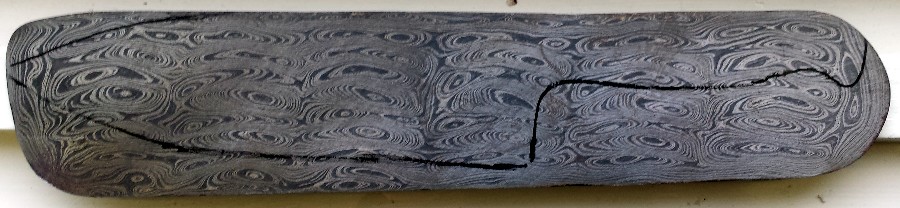
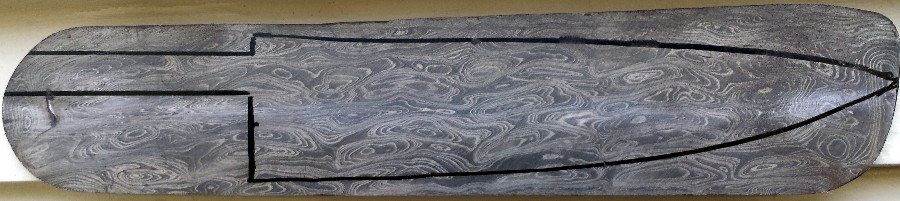
While I was in TN I made a trip to the Smoky Mountain Knife Works in Sevierville. I went them primarily to check out the supply of Alabama Damascus they always have. They always seem to have a pretty good selection of pieces. I used to turn my nose up at it, but some folks here told me it was actually pretty good stuff, so I decided to give it a try.

I ended up with a piece that is roughly 11 inches long and 2 inches wide and 0.145 inch thick. I picked it not so much for the size as for the pattern. The piece costs $25.
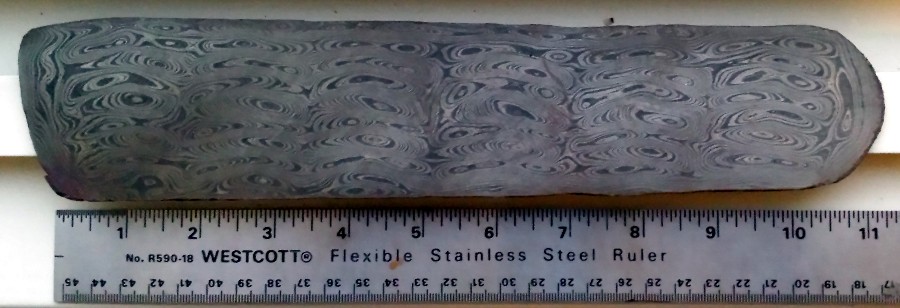
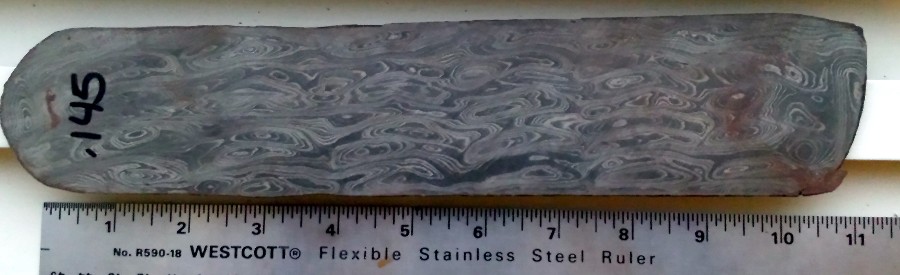
Alabama1s.jpg


Alabama2s.jpg


When I bought this piece I had in mind making two knives from it. I'm still thinking of doing that, but am also considering one larger format knife and a smaller one.
 
Nice piece of steel. At two inches wide I'd seriously consider splitting it lenghtwise.
It would make two good EDC knives app. 7-7,5" x 7/8-1" and leave the rest to be a guard for a future project.
 
I'd split it down the middle into two strips. Use the cut side (former center) as the edge. IIRC, you don't forge, so have someone draw down the bevels a bit to make two tapered billets about 1.25-1.35" wide. You can file/grind them in yourself from there to whatever you want to make. I would suggest a drop point hunter as well, as the pattern looks outdoorsy. The pattern would also be a great match for a stabilized cholla cactus handle.

If you don't have a local friend who can forge the bevels out, I would be glad to do it for you.
 
The price is so low it would be a shame to split it when you could get creative with design since you have plenty of room.

As Salem said a nice chef knife could be made with that width.
 
Good thoughts all around.I'm intrigued by Stacy's offer, and by Salem's suggestion.

After reading Stacy's message I looked more closely at the outer edge of the piece and noticed that the pattern sort of flattens out there, making it look like a more natural place for the spine instead of the edge.

As soon as I read Salem's post I started seeing the chef knife hiding in the pattern.

Given that I have another piece of raindrop pattern damascus, I think I'll move toward the chef knife with this piece and use the raindrop piece for the drop point(s).
 
A chef's blade would be good. You would have to weld a piece of steel on one end and could make a full tang or a hidden tang.

The best way to cut a billet like that to make two blades is a slightly diagonal line down the billet. That will give you some room in the handle end for a full tang, and plenty of steel to pull down when forging the bevels.
If the other piece is roughly the same size, it will work the same way.
 
It being 11" inches long, you could make it into an 8" chef with a minimal or no ricasso, and a 3 inch tang... plenty for a chef knife. Or, with some forging you could probably get a 10" chef out of it, especially if drawing the point out some. The heel could be pulled out to 2.25" or more with a cross peen...
But a 2" heel chef 8" blade with 3" tang could be all saw and grinder work.
 
Hmmm... I see your point. When I used a proper chef knife as a template the billet was clearly not long enough. to make it fit properly I had to shorten both the handle and the blade.

Alabama3s.jpg


The one I used as a model has a deep ricasso that almost serves as a guard, and this would not have that. Sort of leads me to think it might be a compromised design at the outset.
 
Yes, and also you really shouldn't use the very end or edges of the billet for the point or edge. The spine is OK. You want to get back a good 1/4" to avoid compromised steel and other issues.
 
smokey mountain knife works is great. I live in Knoxville so go up from time to time, sometime just go up to fondle different knives, but always leave with some things from their knifemaking area. I also recently bought a piece of Alabama Damascus there, and have started to make a chef's knife from it for a friend. have roughed it out and will try to harden soon in my little makeshift forge, trying my first post-heat treat grind after. Not expecting perfection, but my friend won't mind though.
 
You'll get a longer blade out of it if you go with a hidden/blind tang design, Greg... otherwise, as you say, it might be a bit short.
I don't think I'd want to waste 1/4" of the blade width, grinding back from the edge of the billet... should be fine there, as long as you get down to clean steel when profiling. As for the billet ends, maybe a bit more likely but again it SHOULD be fine... Alabama damascus likely used minimal tack welding at the outset, and subsequent folding likely done hot on the hammer with no tack welding and re-stacking.
Of course I've not worked with their material before so I can't say for sure. A quarter inch is a lot to lose off the heel of a 2" wide chef knife, though...
Actually though, you go ahead and do whatever you wanna do man, IDK if you even wanted a bunch of advise! I'm sure the results will be entertaining and make a nice knife at any rate.
 
Good point, Salem. For some reason I never considered hidden tang... which, for me, is totally odd. That's usually my go-to design.

Here is what an 8 inch chef would take from the billet.

Alabama4s.jpg
 
Last edited:
I'm with you on getting the most from a billet, Salem.
No one wants to waste steel, but a 1.75" wide blade with no issues will beat a 2" wide blade with a flaw in the edge every time.

The billet shown appears to be 2.3" wide, so there should be no problem grinding the edge back 1/4".

Don Agee and I have used a good bit of Alabama Damascus over the years ( Probably 200-300 pounds. I bought part of Brad's first run back nearly 20 years ago). The price is great, and the stuff will make a good knife .... most of the time. I don't use it for kitchen knives because it doesn't hold a goodenough edge for kitchen work. For a $75 small hunter with a damascus blade it works fine, but don't expect to dress a deer without several edge touch-ups. Brad and Lacy are good chaps, and they will replace any bad billet without question. They fill a spot in knifemaking supplies for many beginners, hobbyist, and small production makers.

The ends and sides of the billets are not reliable quality. 1/4" may sound overly cautious, but I have had to grind back more than that to get into good steel. I have found that their really low cost billets have more issues. We have found de-lams, splits, and other issues all along the edges. To a large degree, this is why their billets are 1/10th the cost of one by Delbert Ealy.
Don still uses some, but I stopped using it.

Anyway, we have probably given Greg more than enough food for thought.
 
I appreciate all the feedback on this, honestly. It's my first time with Alabama Damascus, and I have read about delamination occurring when others use it, so I am mentally prepared to see some significant hours of work wasted if I hit a bad spot in a critical location. At the end of the day, if this thing doesn't work out, I'm not out much of anything.

I do see your point about it probably being a less than perfect material for a kitchen knife. Like you, I bought a bunch of S35VN primarily for that purpose. So perhaps I'll set this billet aside for now and contemplate completion of the two kitchen knives already in process for my wife.
 
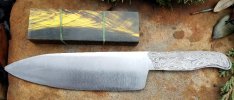
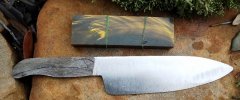
Alabama02s.jpg Alabama03s.jpg
Well, i finally started making progress on this. I never did finish the kitchen knives I was working on, and decided to get the primary grinding done on this one. Also, I selected the handle material.
 
Back
Top