
-
The BladeForums.com 2024 Traditional Knife is available! Price is $250 ea (shipped within CONUS).
Order here: https://www.bladeforums.com/help/2024-traditional/
You are using an out of date browser. It may not display this or other websites correctly.
You should upgrade or use an alternative browser.
You should upgrade or use an alternative browser.
Thicknessing knife scales
- Thread starter golfer1
- Start date

- Joined
- Feb 17, 2009
- Messages
- 7,310
For scales, after mounting them I sand them flat both sides.
I then determine what thickness I want at the front, middle and butt.
I mark that thickness on the edges with a scribe, narrow up front, wide at the middle and narrow at the butt for example. I then grind the scales close to those marks and then work in the contours.
I then determine what thickness I want at the front, middle and butt.
I mark that thickness on the edges with a scribe, narrow up front, wide at the middle and narrow at the butt for example. I then grind the scales close to those marks and then work in the contours.

- Joined
- Sep 21, 2014
- Messages
- 3,111
My solution is to do most of the shaping before attaching the scales. First I use the grinder to get a truly flat surface on each scale. Then I cut the scales to a rough shape of the handle, oversizing it a bit that I deal with once the scales are attached. Then I use a height gauge and grinder to make sure each scale is the same thickness. Then use the same gauge to scribe a line around the bottom of the scale to mark the borders of bevels I want, again grinding this before attaching the scales. Once I'm happy with the rough shape, I attach the scales and once the epoxy has cured, off to the belt grinder to grind off the excess of the corby bolts/pins (I suggest grinding each one only a short bit at a time, going back and forth from one pin to the other (i.e. Pin#1 side A > Pin #2 side A > Pin #1 side B >pin#2 side B, etc) and dunking in water as needed to keep the pins cool and not have them burn a ring around the pin). Then I round out the angles and do the final shaping on the grinder, then a bit of gentle hand sanding with a progression of 800g-1000g-2000g, but I like completely polished pins. I caution you to be careful with the final hand sanding because the handle material is softer than the pins, and if not careful, even with the 2000g, you'll remove scale material quicker then the pin material (not sure if this is true with the carbon fiber rods) you'll be able to feel the pin protruding from the scale, and while fixable, it takes a lot more time and care to make sure you are sanding only the pin and not the scales.
Sorry for being so wordy, but I am Italian....
Sorry for being so wordy, but I am Italian....

KnuckleDownKnives
Time to make the doughnuts..
- Joined
- Feb 12, 2015
- Messages
- 1,715
My method is the same as Adam's.
Start out with everything flat, mark the front middle and heal with scribe lines. Grind from front to middle and then heal to middle. Then contour and finish. I find this method easiest for keeping everything even.
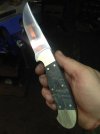
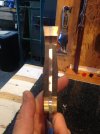
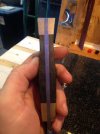
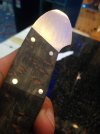
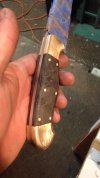
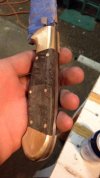
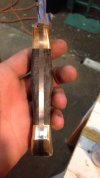
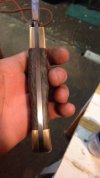
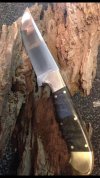
Start out with everything flat, mark the front middle and heal with scribe lines. Grind from front to middle and then heal to middle. Then contour and finish. I find this method easiest for keeping everything even.

- Joined
- Dec 5, 2013
- Messages
- 1,180
Since you asked about thicknessing and not shaping so much, I use this to evenly thickness my scales before installing.
Mini Drum Sander
For me, having accurately thicknessed scales is the key to getting good clean profile finishing.
Bob
Mini Drum Sander
For me, having accurately thicknessed scales is the key to getting good clean profile finishing.
Bob

- Joined
- Sep 21, 2014
- Messages
- 3,111
I guess I left that part out. After making sure the inside is dead flat, I then use the height gauge set to the thinner of the two and then scribe a line all the way around the thicker scale and then sand/grind to this line. I've also done a few without worrying about this, merely making sure I get the sides symmetrical when shaping...

- Joined
- Oct 3, 2002
- Messages
- 12,297
I just eyeball everything. 
- Joined
- Feb 17, 2009
- Messages
- 7,310
That must be one tough eyeballI just eyeball everything.

- Joined
- Oct 3, 2002
- Messages
- 12,297
Yea, I had to start wearing glasses.That must be one tough eyeball


