"Thin" blade. How long would you go?

Joined
Aug 12, 2006
Messages
1,302
Just out of curiosity, how large of a blade would you guys make out of 1/8th inch steel? I know there is no “black and white” in the discussion and of course there are too many variables to make anything definitive but I mean generally speaking for an outdoor-woodsy-camping-hunting-anything but the kitchen, knife.

What brings this up is a severe screw up on a knife I was working over the weekend. The blade on this one is 7” long and about 1.5” wide Elmax with a full flat grind and a harpoon. I really liked the design and didn’t want to screw up my plunge so I used a file guide and ended up busting the shoulder very badly. I started out with a thickness of ~.15” and after all the flat grinding to fix it I was left with ~.13. That .02 makes a big difference but it still feels pretty good and all is not lost. :)

So, not only how long would you go on .125” but how about .098”? I have some more Elmax (.098") I was planning to make ~4.25 blades with but I almost never see FFG that thin at 1.5” wide. I’m not sure that I trust myself yet with a Scandi but a half height grind should be no problem if I have to go that route.

Thanks!
 
Last edited:
I did a kitchen knife in 1/8" O1. It was 11" blade, 3" wide with a almost full flat grind. No issues with it whatsoever. I have a couple 6" 1/8" knives that are holding up well. 4" is definitely not a problem.
 
I have a 10" blade 3V light machete. It is about 1.5" wide. I have used it for a lot of brush clearing and kitchen use. It is around .015 behind the edge and .140" spine. A very light and fast slicer.
 
ETA: By far the most common mistakes made by newer makers and buyers of custom knives are to use stock that's way too thick, not too thin, and to quit grinding too soon.


So, not only how long would you go on .125” but how about .098”?

It depends mostly on how flexible you want the blade to be. You might be surprised how much heavy chopping you can do with a 14"-18" blade that's less than .100" thick... like nearly every machete on the planet ;) Granted, machetes aren't generally FFG, but you get my point.

7" x 1.5" x .130" is frankly a pretty solid knife for anything but serious prying, especially with a good tough steel like Elmax. 4.25" x 1-1.5" x .098 with a FFG will make an outstanding cutter and slicer. Keep the batonning within reason, and don't pry with it.
 
Last edited:
.125" isn't thin in a blade. I make kitchen and fillet knives with 10"-12" blades in .060". I have long fillet knives in .090-.100" that have 16" blades. These are plenty stiff.
 
Ha! That's why I used quotes! I agree that .125 isn't "thin" but .098 on a hunter style knife with a width of 1.5" and a FFG may actually be "thin". No?
 
I made a small kitchen knife for a friend on 15n20, .010" behind the edge .065" stock, and she loves it.
 
...but .098 on a hunter style knife with a width of 1.5" and a FFG may actually be "thin". No?

No. FFG .098" on a 4-4.25" hunter is not at all too thin. I question why one would want a hunter blade 1.5" wide, though. .75" - 1" wide is plenty for anyone I've ever asked.
 
Yeah, tall, definitely, too thin? Definitely not. Hell I wouldn't even call anything over 0.10 "thin". You'll start being amazed how well knives cut when you start trying to find out how thin is too thin.

Like everything there are exceptions to every rule. You don't want to make a deferentially hardened (edge quenched, clay coated, etc) knife that's thinner than say 0.070 at the ricasso in many cases because they'll easily take a set if bent, and bend easily, just as an example.
 
Thanks guys! Like most new knife makers (and buyers) I had to get the "thick knives are cool" thing out of my system. I now look at those 3/16 beasts and wonder what the hell good they are for! I'm moving thinner but taking baby steps. Looking at the .098 it seems thin but I know that is just my inexperience.

Actually, the first knife (mentioned above) that I will be working in the .098 has a height just over an inch at the ricasso. The bar stock was 1.5. It may not be the most practical design but, like starting thicker, it's just a learning phase and I'll get serious with practicality down the road. Maybe I'll post a pic if anyone cares to see.
 
I keep a blade at my shop simply for demonstrating you don't need a thick knife. It is .120 at the spine,1-1/4" tall,5" long blade.It is 1084 fully hardened and tempered to 59Rc.
When someone comes over and wants to make a 1/4" thick blade I take mine out and use a 4lb hammer to drive it through a 2X6 cross grain.Then ask why they need 1/4".
So far it has been hammered through about 20 times and has not broken...yet,but when it does I'll check the grain size.

Stan
 
I now look at those 3/16 beasts and wonder what the hell good they are for!

They're heavy, that's what they're good for.

I'm not being a smart-alec; sometimes you really do want the extra weight to help pull a powerful chopping blow through whatever you're cutting. There will always be market for the thick, 9-10" big bruisers like Busse and Becker make, and most competition cutting knives are 3-4 times thicker than anyone would reasonably recommend for a hunter or utility/bushcrafter. But those are highly specialized, and I wouldn't want to clean a fish, field-dress a deer or prep my supper with one.

Maybe I'll post a pic if anyone cares to see.

Of course we would :)
 
Wow Stan, some impressive test and I know I'd be swayed.

Thicker knives have a place but I was referring to MY 3/16", which suck and have no place.

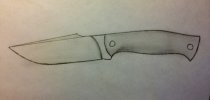
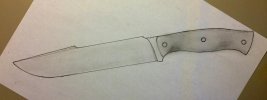
A couple of drawings... I've seen some real nice design drawings here lately but my skills aren't to that level. In my defense I spend less than five minutes on a drawing with just a pencil and eraser.MK2.JPGMK1.jpg
These two are pretty much the same except for the blade length.
 
I like both those drawings quite a bit! On the larger one, keep in mind that even if the ricasso is 3/16" or even 5/16", full distal tapers on both the tang and blade will remove a noticeable amount of weight, help you achieve a quick, lively balance, and the knife will still have a great deal of strength. You're trading some of that extra weight I mentioned earlier for greater speed, cutting ability and comfort.

There is a vast difference between "sharpened prybars" and properly-tapered blades in they way they cut and chop, and how much they fatigue the user. There is very little difference in how strong they are. (assuming the same stock thickness/steel/HT, of course)
 
Wow Stan, some impressive test and I know I'd be swayed.

Thicker knives have a place but I was referring to MY 3/16", which suck and have no place.

A couple of drawings... I've seen some real nice design drawings here lately but my skills aren't to that level. In my defense I spend less than five minutes on a drawing with just a pencil and eraser.View attachment 369050View attachment 369051
These two are pretty much the same except for the blade length.

Pretty nice, but unless it's a fighter and you need to do back cuts, why would you want that sharpened spine ?

If they are fighters, then I think the little one is too little for that.
 
Thanks James. I hear you 100%.

Count- I wish I had a better explanation as to the "why" of it but like I said I have a couple of more things to try and get out of my system before I settle down and work on the practicality aspect. I am VERY much still learning and trying out different ideas just for the sake of the experience and the fun. I'm not trying to sell anything or tout them as a revolution in tactical design or usefulness. If they turn out well at least I'll get a kick out of 'em. But of course you are right. When I mature (right around the corner I'm sure :)) I'll take the overall picture into consideration a bit more.

Thanks!

Eta- yikes! I am starting to sound like that guy that won't except good advice because they once saw something in a movie and now they know better than everyone with years of experience. Trust me though, I'm really not like that. I just have to make a damn 'poon!
 
Last edited:
Back
Top