Thin is in!

I have all 4 of my Phil Wilson knives that are a lot thinner than that with the thinnest being .006" behind the edge to .002" behind the edge at the tip and my 20CP Para 2 that was reground to .008" behind the edge and last is my Alan Davis folder that is .015".

Wow.... I would love to cut with any of those. After using the thick knives that I have grown accustomed to I can only imagine the performance of those things.
 
Wow.... I would love to cut with any of those. After using the thick knives that I have grown accustomed to I can only imagine the performance of those things.

Lets just say I have seen down force well under 10 LBS slicing through 5/8" Manila rope and as low as 5 LBS.

The typical Production blade starts at 15 LBS.
 
We aren't talking about spine thickness. You can have a spine that is 5 mil thick but if the knife is ground well it will still slice like crazy. Take the Microtech Socom Elite for example. It has a beffy 5 mil thick blade, but behind the edge it is only .6mm thick thanks to the aggressive flat grind.

Spine thickness doesn't have as much to do with cutting performance as people make it seem. :)

With that said, normally knives do cut better when the stock is thinner, but it's not always the case.

Spine thickness has a lot more to do with it than you are thinking, regardless of the flat grind. Go cut an apple with a 5mm thick blade... Once you pass the height of the blade into the apple it just acts like a big wedge. A thin blade will inherently cut better and wedge or break the apple less.
 
Spine thickness has a lot more to do with it than you are thinking, regardless of the flat grind. Go cut an apple with a 5mm thick blade... Once you pass the height of the blade into the apple it just acts like a big wedge. A thin blade will inherently cut better and wedge or break the apple less.

As you said it depends on the media, the reason why kitchen knives are very thin, I am talking about good ones here not the junk that people buy at Wally World.
 
Spine thickness has a lot more to do with it than you are thinking, regardless of the flat grind. Go cut an apple with a 5mm thick blade... Once you pass the height of the blade into the apple it just acts like a big wedge. A thin blade will inherently cut better and wedge or break the apple less.

Well of course, that's why kitchen knives are always super thin.

My post was more to mean that thin spine doesn't always = good slicer, and thick spine doesn't always = bad cutter. :)
 
The distal taper on the Para and Military is a main reason why they slice so well compared to others with the same blade thickness, and same thickness behind the edge. With most cuts the whole blade goes through what you are cutting from mid blade to the tip. That much distal taper leaves you with a thin tip, but will cut better than one with less distal taper, given they start at the same blade thickness.
 
If someone could answer a few questions that would be great.

Is the reason ( Ankerson ) your Phil Wilson customs able to be taken to such an acute angle due to his precise heat treatment? Or is it certain properties of the steel he is using?

2nd: Are there certain steels that have the ability moreso than others to hold an extremely acute edge? And if so does this come down to heat treat methods or steel properties?
 
The answer is both from what I understand. HT and steel used can make for some extremely thin knives.

I wish I had calipers to measure a blade I reground, manix 2 that I turned into a high flat instead of hollow ground.

the lowest setting of the Edge pro Apex leaves an edge that's very short, push cuts very well, unfortunately the 154CM can't handle much that thin other than meat and vegetables.
 
Para 2, the perfect knife. Millie the perfect big knife. Try them and see!
 
If someone could answer a few questions that would be great.

Is the reason ( Ankerson ) your Phil Wilson customs able to be taken to such an acute angle due to his precise heat treatment? Or is it certain properties of the steel he is using?

2nd: Are there certain steels that have the ability moreso than others to hold an extremely acute edge? And if so does this come down to heat treat methods or steel properties?

Heat treatment, tempering, high hardness AND the steel all are part of it along with his extreme knowledge and abilities.
 
Spydercos likely have a good rep also for lower factory edge angles. Reducing the angle will improve cutting performance more than thinning the grind. Doing both will of course increase the performance. But, halving the included edge angle improved CATRA tests about 5 times, halving the thickness improved results about 1.2 times.
 
"thin" is relative. it is all about geometry. You can have a knife that is 1/2 inch thick at the spine, but if it is 5 inches wide and .020 at the edge, then it will probably cut pretty well if you can manage to pick it up.:D What puzzles me is when I see some bushcraft knives that are 4 inches long a hair over an inch wide and 1/4 thick with no taper at all except for where the bevel rises to meet the tip in the last 1/2 to 3/4 inch of the blade. What's up with that?:confused:
 
Heat treatment, tempering, high hardness AND the steel all are part of it along with his extreme knowledge and abilities.

I was watching a video of Sal talking about the Spyderco rendition of the Southfork. He mentioned Phil could keep his rockwell hardness to within one point of what he wanted. I believe it was because he placer lasers to monitor the heat in his heat treating oven. I thought that was pretty cool.
 
Spydercos likely have a good rep also for lower factory edge angles. Reducing the angle will improve cutting performance more than thinning the grind. Doing both will of course increase the performance. But, halving the included edge angle improved CATRA tests about 5 times, halving the thickness improved results about 1.2 times.

By lowering the edge angle one is also thinning out the grind around the edge some because they have to remove metal to do that.

But then it depends on how thin the grind is behind the edge in the 1st place also.
 
Last edited:
I was watching a video of Sal talking about the Spyderco rendition of the Southfork. He mentioned Phil could keep his rockwell hardness to within one point of what he wanted. I believe it was because he placer lasers to monitor the heat in his heat treating oven. I thought that was pretty cool.

He has a custom furnace and has extremely accurate Temperature monitoring.
 
I know I've shown this off a few times but it is my yardstick to compare slicing ability. It's .013 behind the edge with a 25deg inclusive edge. Mmm K390 at 64rc

DSC_0895.jpg


But my answer is "yes" to the OP. Thin is in!
 
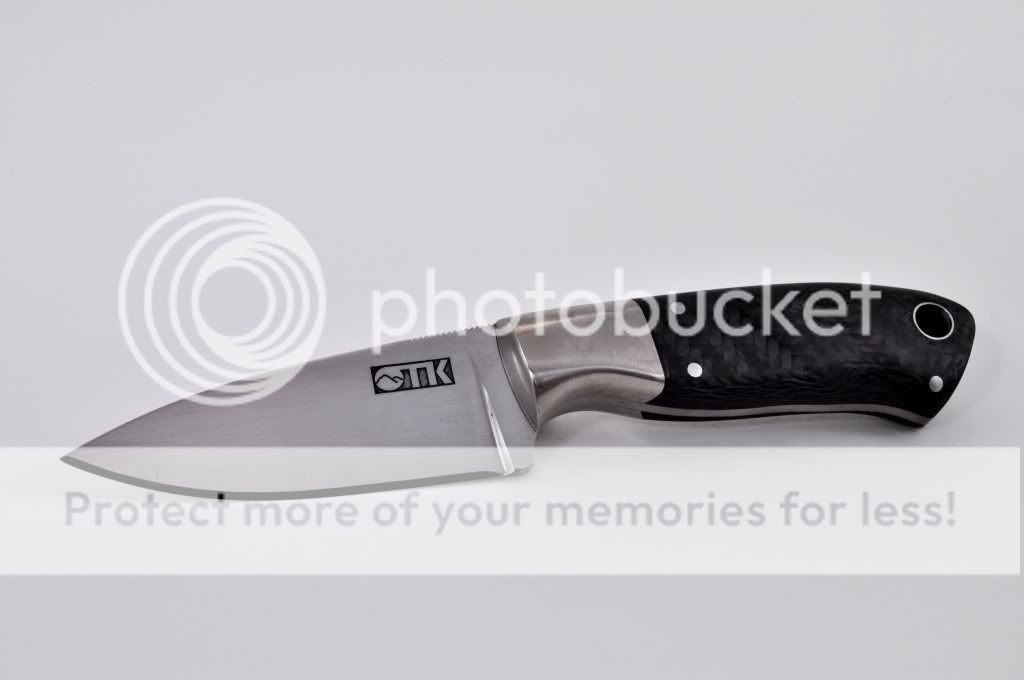
Tom Krein would put a 0.010" finish behind the edge on his regrinds. It almost feels like it disappears, when you pinch the blade and slide it off perpendicular to the edge.

Slice, it does.;)
 

Attachments

  • 1-29-09-Krein-Bump-Grind.JPG
    1-29-09-Krein-Bump-Grind.JPG
    44.5 KB · Views: 6
Back
Top