Since one member thinks I am a fantasy knife snob, I will give you my advice on how to proceed. I don't like most fantasy knives like this one because the make a poor knife, not because they are a fantasy. I realize that Gill Hibben amd many others make unbelievable knives in the fantasy realm. It isn't usually practical, and often not even hardenable steel. Just because I don't care to build them doesn't mean I want to exclude other from doing it.
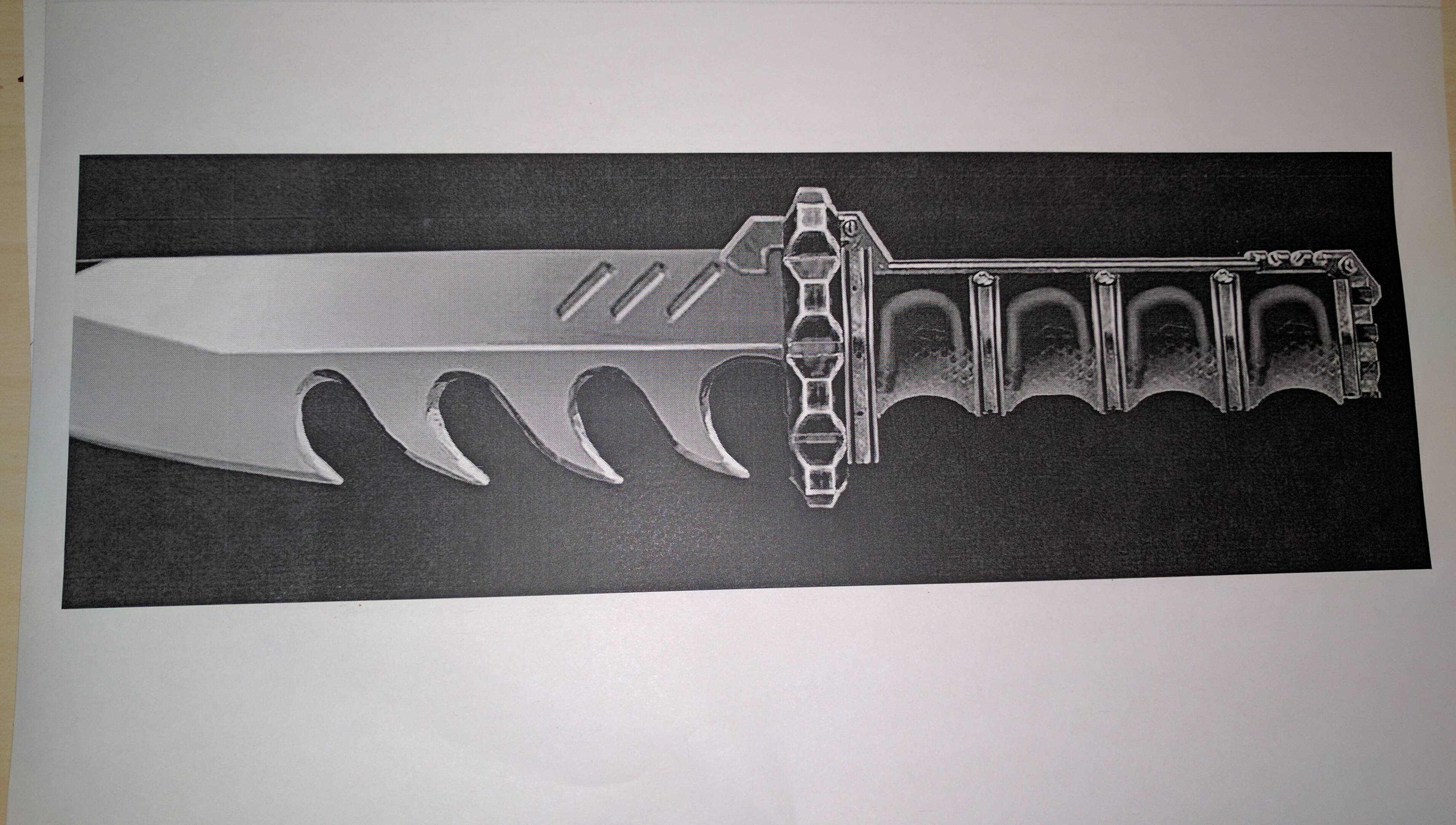
Fateofone - I got your emails. I will make my suggestions here so the others can add anything to them they might have for you. As I said earlier, one problem with a fantasy knife from pictures/anime/etc. is that it never was real. You can have all sorts of features drawn, but they may be impossible to make. Other features may look cool, bit actually be either useless or a bad idea. I will address those first, then suggest some build options.
The deeply "toothed" blade with the sharp edges on the teeth is both useless and a place where the blade would easily break. In use, they would make the knife grab or jam on anything cut or stabbed. They are just fantasy overdone string cutters.
All the steampunk screws and stuff on the handle have no function, and are mere decoration. These can be kept, but don't need to be actual structural components. I like steampunk, so I would make them one of the main parts of the project. Many of the screws can be merely glued in blind holes.
This would be a complex build for a machinist, difficult for most makers, and very difficult for a new maker.
OK, here is what I see in building the knife. Understand - THIS ISN'T GOING TO BE SIMPLE UNLESS YOU HAVE GOOD EQUIPMENT AND SKILLS - and it isn't going to be a good knife.:
1) The main blade can be pretty much as you wish, but seriously consider getting rid of the teeth. The blade would be simpler and more usable if the teeth were gone. They could be simulated by filing in fairly deep and tall scallops and leaving the edge serrated about 1/4" deep, thus creating "faux-teeth".
I would build it as a stick tang. The blade ricasso and tang should be flat and the same thickness. The tang should be as wide as needed for strength. I would say 1/2" is a minimum width. It should extend most of the way back in the handle.
2) The handle will be best built as a frame handle. This will allow the whole handle assembly to be built as a unit and installed on the tang with a couple screws or pins ... or just epoxied in place.
A frame handle is what you might call a handle sandwich. It has two outer pieces that are the scales, and a center filled with one or more other pieces.
To start, make a set of three pieces that are the full profile of the handle as in the photo. Simplest way would be to print three photos of the handle, scaled to full size. Cut them out and glue one on a piece of steel the thickness of the blade and tang. Glue the other two on thinner sheets of metal ( I would pick brass), about 20 gauge would be right. The brass/steel look would be very steampunk, as well as make features like the dental notches on the butt show as two-tone. The thicker piece will be the mortise of the handle. You place the finished blade on it and mark around the tang. This will be sawn out so the tang fits reasonably snug in the mortise. The other two pieces are placed over this in alignment and are usually pinned together to make the inner part of the sandwich. Additionally, soldering the frame seams together with soft solder ( stay-brite) is a very good idea. Once the tang pocket is finished, the handle is made completely off the blade, and the blade installed in the last steps.
NOTE - The projection at the ramp on the core piece should be cut back before assembly as needed to allow the blade to slide between the outer pieces to create the top "wrap" effect of the ramp. I would also take that tiny notch out of the bottom of the ramp piece to make assembly easier if it were me, but it can stay if you want it.
This three piece core makes the whole frame handle a pocketed piece that will slide on the tang. In assembling this core, don't worry about the outside shape and features until after the pocket is made and fits the blade and tang right. Once the core and sides are assembled, the perimeter can be sawn to shape, filed and worked, etc.. Use a jewelers saw, a band saw, and files to get the final bumps and indents of the perimeter as a whole piece.
The scales are best made in canvas Micarta (black, brown, camo - whatever color you want) . It is easy to saw and shape, and will have the right look and grip. Use files and sandpaper to get the finger grooves as you wish. When finished and sanded to 400 grit, give a light buffing and they should look great. The scales will be glued on the frame and held with two or three pins that go through the tang that can be located under the metal bands. Alternately, the scales can be screwed on the frame through the tang with two screws. Corby bolts would work well for that, or any type of sex-bolt you like. Chicago screws would allow taking the scales on and off. The metal bands would be screwed/pinned in place after the scales are installed. One good trick is to temporarily mount the scales on the frame with a few drops of super glue. Then after all the preliminary shaping, just tap them with a mallet from the side ( or wedge a thin knife blade under them) and they will pop off. Another trick if the scales will be assembled with bolts of pins through the tang is to assemble with wooden dowels glued in place with a few drops of super glue. After all the shaping is done. carefully drill out the wood and remove the scales for any final steps, then assemble with epoxy and metal pins.
My choice would be to use black Micarta pins and scales to make the assembly easier. The pins will match the handle and be nearly invisible, so they don't need to be hidden under the metal bands. The places that sell the Micarta scale material usually sell the pins, too.
The "guard" would be easiest to do in two pieces. One being the fluted front piece, and the other the plainer collar. I would make each separately and finish them, then assemble them with to or four pins/rivets/screws as one piece for ease of fitting and installation. Screws from the front would really add to the steampunk look. I would soft solder them together to fill and seal the seam between them, but that isn't a requirement. The tang slot is cut in the assembled guard so it will slide on the tang and seat on the blade shoulders at the ricasso. The rear collar can be pre-cut with a larger t5ang slot, as it does not show. The front guard needs a snug and clean slot because it shows at the ricasso. A notch/slot would be cut in the top of the assembled guard for the ramp pieces to pass through. This is why I suggested not bothering with the tiny notch in the ramp bottom, as it just complicates things unnecessarily and will barely be seen.
BTW, knifekits sells all sizes and head types of screws in gold, black, and shiny steel. They also sell the Micarta.

 ]
]


