Japanese knives seem to have taken a healthy price bump recently, maybe around 33%? I might be inclined to wait and watch those prices to see if they settle down.
I transitioned from very good quality German style knives to similiar quality Japanese knives over the last few years. The edge geometry of the Japanese knives (together with steel that will function with the thin edges) gives a clean, effortless cut or slice, and I much prefer using them to the serviceable German knives I previously used.
I'll give you some advice I picked up on this forum when I was shopping for my first Japanese knives. The thinner blades and very fine sharpening angles make for a delicate edge. That's why they need to be made of harder (and less tough) steel; softer steel would be rolling and chipping like mad if ground to those specs. The user's technique is a lot more important when using a thin Japanese edge compared to a thicker, industrial-strength German style edge like my old Burgvogels!
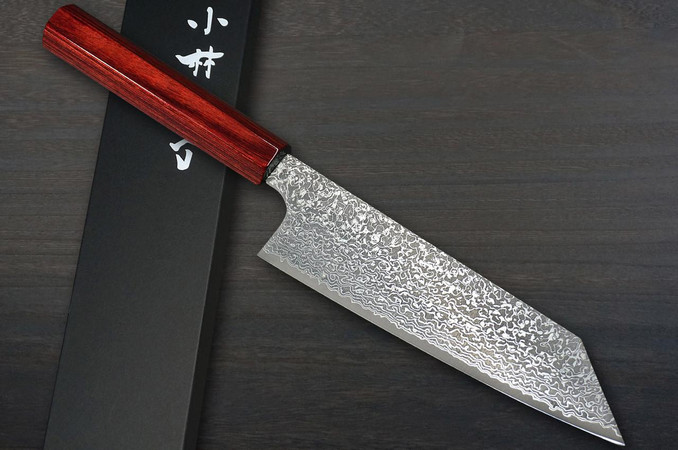
You can chip an edge or snap off a tip very easily, so a $4K knife is probably not the best place to start. Consider a $400-500 Kei Kobayashi as a safer introduction to the style. It will be like flying a space ship compared to your Wusthof's dump truck. If you damage that edge, and it happens all the time, it's not a tragedy.
Kei Kobayashi R2 Black Damascus Super Finish CS Japanese Chef's Bunka Knife 170mm with Red Lacquered Wood Handle

www.hocho-knife.com
This Yoshimi Kato bunka or k-tip santoku has an SG2 core and a black chrome Damascus finish. The blade was $310US and the black and light-colored buffalo horn handle brought the price close to $400. Light as a feather and a dream to use, and I am not afraid to use it.
Silver 3 san mai (three-layer) blades with cypress wood and buffalo horn handles. Very light and beautifully balanced, these knives are totally cool if you are cooking for two or for ten. $230-250. I mounted the handles with epoxy. These knives are available with or without handles, but I like finding the elegant handles! Nice looking, work really well, and if your wife ***** them up, it is no big deal. I gave these as gifts, and the folks that got them are ecstatic.
Pro chef's clean their knives constantly so they don't cross-contaminate dishes, and they build clean-up/maintenance time into their day. The knives are are cared for. Home cooks tend to sit down and eat after they use their knives, and the blades can sit for hours, even overnight, without being cleaned. This doesn't work with AO 1 as it is very prone to corrosion. Modern stainless is so good that you gain practically nothing by using white or blue. Years ago it was different.


 www.chefs-edge.co.nz