Hi HeavyHanded,
I guess the point is solder is very soft and ductile, but has almost zero elasticity? I don't know, but I would be concerned about the following: if the solder has any degree of elasticity, then it may "spring back" slightly after the knife edge is removed. If you want to measure sub-micron features on the knife edge, it would not take much for this to affect the results. I don't know if this is an issue. But if it is, I imagine it would also affect the surface texture, such as scratches etc. The other thing I don't know is how pure the solder is; if it has various inclusions and impurities which might show up, but not actually represent the knife's surface. In practice, it could be neither of these are problems, but I think they would have to be tested for.
As for Verhoeven's electron microscope pictures: On page 5 of his tech report, Verhoeven says,"The majority of the experiments" in the report were sharpened to a included angle of 44 degrees. Most of us here use something around 30 degrees, but I don't think the 7 degrees per side affect his images too much. One incredible strong-point of the SEM is a fantastic depth-of-field, which is why most of his images can look directly into the knife edge. If you look at his pictures, even parts of the knife more than 10-20 microns are in focus; and this distance is in the plane of the photograph. If you do the trig for 22 degrees, then that represents a depth-of-field which is at least 24.8-49.5 microns, if not much larger.
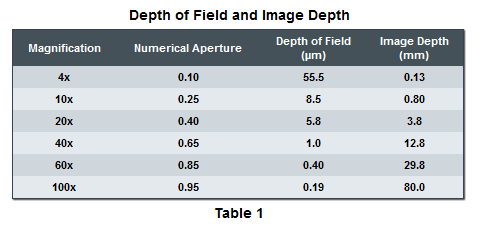
By contrast, for an optical telescope, the depth-of-field is a fraction of a micron; for an objective at 100x, it might be as small as 0.2 microns. See the column labeled "Depth of Field" in this table from Nikon (this is for the magnification of just the microscope objective):
http://microscopyu.com/articles/formulas/formulasfielddepth.html
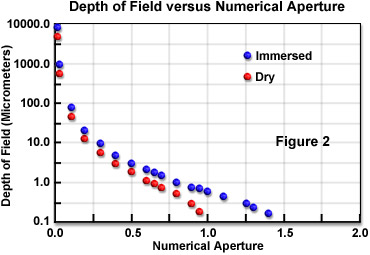
Here's another chart for the depth-of-focus as a function of Numerical Aperature of the objective. For high magnification, the numerical aperature will approach 0.75 to 1.0 (or higher if you use immersion) for an optical telescope. At those ranges, the depth-of-field is around a micron or less. If the sharpness of the knife is already 0.4 microns, then your depth of focus is not much bigger than the roudness of the "ridge" you want to measure, which can make things difficult.
http://microscopyu.com/articles/formulas/formulasfielddepth.html
Verhoeven mentions on page 2, that "One of its [the SEM's] outstanding features is that the depth of field is much improved over the optical microscope, on the order of 300 times better. Hence, the SEM is capable of providing clear images of the edge of sharpened knives at magnifications up to 10,000x." (Brackets mine.) So SEM's have a huge advantage over optical microscopes in depth-of-field. This is why the SEM can look directly into the knife edge and give useful images.
Sincerely,
--Lagrangian
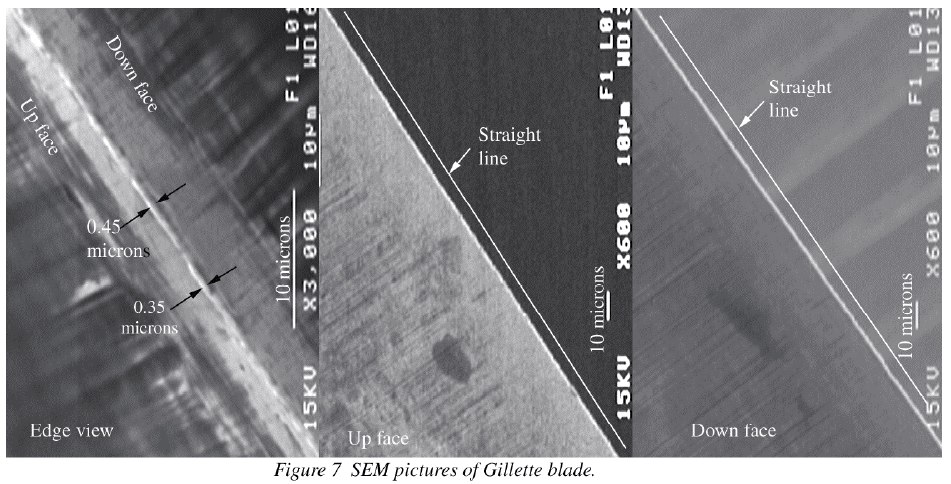
P.S. If you unfamiliar with Verhoeven's electron microscope pictures, here is a random example of one. If you're confused, just note that there are three images. In the first image you are staring directly into the knife edge, which runs diagonally from top-left to bottom-right. This means both of the two bevels of the edge are visible and on the two sides of the edge. You can think of this as looking straight down on a mountain ridge. The next two images are from two the sides of the knife, so in each image you only see one bevel of the edge.
From these types of images (and others) Verhoeven was able to measure the sharpness of a modern razor blade at about 0.4 microns or so. Please note that this is a Gillette razor blade, so the included angle is relatively small (maybe 15-19 degrees inclusive), so within the plane of the image, the depth of focus appears to extend less than 10 microns to each side of the edge.
P.P.S.
Sources:
Prof. Verhoven's tech report:
http://www-archive.mse.iastate.edu/...te.edu/static/files/verhoeven/KnifeShExps.pdf
Nikon's microscopy web page:
http://microscopyu.com/