Thoughts on fixing this...

Joined
Nov 29, 2010
Messages
1,320
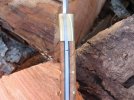
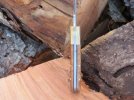
This was to be my 2012 KITH knife. While drilling the weight reduction holes, I got close to the bottom of the tang. Real close. But I thought nothing about it because there was still metal left so I went about my business.

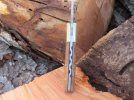
However, after gluing up the scales and finishing them and the bolsters, I decided it needed just a touch more taken off the bottom. I completely forgot about how close that one hole was. When a tiny black speck showed up after grinding, I thought it might have been a speck of epoxy so I laid it back on the grinder. The "speck" grew and I figured it was something on the belt so I cleaned it and tried to "grind the speck off" again. When the "speck" was larger I took my awl and tried to clean it. Only after the tip of the awl went into the "speck" did I realize what happened. It was such a disappointment because this was the first knife I tried metal bolsters on and I felt they turned out well for my first try. I have several friends who want this knife even with the hole and I'm thinking about giving it to one of them for Christmas.

My thoughts were to fill it either with JB Weld or Acraglas. I'm leaning toward Acraglas because I can warm it and it will get real thin. I then plan on using an old injector syringe to fill the 1/4" size reduction hole. I'm sure there will always be a "speck" there, just now it'll be filled with something. You thoughts on what you'd do?
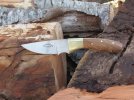
IMG_0035.jpgIMG_0038.jpgIMG_0040.jpgIMG_0041.jpg
 
Nice lines and detail on the knife. For the area where you went into the hole, I see a couple options, other than leaving it. (Which isn't so bad)
-Make it symetical either squared off or drill / grind it out with a very fine bit. Nothing much more than skin deep, so to speak, if you fill it with black epoxy.
-Fill it with a brass insert to match the bolsters. I'm thinking brass rod can be shaped to match the hole, slightly tapered so it creates a seamless fit when tapped in.
 
That is a sad thing when it happens ( and it does happen). You can leave it as is and use the knife. It will always remind you of the error.

A fix would be to carefully take your dremel and a 1mm cylinder burr. Carefully cut the damaged spot on the spine into a straight slot. Go down into the opening below to get at least 1/4" of space below the new slot. Take a small needle file and make the slot as perfect as possible. Take a piece of brass, gold, steel, etc., That is the exact width of the spine. File it to a slightly tapered rectangle that fits the slot. Once it is fitted so it goes at least 1/8" in the pocket, put some epoxy in he pocket, tap in the plug, and let it cure. Once fully cured ( a day or two) carefully file the plug flush and sand even.
 
If it makes you feel any better, I've done that a couple times, too. :o
 
Thanks for the responses. I like the idea of trying a brass plug. I'll dig through my dremel bits and see if I have a burr that small. If not, I'll check out Lowes. I did think about leaving it this way, but was afraid contaminants such as blood and water would get in the hole. Plus, I just didn't like the way it looked. Never thought about using brass or something else to fill the hole with. Thanks again for the suggestions.
 
I've done that once.....then did it a second time!! I think I have learned my lessoon?? I ended up keeping one as a user in the shop and gave the other to a friend.
 
Here are my thoughts. Most mistakes I can fix, but every once in a while I do something like that. I have sanded into the tang hole of a hidden tang, or had a full tang grind just go awry. If your name was not on it, I would say to just give it to one of your friends. Since you have already etched your logo on it, use it as a test knife. Beat it silly and see how it holds up. You may find that you nailed things and you may find other things that need to be different. The reason I suggest this is that you never know what will happen down the road to one of your knives. I occasionally see one of my older knives turn up here on the forum in the "for sale" thread and I cringe. I wish I made them differently 5 years ago, and I suspect that in 5 years I will wish I had made them differently now. All that to say that you don't want to send out a knife with your name on it to the public with an obvious flaw, you don't know how many future customers may be turned off by it. Also, testing knives is a great thing and really eye opening. One thing I see is that some of your pin holes are really close to the edge of the handle. That only gives a few millimeters of wood between the pin and the edge. You may find that during testing and with moderate abuse the wood tends to chip and crack in those areas.

On the other hand, this is just my opinion and you can do whatever you want.
 
Thanks for the additional recommendations guys. It's going to a friend, but only after I attempt to fix it with some brass. Should be interesting.

@Matt. This was one of those knives where I initially profiled it and drilled the holes and then decided to "fine tune" the handle a little more. That's why some of the pin holes are close to the edge and ultimately, why I ground into the weight reduction hole. I've gotta learn to leave stuff well enough alone! I periodically test my knives by cutting various materials and comparing those results against some production knives as well as a few custom knives from various makers (no Bailey knives yet, but if you'd like to "donate" a sample knife...;) ) Every once in a while I'll break one just to see the grain pattern but it's rare when I do that.

@James. Well, knowing some others have done this does make it a little easier to handle, but it being my KITH knife makes it blow big time. I had two alternates ready to go, but after looking them over after the accident, they were kinda plain and I didn't want to enter a knife just to get one in return.
 
There are two types of knifemakers:
The kind who have done this type of thing............And liars.
 
Back
Top