Thoughts on Heavy Mistresses

Joined
Feb 18, 2003
Messages
496
If one reads about the old-style Bowies of the 1830's, one discovers that many of these knives had a very large chassis. It was commonn for Bowies to have ten to twelve inches of blade forged out of 3/8' thick steel. That would make the FBM-LE, the FMFBM's and the FFBM very similar in heft to these frontier knives. We have to ask ourselves, why do most people consider these knives too heavy nowadays? Maybe our ancestors considered the heavy Bowies as "more bang for the buck" for frontier chores and wanted the extra weight to make faster work of their daily routines. I think also that people back in those days had no cars, no telephones no power tools.They had to work harder and more physically than we do. That made them stronger, so they considered these large blades as "normal". The human race is getting wimpy. Remeber how tough those old-timers were?Using these big Busse Mistresses might give you a more real idea of how frontiersmen worked and allow you to feel the heft of an historic weapon. Lend me $1,600 'cause I wanna buy a couple of historic toys!
 
No offense Alex but the museum pieces I've seen are no where near that big. The common "camp" knife sized blades was much more common.
 
The way to compensate for poor steel is to add thickness.

If I bought a 3/8" thick Busse and a 3/8" other maker blade, it would take a lot more effort to show the performance difference. With INFI, the thicker blades just aren't necessary. The thinner knives are where Busse can outshine other makers.

This video clip shows a lower end Busse family knife with a 3/16" blade. :thumbup:

Howling Rat Video
 
way off here. First off the bowies you talk about were typically show pieces and not what was really in use. Even the original Bowie from the Sanbar fight was more of a butcher knife/cleaver.

But as for those big bowies even look at the bagwell bowies and the like copies from ontario. They are 0.3 inches thick but the blade width is minimal and they do not have full tangs so the overall weight is not there.

The most common frontier blades of the time were typically under 1/4 inch thick and about 8.75 inch blades. You can still get these frontier blades as they pop up on ebay every so often. I have missed a few, but they have a very interesting design.
here is a pic and this was about one of the biggest "REAL" knives carried by frontiersmen, not showman cowboys who never went anywhere and did broadway productions.

hbkpic.gif

description is here:
"Overall length of the knife is 14-1/8 inches, blade is 8-7/8 inches long and 1-7/8 inches wide by 1/4" thick. The blade is marked Jukes Coulson Stokes & Co. Sheffield., Handles are walnut panels, held by four rivets. Ferrele & Rivet heads: brass approximately 1/32 inch thick."
 
The way to compensate for poor steel is to add thickness.

True in part - that's why many kukris are so outrageously thick. But that's not the only reason for thick blades. Thickness translates to weight and weight translates to chopping power. I find an FFBM much more effective than a CGFBM when it comes to chopping - and both are far too big for reasonable performance in small work, so you're going to want a smaller knife along anyway.

I don't mind the thick Busses at all. In fact, I very much like the FFBM. :thumbup: And I don't find it too heavy to use and carry (strapped to my backpack) at all - and I'm probably one of the smaller guys in this forum. But for anything that isn't a dedicated chopper, I prefer a thinner blade. Fat GWs? Not something I'd want to use.
 
another thing to consider is the difference in materials used. I was at Nordic Knives in Solvang a while back and was able to handle a John Fitch custom Bowie, 10 3/4" long with a thick spine probably a little more than 3/4" with walnut handles and a silver gaurd and it was noticeably lighter than even my SBR. I'm pretty sure it was a tool steel but I don't know which.
 
Thickness translates to weight and weight translates to chopping power. I find an FFBM much more effective than a CGFBM when it comes to chopping...

Velocity makes a much bigger difference than mass.

Also, consider where the extra steel is added. The handle is full thickness and gets a lot of extra steel, while the blade receives little of this extra weight making the overall package more handle heavy (this is more evident on blades with full height grinds). You are exerting more effort to move the handle of the knife.

If you can get a hold of a Swamp Rat Satin Battle Rat, give that a try. That has to be the best chopper out there. 1/4" thick, light as a feather and chops wood like butter. :thumbup:

:D :D
 
IMO, to each his own I guess.
There is a point at which a knife becomes solely a chopper with little effectiveness for anything else. For years I wielded a 5 lb 22 inch HI Ang Khola which measured 1 inch thick at the spine and was convexed to the edge. If I missed a tree or large branch I could not in any way slow it down before severing a limb of my own. I had to jump out of the way of my own blade. Even my 18 inch Ang Khola was hard to stop. the FFBM is heavy enough that on a full power swing you are not likely to stop it in time to sever something you did not intend to sever. I think in this regard the CG FBM is about the limit. The fact that the NMFBM is an ounce bigger than the already way heavy FFBM only makes it even harder to stop. As a chopper it will have no equal in the busse lineup, but as a general use large blade it will be severely handicapped by it's own weight.

Another reason for me is that I can conceal the SHBM and the BM-E in my small day pack easily. I cannot conceal the FBM it is just a little long for the location I prefer to put my large blades. The NMFBM will be way way to long so as something I carry into the field, it will not be.

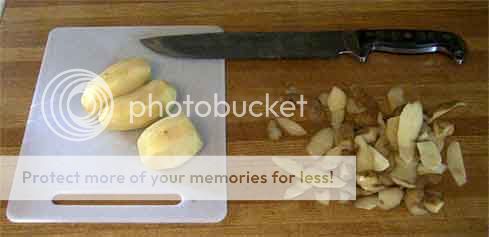
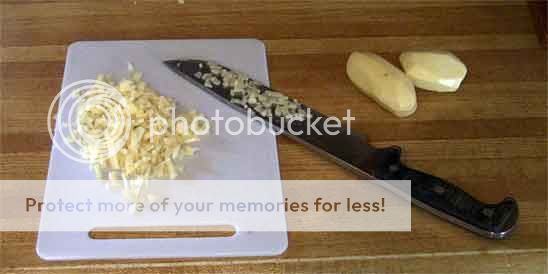
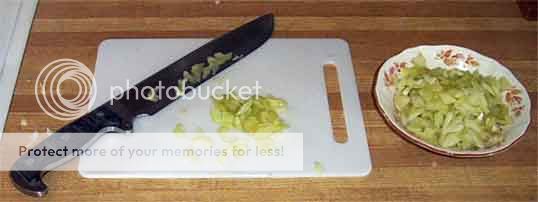
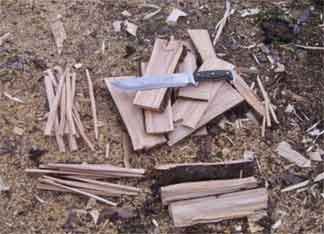
some small tasks than an NMFBM will not easily do:
shbm_potato_peeled.jpg

shbm_potato_diced.jpg

shbm_celery.jpg

shbm_apple.jpg

shbm_figure_four.jpg

shbm_batoning.jpg


yes you can do anything with a big blade, but just like big tasks take forever with a small knife, small tasks will similarly take forever with a huge knife such as this.

As for the fitch bowie, there is a lot going on there. The width of the blade is something to consider and most custom knives are stick tangs or distal taper type tangs and blades which loose weight real fast when you go away from the center of mass. It may have started at 3/4 inch thich spine but it probably came down to a point real quick and real sharp and the blade was probably around 1.5 inches wide, not the 1.9 inches your BR is which is also sabre ground. Busse knives in general retain their thick spine to within a few inches of the tip of the blade. This adds lots of weight out in front and makes for a stronger tip area.
 
If you can get a hold of a Swamp Rat Satin Battle Rat, give that a try. That has to be the best chopper out there. 1/4" thick, light as a feather and chops wood like butter. :thumbup:

:D :D


I dont have a battle rat but I have a Dog Father LE and it is the same principle imo. Its light and fast and hits very very well.
 
Velocity makes a much bigger difference than mass.

Also, consider where the extra steel is added. The handle is full thickness and gets a lot of extra steel, while the blade receives little of this extra weight making the overall package more handle heavy (this is more evident on blades with full height grinds). You are exerting more effort to move the handle of the knife.

If you can get a hold of a Swamp Rat Satin Battle Rat, give that a try. That has to be the best chopper out there. 1/4" thick, light as a feather and chops wood like butter. :thumbup:

:D :D

agreed. edge geometry also helps out quite a bit
 
IMO, to each his own I guess.
There is a point at which a knife becomes solely a chopper with little effectiveness for anything else. For years I wielded a 5 lb 22 inch HI Ang Khola which measured 1 inch thick at the spine and was convexed to the edge. If I missed a tree or large branch I could not in any way slow it down before severing a limb of my own. I had to jump out of the way of my own blade. Even my 18 inch Ang Khola was hard to stop. the FFBM is heavy enough that on a full power swing you are not likely to stop it in time to sever something you did not intend to sever. I think in this regard the CG FBM is about the limit. The fact that the NMFBM is an ounce bigger than the already way heavy FFBM only makes it even harder to stop. As a chopper it will have no equal in the busse lineup, but as a general use large blade it will be severely handicapped by it's own weight.

that is an excellent point for consideration. . . .
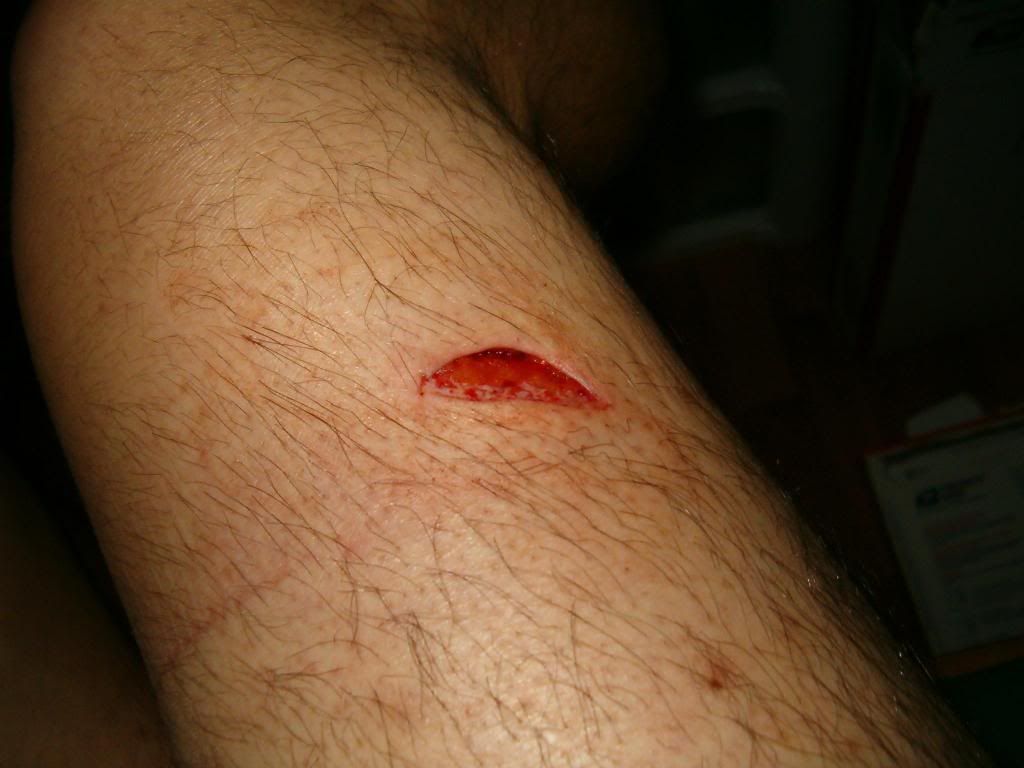
results of failing to stop a mofo (significantly lighter than FBMs) on a hard swing (which could have turned out way worse)

HPIM0586.jpg


HPIM0589.jpg
 
yup could have been much worse. The mofo is actually a very forward weighted blade as it has a drilled tang(under the micarta so I'm told) to push the weight forward. So even though it is a lighter blade than even a BM-E it has a more forward weight balance.

I remember missing a big branch with my 18 inch AK once and I swung hard enough that I knew it wasn't stopping and it was headed for my right shin(the arc my left arm created) and I just moved my right leg back and blade my torso to the right to avoid my own swing. I wish smeone had been filming me as it looked kinda funny. But it would not have been had that AK connected.
 
I don't agree with you guys that the average frontier blade was thinner . I have done a fair amount of research from what's available on the subject and believe that thick blades were common for soldiers of fortune. We have the Smithsonian - that's a museum piece. If you read The Bowie Knife by Thorp you can see that he transcripts an Englishman observations while visiting the Southwest at the time and relates that very thick and heavy blades seemed to have been in vogue at the time. Can you imagine the damage that an FFBM with a clip point could do in a knife fight. I've been chopping a good part of the day with a CGFBM and my arm is tired.
 
Sure, velocity makes a big difference. But you can't discard weight from the equation. And of course, the most important part is the guy or gal wielding the knife.

On long blades like the FBM, increasing thickness doesn't result in a handle heavy knife, since the blade is so long that even with the handle being full thickness with no grind, the handle will be too short to get heavy enough to "steal" the balance of the knife. FFBMs aren't exactly handle heavy...

It's ultimately a matter of tastes and technique. I find that even the lightest, slimmest 10" blade is far too cumbersome for any small work, or "general use", just because it's so damn long. Sure, you can do things with a knife that long, but it won't be effective and won't be comfortable. It's hard for me to see any use besides fighting and chopping for a knife longer than 7" or so of blade.

The issue with not being able to stop a swing that misses hasn't been a problem for me - I try to keep my more precious body parts out of the way of moving sharpened pieces of metal, and then I guess my experiences with swords help somewhat in terms of technique. Could be dumb drunken luck, too, I guess. :D

It may be a matter of different definitions for thick, as well. To me, .250" is thick. It's really thick. .310" is extremely thick. The kukris are just plain outrageous. I very much enjoy the FFBM as a chopper, but I don't plan to ever do any small work with it. It's too damn big for that. And it would too damn big for that even if it was just .125" thick.
 
The issue with not being able to stop a swing that misses hasn't been a problem for me - I try to keep my more precious body parts out of the way of moving sharpened pieces of metal, and then I guess my experiences with swords help somewhat in terms of technique. Could be dumb drunken luck, too, I guess.

my problem was overestimating the branch that i cleaved through.
i'm sure we all try to keep out of the way, but accidents do happen, and there's a lot of potential for them to be really bad.
also, i have significant experience with swords (european longsword) but that doesn't really translate well to a knife
 
also, i have significant experience with swords (european longsword) but that doesn't really translate well to a knife

Translates well enough for me when the "knife" has a 10" long blade like an FFBM. The weight is certainly more like to that of a longsword than of a traditional puukko type of knife. Certainly isn't the same thing as a sword, though, with the obvious differences in design and intended use. But just like I wouldn't try to carve myself a spoon with a longsword, I wouldn't try it with an FFBM either. :eek:
 
I don't agree with you guys that the average frontier blade was thinner . I have done a fair amount of research from what's available on the subject and believe that thick blades were common for soldiers of fortune. We have the Smithsonian - that's a museum piece. If you read The Bowie Knife by Thorp you can see that he transcripts an Englishman observations while visiting the Southwest at the time and relates that very thick and heavy blades seemed to have been in vogue at the time. Can you imagine the damage that an FFBM with a clip point could do in a knife fight. I've been chopping a good part of the day with a CGFBM and my arm is tired.

Well you may disagree but your still wrong:D and your research is where?;)

I have done tons of research as well and have actually collected frontier blades for nearly 16 years. I have sold most off in the 2000 to 2002 period. The real original bowie made for bowie disappeared at the Alamo. The Iron Mistress is all BS as is the Randall copy of it.

The knife Bowie used in the San Bar fight was more akin to a pointed butcher knife than what you would call a bowie knife. In fact there was a picture of the knife that Bowie had before he even had his design made in blade magazine around 2000. The kife actually looks very similar to an SHBM or to a south american gaucho style knife.

Yes, there was some really big bowies out there in use. But if your looking at the bowies that people had for show pieces to emulate Bowie is one thing and those vaired in size from 7 inch blades to 13 inch blades. Thickness varied as well but many of them tapered severely and were light, kind of like bagwells design. Some were heavy but again they were showoff pieces. In fact if you had an FFBM and your enemy had a Bagwell, I would not give 2 cents for your survival. It's all about speed. you cannot wield an FFBM fast.

The true Frontier knife was also a solid chunk of a knife, it was by no means thin, but it also wasnt a monster although in it's time it may have been considered such. But it was meant for hard use not fighting and below is a typical example of just such a knife.

"The Hudson Bay Camp Knife
by Fred Holder

In the February 1994 issue of Blacksmith's Gazette, we addressed some of the most common items of ironwork made by today's blacksmiths for the muzzle loading trade. Knives are another item much used by the muzzle loader shooter and re-creator. During the fur trade era, the time frame many of the buckskinners emulate, a great number of knives were imported from England for trade with the Indians. Many of these knives were also used by the trappers who went to the mountains in search of the beaver. One type of knife much favored by trappers was imported by the Hudson Bay company from the English shops of Sheffield during the first half of the nineteenth century in fairly large quantities.

The knife depicted here is a close copy of a Jukes Coulson, Stokes & Co. knife illustrated in Figure 45 of Firearms, Traps, and Tools of the Mountain Men by Carl P. Russell. The thick horn scales on the original knife are held to the hilt by oversized rivets holding brass washers and by a heavy metal ferrule riveted to the front end of the hilt. The blade is about 8-1/2 inch long but of such thickness and shape as to be quite stiff. Russell states, of the knife, "Here is a knife made to order for the hunter or cook responsible for breaking out chunks of carcasses of the game animals to be served up to trappers. This type of knife was for a time sufficiently stable to give it a recognized place in the inventories of the fur companies and was commonly dubbed the Hudson Bay Knife." The specimen illustrated in Russell's book is owned by the U.S. National Museum. Russell notes that The Museum of the Plains Indian, Browning, Montana also has one like it, except that a third big rivet takes the place of the ferrule on the hilt. Other specimens are owned by the Museum of the American Indian and the North Dakota Historical Society, Russell says.

hbkdwg.gif


This is a copy of the drawing provided by Ike Bay. It was taken from a drawing done by Richard E. Sverdrup of Longview, Washington in 1971. Overall length of the knife is 14-1/8 inches, blade is 8-7/8 inches long and 1-7/8 inches wide by 1/4" thick. The blade is marked Jukes Coulson Stokes & Co. Sheffield., Handles are walnut panels, held by four rivets. Ferrele & Rivet heads: brass approximately 1/32 inch thick.

The author first became acquainted with this type of knife in 1983 when Ike Bay sent in a drawing of the Hudson Bay Camp Knife. The drawing had been made after the knife illustrated in Russell's book. Subsequently, a knife was made to the specifications on the drawing using a piece of 1/4 inch by 2 inch leaf spring as the stock and birdseye maple scales. The knife was forged to general shape and was then filed and ground to final shape. It was left in the annealed state since it was planned to be used as a camp knife for splitting wood for the campfire. It has served the author well over the last dozen years although it has had some pretty rough treatment. It is still used to split wood both for campfires and for wood turning.

When putting on the scales, the cutlers rivets that were available were not long enough to go through the scales and the thick blade; therefore, they were recessed into the scales and brass disks were inlaid over the top of them to give the appearance of large washers. The scales were also epoxied to the blade. The brass plates at the front end of the hilt were simply epoxied to the scales. They were never riveted as they should have been and one of the plates in now missing.

hbkpic.gif


This is a photograph of the knife that the author made using the drawing provided by Ike Bay as reference. The blade was made from 1/4 inch by 2 inch leaf spring and the handle scales were made from birdseye maple. All other fittings were brass.

This was an interesting project which resulted in a very fine camp tool when it was completed. Tapering a piece of 1/4 inch by 2 inch spring steel to a wedge cross section was a lot of hammer work. I did it with a four pound short-handled hand hammer, but would have found it easier with a striker swinging an eight or ten pound sledge. In any case, the result was worth the effort.

This knife should be a good project for blacksmiths serving the muzzle loading sport, or for a muzzle loader who is doing a little blacksmithing to complete his "outfit."

This article was originally printed in the March 1994 issue of Blacksmith's Gazette. It has been edited to fit the format of our Blacksmith's Gazette Internet Site
.
"


These things pop up on Ebay all the time as there were tons of them made. This is by no means a wimpy knife it is basically in between an SHSH and an SHBM in size and it is a 1/4 inch thick.
 
Sure, velocity makes a big difference. But you can't discard weight from the equation.

Comparing the CGFBM and the FFBM is hardly discarding weight from the equation. The CGFBM has plenty to work with. ;)

However, I will say that if the added weight means that I swing the knife slower, then that has made a huge negative impact on the total force of the swing. In other words, if I exert the same amount of effort (work) using a CGFBM as I would have to with the FFBM, the CG would be the clear winner.

On long blades like the FBM, increasing thickness doesn't result in a handle heavy knife, since the blade is so long that even with the handle being full thickness with no grind, the handle will be too short to get heavy enough to "steal" the balance of the knife. FFBMs aren't exactly handle heavy...

I agree. Because of the blade length, the FBM would never become a handle-heavy knife. That isn't the case with most steel hearts and smaller blades though.

Good discussion. :D :D
 
Cobalt, I don't think you can just call me wrong . Check out this link which I picked up in 2 minutes of googling. It is a historic Bowie from 1860 and it is 3/8 in. thick. http://www.hylandgranby.com/marine_antiques_paintings_details.asp?itemID=I00771

Have a look at the size of Sam houston's Bowie which was recently sold. It was huge and it is validated as belonging at one time to Sam Houston. I'm not talking about a Buffaloe skinner's knife, I'm talking about a Big Bowie. The Sanbar knife wasn't the design that we call Bowie. Take a look a Rudy Ruana's site. he was an old timer and he says that the giant Bowie knife that he produces at 3/8" is the most authentic Bowie type. Look at other replicas in historic societies such as the Bridger Bowie. The Iron Mistress was built according to historical research. I don't know if there really is a Smithsonian Bowie in Washington. But I have heard that the knife really exists and that it is thick . Maybe the majority of the knives extant from the period are thinner. That does not mean that the military elite did not carry big honkers. Lastly I would like to mention Mr. Raymond Thorp which did A LOT of research not only into Bowies but into Western History. He is one of the pioneers in frontier research and although not a History Professor was no slouch . In his book he quotes from "British Correspondences Concerning Texas " which was published in 1861 where a British Officer states, regarding the Bowies on sale at the best cutlers in the area, "In weight it was heavier than the heaviest Oriental handjar or poignard, and in its whole character it strongly reminded me of the short heavy Roman gladium." Yeah they're all wrong along with me. I would say that the jury is still out on this one, so before you accuse someone of being wrong, at least hear what they have to say and don't dismiss them so quickly. As Shakespeare said "There are more mysteries between heaven and earth, Cobalt, than your vain philosophy can imagine." Just kidding, but lighten up.
 
Back
Top