So I have a CS titanium Ti-Lite. The blade is loose but the pivot and handle screws are tightened. No side to side play but up and down play. How exactly am I supposed to fix it to either lessen or stop the play entirely? Are these models easy to take apart?

-
The BladeForums.com 2024 Traditional Knife is available! Price is $250 ea (shipped within CONUS).
Order here: https://www.bladeforums.com/help/2024-traditional/
You are using an out of date browser. It may not display this or other websites correctly.
You should upgrade or use an alternative browser.
You should upgrade or use an alternative browser.
Ti-Lite Repair
- Thread starter Fortino
- Start date

- Joined
- Jul 23, 2015
- Messages
- 19,738
So I have a CS titanium Ti-Lite. The blade is loose but the pivot and handle screws are tightened. No side to side play but up and down play. How exactly am I supposed to fix it to either lessen or stop the play entirely? Are these models easy to take apart?
It (original Ti-lite 4) should be easy to take apart, as it's all-screw construction. You'll need a few torx drivers. I can't say for sure what size screws the original Ti-lite 4 used, but my Zytel handle Ti-lite 4 requires a T10 torx driver for the pivot screw, and a T6 torx for all other screws. There might be thread locker on the screws. If there is, and if the screws cannot be easily removed with moderate force, you might need to apply heat to the screw to loosen the thread locker, but I've disassembles many Ti-lites, and never had any difficulty.
As for the looseness of your blade, it sounds like the lock has worn down and it isn't locking up properly. I've seen this before. Of course I haven't examined your knife to be certain.
If the problem is a worn lock, I know of three solutions to tighten it back up, some more difficult than others, but none are simple.
1. The most difficult method is to make a new, custom blade stop, one slightly large in diameter between the liners. This would cause the blade to stop sooner causing an earlier lock-up. But this would be a very involved process and require machining skills.
2. The second method is easier, but still requires some craftsmanship. It requires making a small stainless steel sleeve to fit over the original stop-pin (between the liners) so that the blade will stop sooner, and create an earlier lock-up. This method requires minimal craftsmanship, as all you really need to do is measure the diameter of the stop-pin, search the internet for a piece of stainless steel tubing with an inner diameter that is just a decimal fraction larger than the stop-pin, figure out how thick you need it to be to move the blade forward to the necessary degree, and cut a piece off to fit between the liners. I have purchased stainless steel tubing from McMaster-Carr and on Amazon. I have also used a section from a stainless steel snap for the sleeve on a Ti-lite 4 (see link posted below).
Those first two methods may require a little steel to be removed from the side of the blade tang where it contacts the stop pin when the knife is closed, otherwise the blade detent might not engage. Also, this method will cause the blade to angle slightly forward when open and locked because the blade is stopping sooner. The angle should be barely noticeable, if it is noticeable at all. They are also methods I have used to straighten Ti-lite blades that were angled slightly backwards from the factory by moving the blade a fraction forward.
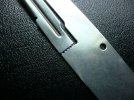
3. The third method is depicted in the picture below. It involves stretching the liner lock to produce an earlier lock-up. You don't need to make anything, but it requires some tool use. The tools required are a pointed punch with a rounded tip, a hammer, and a metal base that can be used as an anvil (like a vise, or a thick plate of steel, etc). Here's how it goes- take the knife apart and separate the liner lock completely from the rest of the knife. Place a piece of scotch tape (thin clear tape) across the base of the lock where the end of the lock meets the rest of the liner on the inside portion of the liner (not the handle side). Use a Sharpie and ruler to draw a line across the tape at the very point where the lock meets the base. Use masking tape to secure the liner to your metal base with the inner side of the liner facing up (handle side facing down). Then use the punch and hammer to create a line of shallow divots across the Sharpie line and across the entire width of the lock where it meets the rest of the liner.
Producing such divots will push the metal outward from the divots, and since the lock is the smallest portion next to the divot being hammered, the lock will be pushed upward (stretched). I recommend the scotch tape because it will grip the punch just enough to prevent it from sliding around when you're positioning it on the line to hit with the hammer. The masking tape is to hold the liner still and prevent it from jumping when you hit the punch. The tip of the punch MUST be rounded, not pointy, because you just want to dent the metal, you don't want to pierce it. The tip of a pointy punch can be rounded using a sharpening hone or diamond file. You want the tip of the punch, and your divots, to be at least 1 millimeter in diameter, but not too much bigger.
The divots need to be shallow, you just want to dent the surface of the lock. Hit the punch with mild force. Better too light than too hard. If the divot isn't deep enough you can punch the same spot again, the existing divot will hold the punch in place for a follow-up hammer strike.
The divots/dents you punch need to be close together, but you want to try and make every divot a clean and separate divot with a fraction of space between them. It's not a problem if a few of the divots merge, or if the line of divots isn't perfectly in line, it happens. You will also want to avoid punching at the very edge of the liner, or the punch might slide over the edge and leave a gouge across the edge of the liner. And it might be necessary to punch more than one line of divots to stretch the lock enough and produce the desired degree of lock-up. Punch one complete line, assemble the knife, test the lock-up, and if it's still loose, or if the lock is almost all the way across the tang of the blade, take the knife apart and punch another line just above the first, then reassemble and test again.
I have performed all of these methods on various Ti-lites I have had, both the Ti-lite 4, and Ti-lite 6, and they all worked very well.
I hope something in this post helps you. Good luck. I'm happy to answer any questions you might have.
Another option might be to purchase a new Zytel handle Ti-lite 4 and swap out the liner with the lock. But I can't confirm that this would work. From what I have seen the old titanium Ti-lite 4's have more screws on the back handle and liner than the modern knives.
Here is a thread where I provided some of the same advice to another person with this issue (worn out lock). Although I don't think I mentioned making a new stop-pin (something I started doing later)- https://www.bladeforums.com/threads/original-4-ti-lite-parts.1984573/#post-22582479
This is the lock of one of my Ti-lite 6's. This picture was taken before I discovered the scotch tape trick.
Last edited:
- Joined
- Mar 11, 2021
- Messages
- 182
The original titanium Ti-Lites liner lock is made of titanium. Unfortunately, after a lot of repeated use they are notorious for developing blade play up and down. I don't know if the stainless-steel liner lock from newer models could be swapped out or not.
Thank you so much for all of the input. I did forget to mention that it is a titanium handled Ti- Lite. It does hand a little bit of side to side play too I have found. When closed it is off center. And to top it off, one of the handle screws is stripped. This is a diamond in the rough but I love this model.It (original Ti-lite 4) should be easy to take apart, as it's all-screw construction. You'll need a few torx drivers. I can't say for sure what size screws the original Ti-lite 4 used, but my Zytel handle Ti-lite 4 requires a T10 torx driver for the pivot screw, and a T6 torx for all other screws. There might be thread locker on the screws. If there is, and if the screws cannot be easily removed with moderate force, you might need to apply heat to the screw to loosen the thread locker, but I've disassembles many Ti-lites, and never had any difficulty.
As for the looseness of your blade, it sounds like the lock has worn down and it isn't locking up properly. I've seen this before. Of course I haven't examined your knife to be certain.
If the problem is a worn lock, I know of three solutions to tighten it back up, some more difficult than others, but none are simple.
1. The most difficult method is to make a new, custom blade stop, one slightly large in diameter between the liners. This would cause the blade to stop sooner causing an earlier lock-up. But this would be a very involved process and require machining skills.
2. The second method is easier, but still requires some craftsmanship. It requires making a small stainless steel sleeve to fit over the original stop-pin (between the liners) so that the blade will stop sooner, and create an earlier lock-up. This method requires minimal craftsmanship, as all you really need to do is measure the diameter of the stop-pin, search the internet for a piece of stainless steel tubing with an inner diameter that is just a decimal fraction larger than the stop-pin, figure out how thick you need it to be to move the blade forward to the necessary degree, and cut a piece off to fit between the liners. I have purchased stainless steel tubing from McMaster-Carr and on Amazon. I have also used a section from a stainless steel snap for the sleeve on a Ti-lite 4 (see link posted below).
Those first two methods may require a little steel to be removed from the side of the blade tang where it contacts the stop pin when the knife is closed, otherwise the blade detent might not engage. Also, this method will cause the blade to angle slightly forward when open and locked because the blade is stopping sooner. The angle should be barely noticeable, if it is noticeable at all. They are also methods I have used to straighten Ti-lite blades that were angled slightly backwards from the factory by moving the blade a fraction forward.
3. The third method is depicted in the picture below. It involves stretching the liner lock to produce an earlier lock-up. You don't need to make anything, but it requires some tool use. The tools required are a pointed punch with a rounded tip, a hammer, and a metal base that can be used as an anvil (like a vise, or a thick plate of steel, etc). Here's how it goes- take the knife apart and separate the liner lock completely from the rest of the knife. Place a piece of scotch tape (thin clear tape) across the base of the lock where the end of the lock meets the rest of the liner on the inside portion of the liner (not the handle side). Use a Sharpie and ruler to draw a line across the tape at the very point where the lock meets the base. Use masking tape to secure the liner to your metal base with the inner side of the liner facing up (handle side facing down). Then use the punch and hammer to create a line of shallow divots across the Sharpie line and across the entire width of the lock where it meets the rest of the liner.
Producing such divots will push the metal outward from the divots, and since the lock is the smallest portion next to the divot being hammered, the lock will be pushed upward (stretched). I recommend the scotch tape because it will grip the punch just enough to prevent it from sliding around when you're positioning it on the line to hit with the hammer. The masking tape is to hold the liner still and prevent it from jumping when you hit the punch. The tip of the punch MUST be rounded, not pointy, because you just want to dent the metal, you don't want to pierce it. The tip of a pointy punch can be rounded using a sharpening hone or diamond file. You want the tip of the punch, and your divots, to be at least 1 millimeter in diameter, but not too much bigger.
The divots need to be shallow, you just want to dent the surface of the lock. Hit the punch with mild force. Better too light than too hard. If the divot isn't deep enough you can punch the same spot again, the existing divot will hold the punch in place for a follow-up hammer strike.
The divots/dents you punch need to be close together, but you want to try and make every divot a clean and separate divot with a fraction of space between them. It's not a problem if a few of the divots merge, or if the line of divots isn't perfectly in line, it happens. You will also want to avoid punching at the very edge of the liner, or the punch might slide over the edge and leave a gouge across the edge of the liner. And it might be necessary to punch more than one line of divots to stretch the lock enough and produce the desired degree of lock-up. Punch one complete line, assemble the knife, test the lock-up, and if it's still loose, or if the lock is almost all the way across the tang of the blade, take the knife apart and punch another line just above the first, then reassemble and test again.
I have performed all of these methods on various Ti-lites I have had, both the Ti-lite 4, and Ti-lite 6, and they all worked very well.
I hope something in this post helps you. Good luck. I'm happy to answer any questions you might have.
Another option might be to purchase a new Zytel handle Ti-lite 4 and swap out the liner with the lock. But I can't confirm that this would work. From what I have seen the old titanium Ti-lite 4's have more screws on the back handle and liner than the modern knives.
Here is a thread where I provided some of the same advice to another person with this issue (worn out lock). Although I don't think I mentioned making a new stop-pin (something I started doing later)- https://www.bladeforums.com/threads/original-4-ti-lite-parts.1984573/#post-22582479
This is the lock of one of my Ti-lite 6's. This picture was taken before I discovered the scotch tape trick.
View attachment 3138014

- Joined
- Mar 31, 2012
- Messages
- 3,410
Could he also find someone with a carbidizer to add carbides to the top of the liner?It (original Ti-lite 4) should be easy to take apart, as it's all-screw construction. You'll need a few torx drivers. I can't say for sure what size screws the original Ti-lite 4 used, but my Zytel handle Ti-lite 4 requires a T10 torx driver for the pivot screw, and a T6 torx for all other screws. There might be thread locker on the screws. If there is, and if the screws cannot be easily removed with moderate force, you might need to apply heat to the screw to loosen the thread locker, but I've disassembles many Ti-lites, and never had any difficulty.
As for the looseness of your blade, it sounds like the lock has worn down and it isn't locking up properly. I've seen this before. Of course I haven't examined your knife to be certain.
If the problem is a worn lock, I know of three solutions to tighten it back up, some more difficult than others, but none are simple.
1. The most difficult method is to make a new, custom blade stop, one slightly large in diameter between the liners. This would cause the blade to stop sooner causing an earlier lock-up. But this would be a very involved process and require machining skills.
2. The second method is easier, but still requires some craftsmanship. It requires making a small stainless steel sleeve to fit over the original stop-pin (between the liners) so that the blade will stop sooner, and create an earlier lock-up. This method requires minimal craftsmanship, as all you really need to do is measure the diameter of the stop-pin, search the internet for a piece of stainless steel tubing with an inner diameter that is just a decimal fraction larger than the stop-pin, figure out how thick you need it to be to move the blade forward to the necessary degree, and cut a piece off to fit between the liners. I have purchased stainless steel tubing from McMaster-Carr and on Amazon. I have also used a section from a stainless steel snap for the sleeve on a Ti-lite 4 (see link posted below).
Those first two methods may require a little steel to be removed from the side of the blade tang where it contacts the stop pin when the knife is closed, otherwise the blade detent might not engage. Also, this method will cause the blade to angle slightly forward when open and locked because the blade is stopping sooner. The angle should be barely noticeable, if it is noticeable at all. They are also methods I have used to straighten Ti-lite blades that were angled slightly backwards from the factory by moving the blade a fraction forward.
3. The third method is depicted in the picture below. It involves stretching the liner lock to produce an earlier lock-up. You don't need to make anything, but it requires some tool use. The tools required are a pointed punch with a rounded tip, a hammer, and a metal base that can be used as an anvil (like a vise, or a thick plate of steel, etc). Here's how it goes- take the knife apart and separate the liner lock completely from the rest of the knife. Place a piece of scotch tape (thin clear tape) across the base of the lock where the end of the lock meets the rest of the liner on the inside portion of the liner (not the handle side). Use a Sharpie and ruler to draw a line across the tape at the very point where the lock meets the base. Use masking tape to secure the liner to your metal base with the inner side of the liner facing up (handle side facing down). Then use the punch and hammer to create a line of shallow divots across the Sharpie line and across the entire width of the lock where it meets the rest of the liner.
Producing such divots will push the metal outward from the divots, and since the lock is the smallest portion next to the divot being hammered, the lock will be pushed upward (stretched). I recommend the scotch tape because it will grip the punch just enough to prevent it from sliding around when you're positioning it on the line to hit with the hammer. The masking tape is to hold the liner still and prevent it from jumping when you hit the punch. The tip of the punch MUST be rounded, not pointy, because you just want to dent the metal, you don't want to pierce it. The tip of a pointy punch can be rounded using a sharpening hone or diamond file. You want the tip of the punch, and your divots, to be at least 1 millimeter in diameter, but not too much bigger.
The divots need to be shallow, you just want to dent the surface of the lock. Hit the punch with mild force. Better too light than too hard. If the divot isn't deep enough you can punch the same spot again, the existing divot will hold the punch in place for a follow-up hammer strike.
The divots/dents you punch need to be close together, but you want to try and make every divot a clean and separate divot with a fraction of space between them. It's not a problem if a few of the divots merge, or if the line of divots isn't perfectly in line, it happens. You will also want to avoid punching at the very edge of the liner, or the punch might slide over the edge and leave a gouge across the edge of the liner. And it might be necessary to punch more than one line of divots to stretch the lock enough and produce the desired degree of lock-up. Punch one complete line, assemble the knife, test the lock-up, and if it's still loose, or if the lock is almost all the way across the tang of the blade, take the knife apart and punch another line just above the first, then reassemble and test again.
I have performed all of these methods on various Ti-lites I have had, both the Ti-lite 4, and Ti-lite 6, and they all worked very well.
I hope something in this post helps you. Good luck. I'm happy to answer any questions you might have.
Another option might be to purchase a new Zytel handle Ti-lite 4 and swap out the liner with the lock. But I can't confirm that this would work. From what I have seen the old titanium Ti-lite 4's have more screws on the back handle and liner than the modern knives.
Here is a thread where I provided some of the same advice to another person with this issue (worn out lock). Although I don't think I mentioned making a new stop-pin (something I started doing later)- https://www.bladeforums.com/threads/original-4-ti-lite-parts.1984573/#post-22582479
This is the lock of one of my Ti-lite 6's. This picture was taken before I discovered the scotch tape trick.
View attachment 3138014
Could he also find someone with a carbidizer to add carbides to the top of the liner?
I think that would work. But from what I see, carbidizers are a bit pricey (even home made versions). If a person dealing with such an issue could find someone who already has a carbidizer, and doesn't charge a lot, it might be worth it. But between shipping costs and the cost of having someone do the work, a punch and hammer is likely the less expensive option.