
I know that I can't be the only one who occationally gets those annoying horizontal grind lines on a long blade. They often come when you lay the blade flat against the platen and always start at the plunge. That might be a good way of starting a plunge, but unless you tilt the tip away from the belt you end up cutting a gash with the opposite edge of the belt as well.
I was recently working on a 8" Chef knife and noticed a few of these grinding imperfections. I admit it, I get them from time to time... well, most of the time on long blades. Suddenly I remembered a trick that Dan Graves showed us at the last hammerin. If you haven't gone to one of his, you SHOULD!
His trick is to stack up a scotchbrite belt UNDER a 360 J-flex blelt on your grinder. It takes a few tries to get the tracking and lining right so they don't slip off, but my goodness, this method works great! Use it on a slack belt as you would to get a convex grind. The extra stiffness behind the J-flex helps to keep your flats straight while blending in the grinding imperfections.
I forgot to take pics, but here is a crude diagram to show what I'm talking about
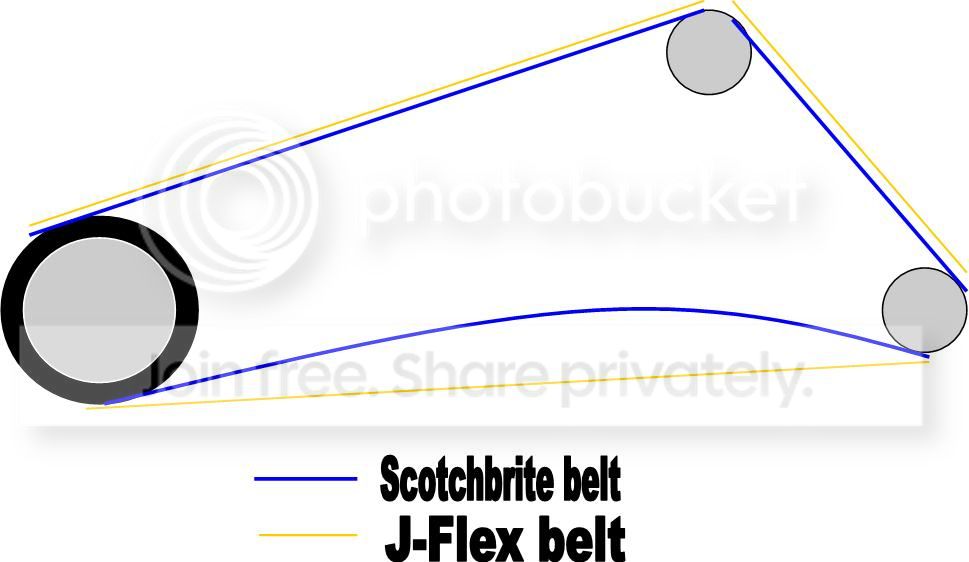
As you can see the scotchbrite belt is usually a bit longer than the J-Flex, so it will buckle/bow up. Try to make it so that happens between the contact wheel and drive wheel. I'm not sure if I tried this using a flat platen but it will certaily work as a slack belt.
Give it a try sometime. I image this method would be a good alternative to the multiplaten as it is basically the same thing - a slack belt with stiff lining underneath
I was recently working on a 8" Chef knife and noticed a few of these grinding imperfections. I admit it, I get them from time to time... well, most of the time on long blades. Suddenly I remembered a trick that Dan Graves showed us at the last hammerin. If you haven't gone to one of his, you SHOULD!
His trick is to stack up a scotchbrite belt UNDER a 360 J-flex blelt on your grinder. It takes a few tries to get the tracking and lining right so they don't slip off, but my goodness, this method works great! Use it on a slack belt as you would to get a convex grind. The extra stiffness behind the J-flex helps to keep your flats straight while blending in the grinding imperfections.
I forgot to take pics, but here is a crude diagram to show what I'm talking about
As you can see the scotchbrite belt is usually a bit longer than the J-Flex, so it will buckle/bow up. Try to make it so that happens between the contact wheel and drive wheel. I'm not sure if I tried this using a flat platen but it will certaily work as a slack belt.
Give it a try sometime. I image this method would be a good alternative to the multiplaten as it is basically the same thing - a slack belt with stiff lining underneath


