Ok. Tonight I am finally going to put polished handles on a knife. The blade tang is NOT going to be polished. So I know it will be key to make sure not to have any epoxy ooze out from between the scales and blade tang when I epoxy the polished handles on the satin finish tang tonight. Does anyone have any suggestions on how to do this so I dont get dried epoxy on the blade tang? I assume I still want to use plenty of epoxy so I get a nice water tight seal between the blade tang and scales so the blade doesnt rust.

-
The BladeForums.com 2024 Traditional Knife is available! Price is $250 ea (shipped within CONUS).
Order here: https://www.bladeforums.com/help/2024-traditional/
You are using an out of date browser. It may not display this or other websites correctly.
You should upgrade or use an alternative browser.
You should upgrade or use an alternative browser.
Tips Needed for Epoxying Polished Handles on a Satin Finish Blade Tang
- Thread starter dzlvs8
- Start date
- Joined
- Jun 13, 2007
- Messages
- 7,743
I'm not following. Why are the scales already polished, or even fully shaped before glue up? For the best adhesion you'll need to rough up the tang and mounting surfaces of the scales.
In any case, you'll want some squeeze out if you are insuring a proper seal, or at least I do.
Unless I'm reading that wrong, you'll need lots of qtips, acetone and you should probably, very carefully, mask the scales.
Got any pics? That would help (me at least) to understand what you're working with.
In any case, you'll want some squeeze out if you are insuring a proper seal, or at least I do.
Unless I'm reading that wrong, you'll need lots of qtips, acetone and you should probably, very carefully, mask the scales.
Got any pics? That would help (me at least) to understand what you're working with.
As Stringamort says I would not have the all the parts already finished. But since you are there here is what I would do. Put vasoline or some grease of similar consistency on all the parts you do not want epoxy on. After the epoxy cures you can use a piece of wood or micarta with the end squared off to remove the epoxy. I use popsicle sticks with the end whittled square to remove the epoxy from guards and ricasso area. It will not stick to greased surfaces and should just pop off nicely. It may take a bit of pressure to remove it, but it should come off in one chunk.
There is no absolute guarantee for this priocedure, but it has worked well for me.
There is no absolute guarantee for this priocedure, but it has worked well for me.
- Joined
- Jun 13, 2007
- Messages
- 7,743
Now that I've thought about it for a minute...
I would just plan on re-polishing the scales. The tang is no big deal at all. However you finished it, it'll be a matter of a few minutes to restore it after glue up. Just get as much of the epoxy off the tang as possible while it's still soft. Don't just wipe it off once and be done with it. Check on it periodically as epoxy will seep out as it cures. Popsicle sticks are all great idea. A scrap of micarta or g10 or wood will work too.
You probably already know, but ideally, you want the area of the scales that fit against the ricasso finished because it'll be hard to do after the fact without damaging the finish of the ricasso. That's not just something I read btw. I know because I've done it.
I've done a few scales on blanks. I get the perimeter close to fitting flush with the tang all the way around, finish the front of the scales, then glue/clamp. After it cures I shape the scales and finish them.
Tang prep, that is, drilling any extra holes for "epoxy rivets", roughing the surface, making a "trough" on the face of the tang to insure space for epoxy and roughing the inside of the scales, (plus extra divots, etc) and finally, mechanical fastening, should all be planned out, and even practiced, before glue up. Wet sanding the epoxy against the tang is a good idea too.
Unless you've already looked at it carefully, check out The Weatherman(s) recent thread on how to do scales on a Spyderco Mule. Some very sound advice in there.
Here's a pic of my last glue up.
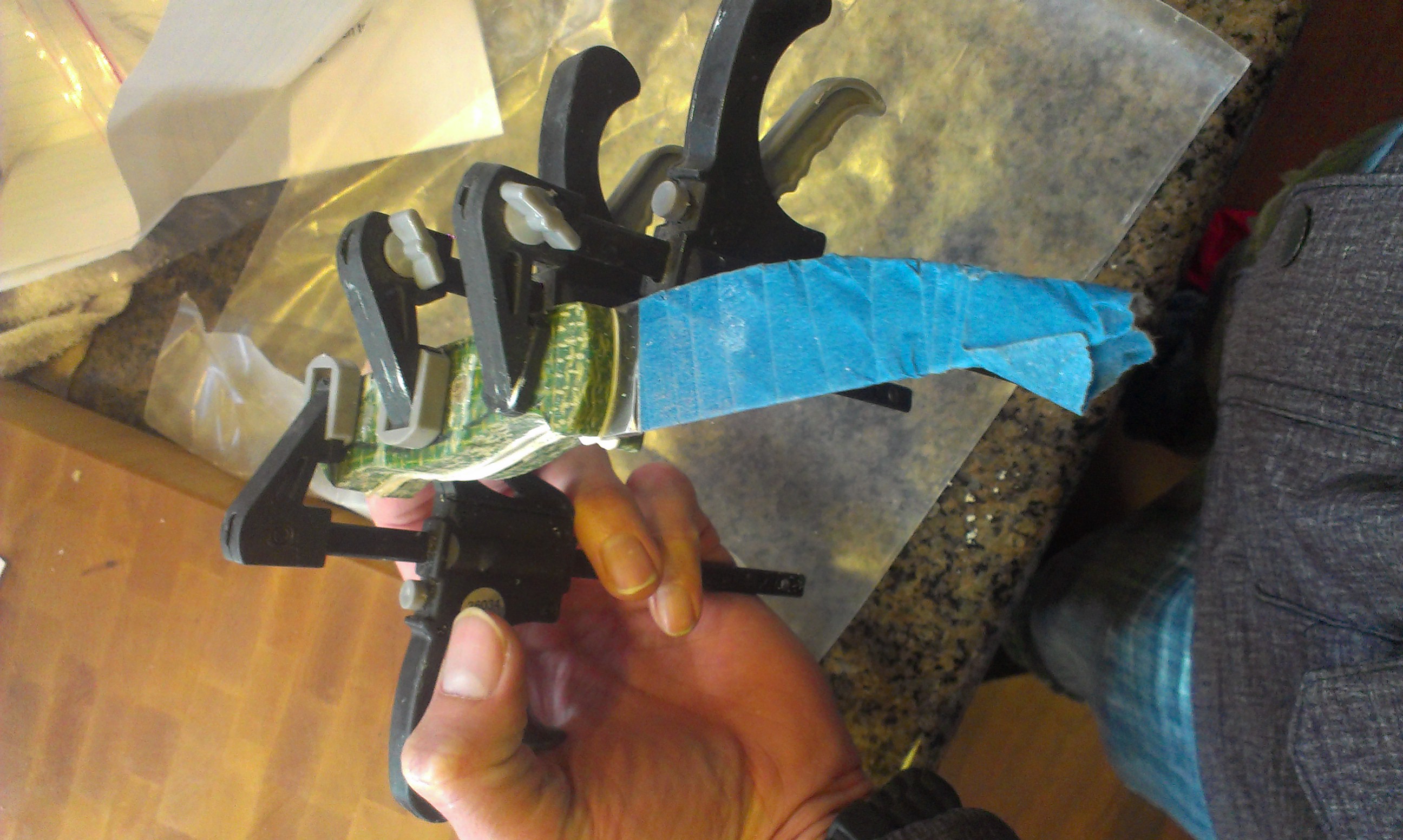
Light pressure from whatever clamps you are using is advised. Because there are liners on that one, holes were drilled through them and into the scale material being careful to not drill so deep as to have any of the holes inadvertently exposed while grinding/shaping.
Hope that helps some. If you explain a little more about what you're up against it'll help the guys that do this on a daily basis (not me haha) to better help you.
Good luck and have fun! That part of the process is my very favorite, mostly because it means that you're almost finished.
I would just plan on re-polishing the scales. The tang is no big deal at all. However you finished it, it'll be a matter of a few minutes to restore it after glue up. Just get as much of the epoxy off the tang as possible while it's still soft. Don't just wipe it off once and be done with it. Check on it periodically as epoxy will seep out as it cures. Popsicle sticks are all great idea. A scrap of micarta or g10 or wood will work too.
You probably already know, but ideally, you want the area of the scales that fit against the ricasso finished because it'll be hard to do after the fact without damaging the finish of the ricasso. That's not just something I read btw. I know because I've done it.
I've done a few scales on blanks. I get the perimeter close to fitting flush with the tang all the way around, finish the front of the scales, then glue/clamp. After it cures I shape the scales and finish them.
Tang prep, that is, drilling any extra holes for "epoxy rivets", roughing the surface, making a "trough" on the face of the tang to insure space for epoxy and roughing the inside of the scales, (plus extra divots, etc) and finally, mechanical fastening, should all be planned out, and even practiced, before glue up. Wet sanding the epoxy against the tang is a good idea too.
Unless you've already looked at it carefully, check out The Weatherman(s) recent thread on how to do scales on a Spyderco Mule. Some very sound advice in there.
Here's a pic of my last glue up.
Light pressure from whatever clamps you are using is advised. Because there are liners on that one, holes were drilled through them and into the scale material being careful to not drill so deep as to have any of the holes inadvertently exposed while grinding/shaping.
Hope that helps some. If you explain a little more about what you're up against it'll help the guys that do this on a daily basis (not me haha) to better help you.
Good luck and have fun! That part of the process is my very favorite, mostly because it means that you're almost finished.
Use a slow-setting epoxy. And keep vigilant watch after clamping up. Wipe away any excess epoxy with cotton swabs lightly saturated in acetone. Keep checking for any seepage until the epoxy begins to cure.
I've done this using rubbing alcohol and paper towels. The OP didn't say what scale material he was using, it or the finish could be affected by acetone.
- Joined
- Jun 13, 2007
- Messages
- 7,743
My apologies to Altofsky. I didn't see your post before giving the same advice.
Okay, op, just read your last reply.
When you say tang, you are meaning ricasso. So long as you manage the squeeze out you shouldn't have a problem. In the pic I posted I had plenty of it. In fact, my epoxy was colored white so keeping squeeze out cleaned up was of the utmost importance. Even so, it was just a matter of wiping it off with the above mentioned acetone on qtips.
Looking forward to seeing your work.
Anthony
Edit- dang it, my phone is slow. I wasn't aware that acetone could affect the finish on some scale material bd, but it makes sense. Op, is that stabilized wood? In any case, I'd check using acetone on a scrap of the wood (finish it how you did the front of the scales of course) to see if there's a negative reaction. I'd do that with alcohol too just for my own edification.
Or... Wait for better advice.
Okay, op, just read your last reply.
When you say tang, you are meaning ricasso. So long as you manage the squeeze out you shouldn't have a problem. In the pic I posted I had plenty of it. In fact, my epoxy was colored white so keeping squeeze out cleaned up was of the utmost importance. Even so, it was just a matter of wiping it off with the above mentioned acetone on qtips.
Looking forward to seeing your work.
Anthony
Edit- dang it, my phone is slow. I wasn't aware that acetone could affect the finish on some scale material bd, but it makes sense. Op, is that stabilized wood? In any case, I'd check using acetone on a scrap of the wood (finish it how you did the front of the scales of course) to see if there's a negative reaction. I'd do that with alcohol too just for my own edification.
Or... Wait for better advice.
Last edited:
I found that by temporarily mounting the scales over a Pc of tape applied to the ricasso and under the scales, then using a X-acto knife to carefully trim around the scales against the ricasso. Take the scales off, remove the tape that was cut to match the scale but leaving the Pc on the ricasso in place. Glue up the scales and after they set you can just remove the tape and the excess epoxy goes with it. Pretty simple and clean for me. I use a thin film tape used in powder coating but I would think packing tape or electrical tape would work ok too?
Last edited:
- Joined
- Jun 13, 2007
- Messages
- 7,743
The tape idea is something I tried but had trouble with. I didn't remove enough and inadvertently epoxied a tiny bit of painters (blue) tape under one scale. I still need to fix that on that knife. Pa's method of cutting then removing the scale sounds smart. I tried to just tape around the scale perimeter. Not so smart.
The tape idea is something I tried but had trouble with. I didn't remove enough and inadvertently epoxied a tiny bit of painters (blue) tape under one scale. I still need to fix that on that knife. Pa's method of cutting then removing the scale sounds smart. I tried to just tape around the scale perimeter. Not so smart.
Hmmm. Yeah, if I hear other people chime in with the tape method being sucessful for them, maybe I will try it. I really hate messing up knives and experimenting with a new method leaves a lot of room for error. I like the idea of just wiping it off, but I never felt that I could get it all off. I usually put my knives in a vise. I might switch to just clamps this time in order to give me easier access to wiping the handle and ricasso off. Any other recommendations on a method are welcome. I am about to go embark on shaping the handles now!

- Joined
- Jul 4, 2010
- Messages
- 873
I put the tape on and trim also. I also put tape on the front of the scales. I use scotch tape I think it works well. If I feel that I may scratch the ricasso I use a sharpened brass feeler gauge. Most sets have one and they are somewhat hardened. Jess
- Joined
- Jun 13, 2007
- Messages
- 7,743
I didn't mean to indicate that the tape method is problematic, just my method. Honestly, if simply wiping the squeeze out didn't work so well for me I'd try it.
The way I look at it, as much as I want my knives to be perfect, especially the first ones that take so much effort, I also figure it's a time for learning, experimenting and making some (hopefully) small mistakes.
Good luck with shaping. It's so much fun. Remember thin is in. And as Andy Roy says, make sure it's sexy. Take your time too.
The way I look at it, as much as I want my knives to be perfect, especially the first ones that take so much effort, I also figure it's a time for learning, experimenting and making some (hopefully) small mistakes.
Good luck with shaping. It's so much fun. Remember thin is in. And as Andy Roy says, make sure it's sexy. Take your time too.
Soooo, what I did was I tried to shave the pins down a little smaller so they would still be tight in the holes but also be a little easier to get back out. I needed to do this because I decided to take the handles off in order to polish them after shaping them while attached to the blade. That didn't work very well. When I put the handles on after polishing, the handles didn't exactly line back up with the blade, even though the blade holes for the pins were drilled for an exact fit.
Also, the other problem that this presented is that since I couldn't epoxy the handles on in my vise (because the pins were flush with the handles and not recessed, I couldn't squeeze the forward most portion of the handles with clamps. Soooo, my handles aren't flush with the tang. Luckily some black max (glossy black) super glue will seal it up and hide the flaw.
The process I did initially was terrible. It's the second time I tried the process above and it sucks.
So, after that mess I ended up reshaping the handles slightly again and then just throwing some masking tape on the ricasso to keep it from getting polished. It worked like a charm. There was no trimming of the tape involved or anything. Anyway, here is my new knife. This is the fifth knife I've made. Bevel was ground partially with a jig and partially freehand. I still have some work to do to get the grind to match on both sides at the ricasso. :/ Knife porn below...
My 5th knife. I make these in a 1 bedroom apartment and perform the heat treat on my patio!
[video=youtube;TPVOMNb4hzU]http://www.youtube.com/watch?v=TPVOMNb4hzU[/video]
Also, the other problem that this presented is that since I couldn't epoxy the handles on in my vise (because the pins were flush with the handles and not recessed, I couldn't squeeze the forward most portion of the handles with clamps. Soooo, my handles aren't flush with the tang. Luckily some black max (glossy black) super glue will seal it up and hide the flaw.
The process I did initially was terrible. It's the second time I tried the process above and it sucks.
So, after that mess I ended up reshaping the handles slightly again and then just throwing some masking tape on the ricasso to keep it from getting polished. It worked like a charm. There was no trimming of the tape involved or anything. Anyway, here is my new knife. This is the fifth knife I've made. Bevel was ground partially with a jig and partially freehand. I still have some work to do to get the grind to match on both sides at the ricasso. :/ Knife porn below...
My 5th knife. I make these in a 1 bedroom apartment and perform the heat treat on my patio!
[video=youtube;TPVOMNb4hzU]http://www.youtube.com/watch?v=TPVOMNb4hzU[/video]