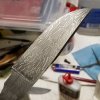
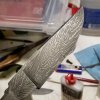
Tips on getting crushed Ws to crush?

kuraki

Fimbulvetr Knifeworks
Joined
Jun 17, 2016
Messages
4,679
I spent the better part of the day yesterday working up two billets I was intending to be crushed Ws. Each billet was identical and were as follows:
1. 18 layers of 1075 and 15n20, 1075 layers were double layers, 8" x 1"
2. Weld and draw to about 10" long, then flipped on edge and drawn/ crushed to over 16" long.
3. Cut to 4x4" lengths stacked, welded and drawn out to about 10". At this point billets width has doubled to over 2"
4. Milled edges to clean and straight, cut both billets in 3" lengths and stacked both billets together, welded and drawn out to 12" or so.

After the welding and drawing in step one, all forging was done in the crushing direction.

Chopped the lapped end off and checked the pattern:
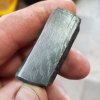
20180218_093855.jpg

On the bottom left is exactly what I was shooting for, but on the right you can see how some of the layers just upset without crushing.

So two questions. Is there a technique to getting more crush, or is it simply that I need to restack more times? Second I was hoping my next step at this point would be ferry flipping, but unsure if I should add another step or two, to try and get a better pattern.
 
Oh, forgot to mention I'm doing all the forging in my press. With large radius dies.
 
Maybe I should have started 2" wide so the first crush would have been more effective.
 
Get your billet as thin before you reorient, as you can without causing it to collapse when you do, and then take it as thin as you can and still have room to clean up, before you restack. I'd also just recommend flat dies. Radius dies are great for heavy drawing of stock, but good secure flat dies helps you keep your proportions much better for this kind of work.

Regardless, the thinner you go, the more extreme the activity of the W's, and the first draw once you reorient, is the most important here if you want big dramatic swoops, if you do it right, on a press, you can make it "too extreme". It's also important, to not press the sides after you re-orient, any more than the bare minimum necessary to keep the billet square. Once you turn it 90 deg, stay off the sides until the end, and just square it up enough to get everything reasonably straight and the corners reasonably square. Don't do any more reduction in width than you have too, you can make it narrower in subsequent stacks if necessary.
 
A number of guys crush on a bias using squaring dies before "flat crushing" the new "point" to get the W's to start forming.
 
I did read that somewhere and intended to do it but my hastily built squaring die broke last time I used it and I didn't want to half ass a repair. Looks like building a proper squaring die set and flat die set is in my future.
 
That can help, especially if you don't want to go as thin drawing, but you can get huge activity without "pre-distorting" in squaring dies, much of this technique exists IMO because drawing becomes tedious with a press after a certain point. All of these factors of course, depend entirely on the other variables though, such as initial billet size and layer count, etc.

Just knocking the corners off on the flat dies will help, but even still, it's not mandatory. Getting good "C"s on the first draw instead of "S" shapes can help you avoid one restack, but honestly I think people fixate on this more from the standpoint of creating homogeneity in their billets, which is something I let go of years ago. I simply am not trying to "tame" damascus, and have no expectations of being able to make a mosaic/end-grain that's not made from powder, exactly the same each time.

Embrace it! ;)

kuraki, are you planning to flip or loaf this, or do something else to bring the pattern to the outside?
 
I was planning to ferry flip with sacrificial plates on the pattern face to try and conserve material and do it dry (welded seams).

This is mostly a learning billet. While I'd love to see a distinct controlled pattern, I'm not currently forging consistently enough to achieve that. Flat dies, and a better system of forging press depth stops will help with that.
 
The number of layers you have is the number of rows of Ws you'll have from spine to edge. 18 is just not enough.
I normally start with 12 layer billets - since my 1095 is 3/8" thick - weld, draw out and quad-cut to re-weld so I have 48 layers of before I crush into Ws. Then X 4 X 4 for 16 layers of Crushed Ws.
6UUxXP6.jpg
 
Back
Top