to Buy or Build - Propane Forge

Joined
Jan 26, 2014
Messages
10
I have been researching propane forges and a lot of people suggest buying an Ellis from high temp tools or making one. My ultimate goals are to craft katana blades (stock removal). From there I plan to move to welding/forging blades.

1. Are 2 burners essential to heat treating a katana blade? Or is it just more time intensive and more of a margin of uneven heat error? Can I get away with a single blown burner?

2. Ellis has a nice blown single burner that is about 13 inches long. Does a blown single burner make up for not having two venturi? Would a single blown allow me to evenly heat a longer blade?

3. Some initial thoughts I had about making my own forge are to either use a 100lb Propane tank (cut down to size) or an old water heater shell (cut down to size). I was thinking of utilizing two burners in a blown setup as opposed to the venturi style. What is your opinion of that sort of setup? Would an old water heater or propane tank suffice?


Thank you for any responses.

My list of choices:

1. Buy an Ellis 8-HT Forge or ordering a customer 2 burner in the Ellis flavor
2. Buy a Chileforge Serano
3. Build my own (leaning toward a blown setup)
5. Buy a Diamondback 2 Burner
 
Deeper is better, I used a 20LB propane cylinder and I wish I would have used a 30LB, I use a single variable speed fan that runs off a battery hooked to a charger so if the power goes out, there wont be an explosion, the range of heat I get from that setup is is pretty big, no problem taking a piece of metal right up to destruction, coupled with a door I can turn it way down to conserve fuel
 
Filling out your profile is a good idea so people know where you are. This makes it easier to recommend suppliers and such.

I you plan on forging and heat treating a sword length blade, 16" is minimum, 20" is better, 24" is super. You will have to "pump" the blade in and out to get it evenly heated for HT. The more in the chamber at one time, the better.

I would recommend building one from either HTT&Rs kits/supplies, or from scratch. Here are the basic things that will work best:
Round shell - The shell should be as long as you want the forge chamber, plus two inches. A piece of 10" round by 22" long is good. That will build a 20" forge with a 5" chamber when done.
Insulation - Use 2" of wool. Either regular 2" thick wool, or two layers of 1" Hi-Z wool. The Hi-Z wool is worth the extra, IMHO. Use 1" Insulboard for the ends. No need for an outer end plate unless you want a shelf on the ports. If doing that just weld a piece of 2" angle iron across the ends when the lining is done and cured.
Refractory - 1/4"+ Satanite for the walls with a good coat of ITC-100 over that. Put a floor of bubble alumina down that is about 3" wide.
Burner - Build a blown burner with a good size burner tube. 1" is good, 1.25" is better. A 3" wide by 4" long mixing chamber is a really good idea on the burner. Burner flares are nice, but not mandatory. Having two burner tubes is a good idea on any forge over 16". You only need one blower for the unit. The burners should enter the chamber at the top and be on an angle to direct the flames along the walls ( tangential). Separate gas and air valves at each burner is better than a manifold. You can tune them to give an even chamber temp, and shut one down when not needed for forging if desired. The entire forge with a blown burner is $200 or so. If possible, use a blower motor that is able to be slowed down. Either a standard shaded pole type ( use a dimmer switch or cheap speed controller), DC, or 3Ph.
PID Control - If you go to the trouble of building a first class blown forge, it only makes sense that you will want to know the internal temperature. A PID ,TC, and Ceramic Sheath ( plus a few wiring parts) is all that takes. Cost is around $100 for good quality parts.
It is also only a few more dollars ( very well spent) to make the forge run automatically on PID control. The stickies have a section on that. It works super well. Keeping +/- 2 or 3 degrees in not uncommon. All you need to make it run on PID controlled is to add a propane gas solenoid to the gas line and a few more valves and fittings ( plus a few electrical parts). This will run about $100 extra.

So for $400-500 you can have the Cadillac of forges, or spend that amount on a pre-made forge with very limited capabilities.

From this you can add auto-ignition or pilot light, flame control to lower the forge flame when you pull the bar out to forge, and bring it back up when you put the bar back in for the next heat, etc.


BTW, many "Pre-made" forges come with the lining NOT installed. You have to put it in and coat it with the refractory, cure it, etc. What you are really paying them to do is put the shell parts together for you.
 
IMHO - Save yourself time and headaches. Go blown right from the start...

Can you get to welding heat with a venturi setup? Yes, but (with all due respect) Ron Reil and his followers would have you believe a venturi burner is superior to a blown burner in every respect. This simply isn't true. Blown allows you to adjust the atmosphere at will, and uses much less fuel. Ever wonder why you see a single burner on a blown setup, but up to 4 on a venturi setup of the same size? Venturi burners are using the pressure of the gas itself and the shape of the burner to bring air into the forge. Simple fire chemistry... Force feed it and you don't have to rely on pressure and burner shape alone to bring air into the forge.

Venturi burners are cheap as well, which is why most people start there. Just a tip, if you are thinking about using it outside at all, venturi burners are finicky about breezes and ambient temperature.

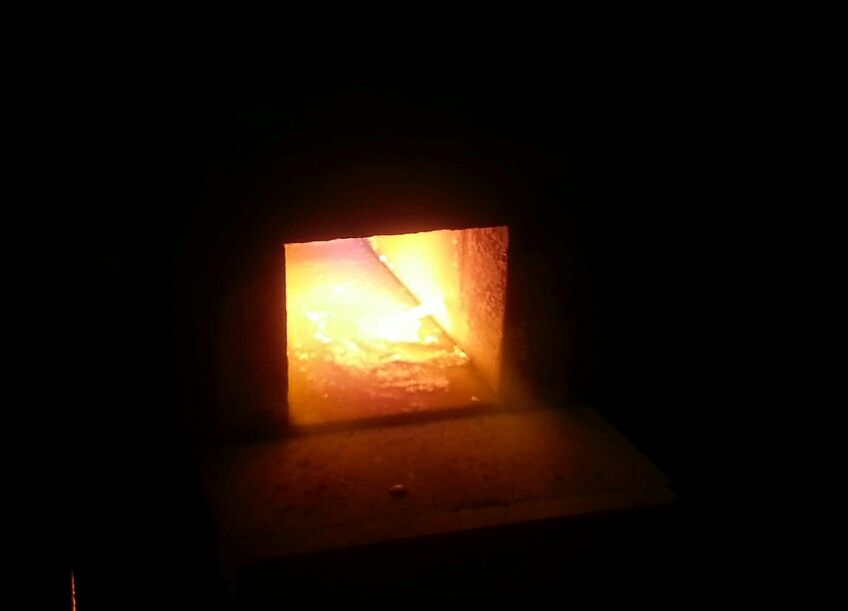
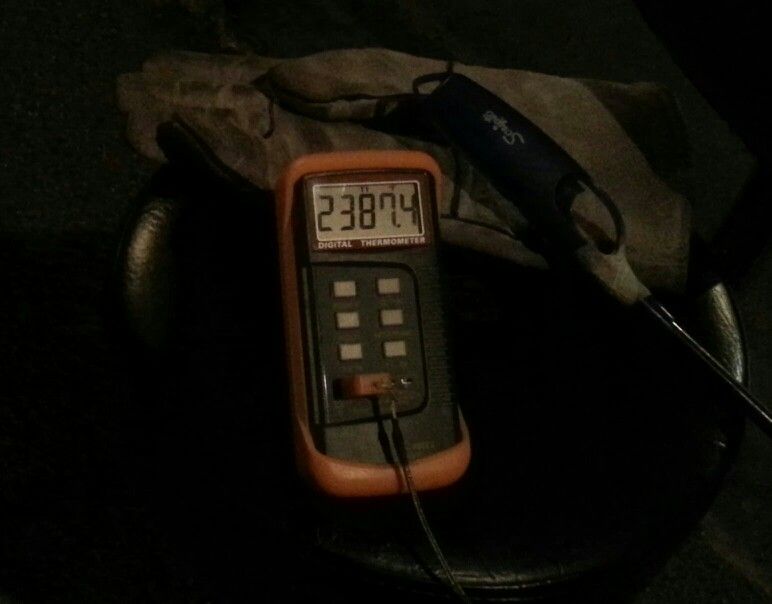
As for how many burners you need. Well, it depends on the type of burner, it's placement in your forge, and the efficiency of your refractory materials. I run a single 1" blown burner in my old forge (terribly inefficient due to design problems) and still easily get to 2400 degrees at about 3psi (gas from a 1/16" orifice) with a nice neutral atmosphere. Forge dimensions are 12.5" deep x 4.5" square. This one is an ITC coated hard firebrick deal, which again, is far from what I would consider efficient. Thermocouple is about 2 inches back in the lower corner of the forge well away from direct flame.
2f2054c38b3fa3d7aa983f33e5970936.jpg

7039bdb05599b4dac28461d81fed82f5.jpg


With a venturi burner I struggled to get to welding heat reliably. It was one of those 'stars aligning' types of things. I could have added a second burner but that seemed terribly wasteful fuel wise. And with propane getting to $5 a lb lately, that just doesn't make sense...

I am not trying to absolutely trash venturi setups, and have used some forges that were tuned very nicely and ran great. They heated up well, retained heat and were fairly fuel efficient. I just know I spent a lot of time reading burner industry publications, buying and building burners, and essentially fighting for every last BTU. When I threw a blower on, especially a variable speed blower, it was absolute bliss. I could dial my atmosphere up and down, and dictate my temps at will.

I am also becoming a big proponent of building your own forge. It isn't terribly difficult to source the parts and build a really efficient forge that meets exactly the needs you have. There are great production forges out there, but they are built to fit a wide variety of circumstances and to be shippable... If you want plug and play, then that's a good route. But... If you are going to be doing katana's and such, you could easily build a nice long two burner/one blower forge from a section of 10" stove-pipe with just some kaowool and refractory coating. Use bricks for the front and rear openings and you're set. With a little searching on here you can find the answers to almost any question you ever had about forge design... Well worth the time and research, plus the sense of satisfaction when it all comes together and runs just right...

I am slowly finishing my new forge which will be my ideal setup. Old Bessie there keeps me going and has plenty of control and heat, but after learning some things from some members here, a lot of trial and error, and researching outside our industry, I realized I could do better than the forge I had. And, FWIW, if your power goes out with a blown burner it shouldn't cause an explosion. Unless it huffs itself out and you are leaving it unattended... Which, a forge should never be left unattended. I can kill the blower on my setup and it just looks like I replaced the burner with a set of fireplace logs...

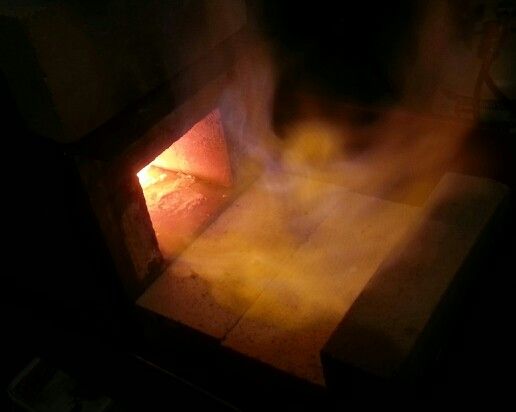
And this photo just because I think it looks cool... I don't run it with the front wide open, these are just for the sake of photography.
ed3f8158dfc8b954507ea2644dd47306.jpg


--OK, now the venturi guys and the guys selling forges can feel free to tell you their side of the story!! I am certainly not meaning to ruffle any feathers or sound like I have it all figured out either. But after a couple of years plugging away at it, I think I am finally making some progress.

Edit - Apparently Stacy and I were typing at the same time again. Dang it...
 
I have a dumb question. I may never make a katana, but I do want to build a forge soon. a katana is 23in or longer I believe it is for it to be considered a katana. how would you heat treat that in a forge smaller than the blade? im guessing just half at a time. I will probably make a small forge, and I may make a blade longer than the forge is why I ask.
 
I have a dumb question. I may never make a katana, but I do want to build a forge soon. a katana is 23in or longer I believe it is for it to be considered a katana. how would you heat treat that in a forge smaller than the blade? im guessing just half at a time. I will probably make a small forge, and I may make a blade longer than the forge is why I ask.

You can either pump the blade in and out of the forge like Stacy was mentioning, or... I made my forge 12.5" deep but with open ends. I can't get a huge area to forge welding heat, but I can add bricks to both ends, use a piece of steel as a muffle, and get that length up to HT temps pretty easily. Would still take a bit of moving the blade around though to make sure it is good and even..

Without getting into the different zones respective to metallurgy that would occur between the halves... simply, you can't HT anything one half at a time...
 
Last edited:
Just a little oddity here probably. But...

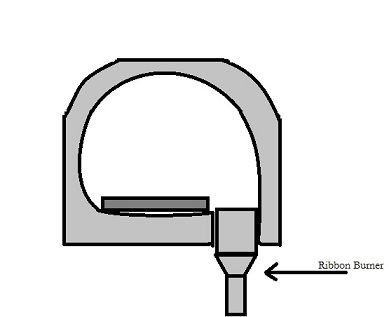
I took the design of my forge in progress from a pic Stacy shared. It was a table forge with a ribbon burner. I am expanding this a bit, and adding a couple of other things like a small idle burner, and the ability to change the volume of the forge. Here is a crude MSPaint drawing. When completely done will be kaowool/satanite/ITC-100 with bubble alumina floor with a blown ribbon burner and a small venturi idle burner. I will also be able to vary the ribbon burner as well as direct the flame to a degree.

ffef7e1ba299c87fd38a55d9491373f2.jpg


Thoughts?
 
Just build your own.
If you continue down the path of making knives, you had just better get accustomed to building most of the things you need.
A knife maker needs to think on his feet and become his own fabricator.
And don't rely on the internet for all your solutions. Use your head!! Think.
Get a welder. Have a stack of steel. A band saw, a chop saw, etc.
If you're always ordering things or trying to get other people to come up with your solutions, you'll never get a knife made.
 
"Pumping" is the rhythmic stroking of a long sword back and forth through the forge. All forges longer than 8-10" should be built with a rear port. You can block it with a fire brick when not needed, but for forging and HT on long work, it is a must.

In "pumping" you bring the forge up to heat and get it regulated so it is holding around the desired temp ( or a tad higher) for 10-15 minutes. You DON'T want it roaring hot. Using long handled tongs, start by pushing the blade in until the end of the tang ( nakagojiri) reaches the center of the chamber, and then draw back out till the tip reaches the center of the chamber. By slowly doing this at an even pace the sword will rise to the target temp. Check regularly with a magnet ( a buddy checking both the tip and the tang with a magnet pick-up wand is a real help here). Once it is non magnetic, heat about 50-75 degrees hotter and quench. It is actually much easier to do than to describe.

One classic reason to make your major tools is ,"If you make it, you can fix it. If you can fix it, you can modify it."
 
Thank you so much for the responses. Yes pumping the blade was the intention for sure. This is why one of my questions was specifically (with pumping in mind <--I didn't know how to word it) on the requirements in length of the forge/burner number. Ultimately it is sounding like the ideal forge would be (for longer blades):

1. Chamber length of 20" with a width of 5" fully lined.
2. Double burner with blower

If I did a 16" chamber would 1 blown burner be enough to heat the chamber effectively to evenly heat a longer blade or would the extra length of blade being exposed to room temp on each pump be enough to cause a loss of heat? Does a blade lose heat that fast?
 
An efficient chamber that size can be heated by a well designed single burner.

With a blown burner, the biggest obstacle is fuel/air mixing. The better it mixes the better it burns. The placement of the burner in the forge is also critical. That said, a chamber that long I would preferrably go with one blower, a manifold, one point of gas injection and two burner tubes... Very easy to do and should reach welding heat in a chamber that size no problem... With a design like that you can also set it up to run one tube at a time if you have a way to reduce chamber size. Great for smaller projects.

Invest in quality refractory coatings. ITC-100 is a little pricey, but you will be amazed at how quickly it comes up to temp and holds it.
 
Hey guys it sure has been while!!! You know the story, research, money, time, time, time, time, more money...learning...etc. Anyway I have finally gotten the forge together. Pictures attached. I have not attempted anything like this so at first I am feeling a little intimidated by this Dragon. I need some help and opinions please.

Forge Description:

-I made this out of a 100 lb propane tank.
-Measurements: 22 inches long with a 10 inch opening
-2 inches of inswool coated in satanite (currently only 1 coat, going to go 2-3 more)
-This burner kit is from hightemptools.com as well as the pressure gauge
-Forge Burner 164cfm from BlacksmithDepot.com
---------------------------------------------------------------------

My first attempt at operating settings were as follow:

Fan Choke open 1/4
Propane pressure 4.5
Needle valve open 1/4

The forge list fine but it felt really flamey? The flame just seems very full and flowing not so much strong.

1.) With those settings in mind what am I doing wrong? Or am I doing anything wrong?
2.) Is my chamber just too big? Is there too much room for it to flow and wonder? I was thinking about adding another inch or two of wool to make my chamber smaller to get more with less out of my burner. Is that the right approach?

When I raise the Air it gets really Breathy out of each side. If I close the back it gets breathy out of the front.

When I upped the fuel via Needle Valve, with this air flow, the forge seemed like there wasn't enough air feeding the flame to burn the fuel efficiently so there seemed to be a build up of fuel while the forge was still and poof,,,big breath out of each end. It scared me a bit so I shut everything off immediately.

Because I am new to this I just wanted to reach out and get any tips or suggestions on dialing in this burner right. I am ok without forge welding. I just want to heat treat for now. I can add or change what I need to later if I get into forge welding.

All in all so far this has been a really awesome learning experience. I am really happy those who reached out to me last year did. It inspired me to really get going!!

20150125_190836.jpeg


20150125_190723.jpeg


20150125_190736.jpeg


20150125_190759.jpeg


20150125_190845.jpeg


20150125_190744.jpeg
 
The thing that strikes me first is that there is no back port. 22" long, wide, and 154CFM feeding it needs some place to go. It is all coming out the front right now.

Tips:
Try a speed control ( light/fan dimmer) on the blower. They usually will allow the blower to be variable. The choke plate works, but requires a bit of finesse.

Set the gas pressure to about 2 or 3 pounds ( just barely enough to make the gas flow). Start by barely cracking the gas valve ( 1/4 open is a lot on some needle valves). Have the fan barely delivering any air. Light the forge. Up the gas a tad, then the air, repeat, etc., until it is purring along with a nice low flame. Let it heat the chamber for about five minutes, then turn it up some more. With some fiddling, it should run just fine.

There will be some amount of dragon's breath. That is the flame coming from the ports. With only one port, it will all come out the front. The Dragon's breath should be neutral to just slightly yellow/orange. If it is bright blue, you have it too lean. A blown burner can make some noise, but you get used to that.
 
If you want to become a sword maker, the forge is only half the problem, you will also need an oven long enough to temper the blade. The oven also needs PID control to get reliable temps. ( A katana will not be able to fit in your kitchen oven ).
 
The thing that strikes me first is that there is no back port. 22" long, wide, and 154CFM feeding it needs some place to go. It is all coming out the front right now.

Tips:
Try a speed control ( light/fan dimmer) on the blower. They usually will allow the blower to be variable. The choke plate works, but requires a bit of finesse.

Set the gas pressure to about 2 or 3 pounds ( just barely enough to make the gas flow). Start by barely cracking the gas valve ( 1/4 open is a lot on some needle valves). Have the fan barely delivering any air. Light the forge. Up the gas a tad, then the air, repeat, etc., until it is purring along with a nice low flame. Let it heat the chamber for about five minutes, then turn it up some more. With some fiddling, it should run just fine.

There will be some amount of dragon's breath. That is the flame coming from the ports. With only one port, it will all come out the front. The Dragon's breath should be neutral to just slightly yellow/orange. If it is bright blue, you have it too lean. A blown burner can make some noise, but you get used to that.

Stacy what do you mean by "backport". Does that mean an opening? Is my opening too big? Both ends are cut of and the back is designed on a slide der to increase and decrease the opening. Is that not good enough?
 
On a forge the size of yours I would normally put a 3X4" front port and a 3X3" back port. The back port is usually level with the floor (front port, too). The floor will normally be a flat surface about 3" wide made from some kiln shelving, bubble alumina, or refractory. When the back port isn't needed, like during HT, it can be blocked off with a few firebricks.

Another thing I see in your forge is what appears to be a very large chamber diameter. That isn't necessarily a bad thing, but it does affect how it functions. You have that much more area to heat. Normally, 6" is plenty enough chamber width for swords.

Perhaps another layer of 1" wool would be a good idea.


Charles,
You would be surprised at how big a sword can be tempered in the kitchen oven. I have put both a katana and a broadsword in at a diagonal with the excess sticking out the top corner of the door. After an hour, I reverse the sword. After another and hour I take out, cool off in water, and repeat the temper.
 
Charles,
You would be surprised at how big a sword can be tempered in the kitchen oven. I have put both a katana and a broadsword in at a diagonal with the excess sticking out the top corner of the door. After an hour, I reverse the sword. After another and hour I take out, cool off in water, and repeat the temper.

Id have no problem doing that but the idea made me laugh a little bit thinking about my wife walking by and getting snagged on the tang end were the peen block goes :D
Of ourse you could just heat it in the forge until water droplets dance off the blade just so :encouragement:
 
Back
Top